TheJournal.ie uses cookies. By continuing to browse this site you are agreeing to our use of cookies. Click here to find out more »
Dublin: 7 °C Thursday 23 May, 2013

1982: Women’s bodies used to sell ‘everything from cars to chocolate bars’

A campaign dedicated to eliminating the degrading treatment of women in advertising wrote to the Taoiseach in 1982 to highlight the ‘continual humiliation’ of women in the media.

Image: Vereshchagin Dmitry via Shutterstock

THE CHAIR OF the Campaign Against Sexual Exploitation (CASE) wrote to the Taoiseach in 1982 to express the group’s opposition to the “degrading treatment of women as sex objects in all forms of the media” in Ireland, newly-released State Papers have revealed.

CASE was affiliated with the Council for the Status of Women, a group set up in 1973 – the year Ireland entered the European Union – with the goal of gaining equality for  women. The year of the Council’s founding was also marked by the removal of the marriage bar, which forbade Irish women to work after marriage, in the mist of agitation for equal pay.

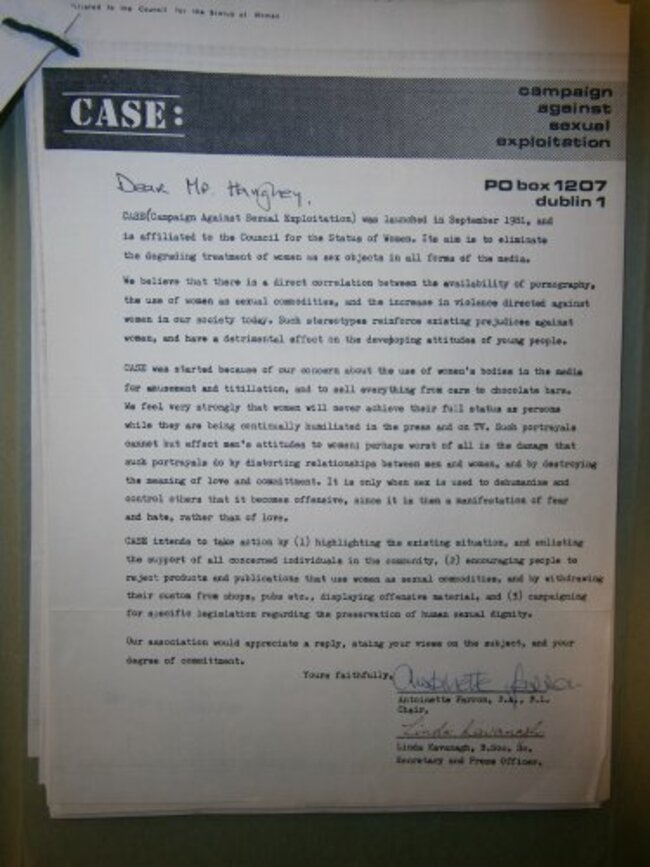
Almost a decade after the founding of the Council, CASE Chair Antoinette Farron wrote to the Taoiseach Charles Haughey to present the association’s views:

CASE was started because of our concern about the use of women’s bodies in the media for amusement and titillation, and to sell everything from cars to chocolate bars. We feel very strongly that women will never achieve their full status as persons while they are being continually humiliated in the press and and TV.
Such portrayals cannot but effect men’s attitudes to women; perhaps worst of all is the damage that such portrayals do by distorting relationships between men and women, and by destroying the meaning of love and commitment. It is only when sex is used to dehumanize and control others that it becomes offensive, since it is a manifestation of fear and hate, rather than of love.

OLYMPUS DIGITAL CAMERA

Advertising Standards

The Advertising Standards Authority of Ireland (ASAI) had been set up a year previously, in 1981, to act as the independent self-regulatory body for the advertising industry.

An internal document from the Department of Trade, Commerce and Tourism related to the letter to the Taoiseach, dated the following month, noted that the principal statutory instrument covering the area of advertising was the Consumer Information Act 1978 – but that the Act was “concerned only with the truthfulness of trade descriptions and advertising rather than its more subjectively perceived aspects. ”

It noted that a European Economic Community (EEC) initiative on misleading and unfair advertising was being discussed in Brussels at that time and that, when finally adopted, the Directive “may go some way towards ensuring that the use of women in advertising does not lead to ‘promotion of discrimination on the grounds of sex, race or religion’.”

The document as highlighted the existence of the newly-established ASAI, saying that obne of the major principles of the body’s Code of Practice was that all advertising should be “legal, decent, honest and truthful”.

It added: “The setting up of this Authority in May, 1981 was regarded as a significant move by the advertising industry towards self-regulation.”

Government response

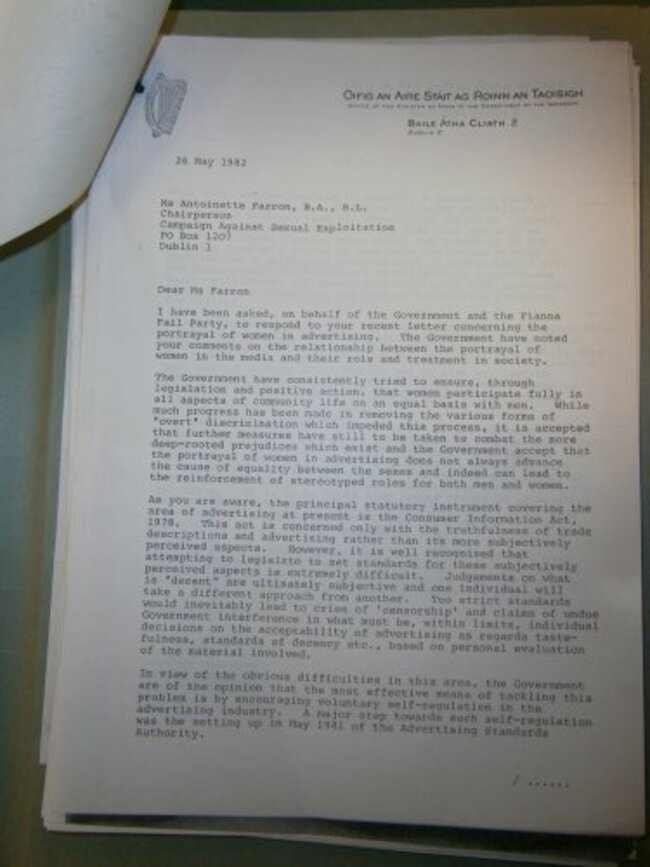
The response to CASE, from Minister of State Bertie Ahern, declared Farron’s letter a “very fine statement on the principles we should apply” and that the government agreed “fully” with the sentiments expressed.

Ahern wrote that the government had tried to ensure, though legislation and positive action, that women were able to participate fully in all aspects of community life on an equal basis with men – but noted that, while much progress had been made regarding various of overt discrimination, measures still had to be taken to “combat the more deep-rooted prejudices that exist”.

OLYMPUS DIGITAL CAMERA

“The Government accept that the portrayal of women in advertising does not always advance the cause of equality between the sexes and indeed can lead to the reinforcement of stereotyped roles for both men and women,” he said.

However, Ahern also noted that judgements on what is ‘decent’ were ultimately subjective and that “too strict standards would inevitably lead to cries of ‘censorship’ and claims of undue Government interference”. As such, he said, the government believed the best means of tackling the problem was by encouraging voluntary self-regulation within the advertising industry – and that the establishment of the ASAI had been a “major step” towards this.

OLYMPUS DIGITAL CAMERA

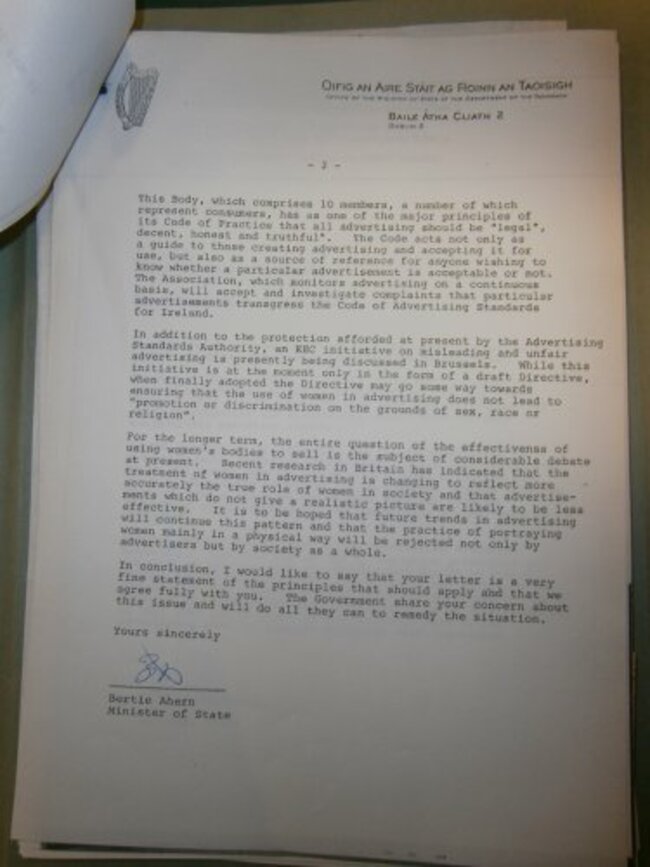
Ahern also commented on the “entire question of the effectiveness of using women’s bodies to sell”, saying that the subject was one of considerable contemporary debate:

Recent research in Britain has indicated that the treatment of women in advertising is changing to reflect more accurately the true role of women in society and that advertisements which do not give a realistic picture are likely t0 be less effective. It is to be hoped that future trends in advertising will continue this pattern and that the practice of portraying women mainly in a physical way will be rejected not only by  advertisers but by society as a whole.

See National Archives, ref number 2012/90/902

Read next:

Comments (33 Comments)

  • Phew….I’m nearly 1982’d out by now

    Reply
  • The culture of objectifying and over sexualisation of women can be considered harmless on an individual level. On each glossy mag, promotion or tv show most would say, ‘what’s the harm’ but on a grand scale the constant barrage of it must be having effects, particularly on the minds and body images of young girls. Films aren’t much better, media is basically telling young girls, being ‘hot’ is the most important thing, seems like a stupid and toxic message to me.

    Reply
    • sad day when to be considered beautiful is considered a bad thing.

      Reply
    • It’s a sad day when young girls being told being beautiful is more important than being educated, compassionate, hard working, courageous etc. Women don’t want to be just ‘beautiful’

      Reply
    • @ Rossa

      I’m all for beautiful women. My girlfriend happens to be one :) I just think a society that says there’s one type of beauty and holds it up as the most important attribute for a girl to possess or obtain is gonna have problems eg Eating disorders, mental health problems among its women etc..

      Don’t get me started on the glorification of mediocrity. I mean there’s something wrong when being a ‘WAG’ or an ‘it girl’ is an aspiration for some.

      Reply
    • very good point john….it has a larger effect on how girls view themselves!

      Reply
    • posted

      Reply
    • Exactly – there’s nothing wrong with admiring a beautiful lady or man. But advertising / glossy magazines etc seem to have a very specific and narrow set of ideals about “beauty”.

      In truth, beauty is about more than being a certain dress size, having a certain “look”, being the right age, having the right hair or in the case of men – being tanned and muscly. Beauty is about much more than that, it comes in all shapes, sizes and colours – but the media does a poor job of reflecting this.
      (Beauty of course goes much further than skin deep, but irrelevant in the context of marketing).

      Then there’s all the photoshopping and “post production enhancements”, that’s simply making the projected image of “beauty” unattainable for anyone – even the model themselves!
      Boots had an ad for their makeup which was real women and without trickery – personally I thought these women looked better, because they looked REAL.

      Reply
    • John, I salute you, you expressed my thoughts very eloquently

      Reply
  • They all have lovely bottoms

    Reply
  • Not a lot has changed as women are still used to sell everything. But there is also a trend of men are dumb and smart girl/ Mum comes along and saves the day as a story line.

    Reply
  • Women are beautiful , this is why they are used to promote stuff . They’re also a feck’n mystery for complaining that we think they are beautiful

    Reply
  • Anyone else scroll through this article hoping to see nice pictures of girls from the 80s?

    Reply
  • They won that battle, didn’t they!

    Reply
  • Maybe CASE should get back on the “case” to prevent the sexual exploitation of ex-Taoisigh being forced to sit in compromising positions in kitchen cupboards to hawk a few newspapers!

    Reply
  • Load of old feminist waffle , its women who volunteer for this ‘degredation’

    Reply
  • Huh? So I must have imagined those adverts for muesli, diet coke and fat free yogurt, to name but a few, with scantily clad, muscle bound men portrayed in a demeaning/provocative manner? Gotchya. When its men it’s what, just a bit of fun but a different story when its women. You can’t have it both ways ladies.
    If this is wrong, its wrong for everyone, those that condem the portrayal of women in the media will often oggle male stars bodies or the Chippendales and fail to see the hypocrisy. You only have to glance through a woman’s magazine to see how men are portrayed, yes I have a wife and daughters.

    Reply
    • I think you may have missed the point. But in reply to your comment, the objectification of men in advertising is just as wrong but not as damaging as it is for women. We have grown up in a patriarchal society where women have had to fight for equality, and we still aren’t there yet. There will always be a hysteresis when it comes to gender bias because women have historically always been the underdog.

      Reply
    • Make me a sammich

      Reply
    • I agree, there’s a pretty narrow portrayal of the ideals for men.
      Mind you – it’s also pretty well known that women go for all sorts of men. Some women go for the George Clooney, some Johnny Depp, Brad Pitt.. And some prefer Sean Connery or Jack Nicholson. Some prefer rock stars, some prefer the guys on Big Bang – whereas women are always supposed to be slim, large busted, long legs. The girls who are closer to normal are portrayed as the “heavier girl” even though they are in no way heavy.
      While the ads for colognes etc with muscly men are equally as degrading and silly – the generally accepted “attractive” women are nearly all slim, tall, and impeccably airbrushed.
      The ideal is a bit more difficult to achieve.

      Reply
    • Colin C 29/12/12 #

      I don’t care about the ‘objectification’ of men or women, whatever that silly term means. But at least young women do not have to put up with constant advertising bombardment to tell them they are stupid and lazy as most advertising featuring men and fathers in particular does. Next time you hear an ad featuring two women chuckling over the idiocy of their other haves, think about how much more damage that message does than including beautiful and generally intelligent and confident women in similar ads.

      Reply
    • Advertising tends to portray stereotypes, it portrays women a certain way to sell products aimed at a male target market and does the same to a female market by portraying men a certain way. And, by and large it, it works or they wouldn’t keep doing it. This can be shown by two Coke products, one, Diet Coke, is aimed at a female target market and it’s advertising portrays a shirtless muscle bound man being ogled by women.

      http://www.youtube.com/watch?v=MpizkWEmg1g

      In another Coke advert for Coke Zero the roles are reversed, the ordinary man gets the girl and a “James Bond” style adventure in the process.

      http://www.youtube.com/watch?v=Q29T-hH7Pqs

      In both adds the “objectification” of sexuality, whether male or female, is the primary theme, both are portrayed in an amusing manner and both use the human body to sell a product. It could be therefore argued that adds like these show the era of objectifying womens bodies alone in advertising is over and there is a certain equality. There is no doubt that women do the exact same thing to men in advertising now. My point is if this is wrong, it has to be wrong for both sexes, not one alone.

      Reply
    • @Shanti I agree with much of what you’ve said but advertisers don’t dictate to society, they tend to reflect what society likes. What one culture or society likes another won’t and advertisers are very clued into this. Today in the West most men tend to like the blonde haired, blue eyed, long legged, big boobed “Pamela Anderson” type, but other cultures may find her repulsive or even insulting. It wasn’t always like this.
      If we look at the paintings of artists like Peter Paul Rubens, who, in the early 17th century painted many nude female figures in what was considered then, the perfect female form, we would consider them now to be as you put it, “heavier girls”.
      Anthropologists tell us that the average human form is changing over time, we’re getting taller … and boobs are getting bigger. Advertisers take advantage of this and portray “artificially enhanced” models or use the infamous airbrush, I’ve even read how over the decades the makers of the doll Barbie have changed its … proportions to reflect what society likes.
      Beauty, the ideal is, as you’ve said, is in the eye of the beholder, it’s entirely subjective, but on average the same people from the same cultures like the same things. The more uniform a face is the more attractive we’ll find it, there’ll always be trends but we can’t help our brains reacting to what they like, and advertisers know this and how to exploit it. Its what they do.

      Reply
  • This report would have been better with some pictures…!

    Reply
  • So being a female model, or an actress, and making living by being in ads is degrading?!

    Reply
  • Advertising has gone full circle in some ways – now it’s men who are portrayed as being the stupid ones in many ads. The feminists have their victory.

    Reply
  • This type of objectification and advertising is directed primarily at men, they are just so stupid, how can seeing a pretty face make you more likely to eat muesli

    Reply
  • Who cares? Really.

    Reply

Add New Comment