Sign in. It’s quick, free and it’s up to you.
An account is an optional way to support the work we do. Find out more.
Sign in. It’s quick, free and it’s up to you.
An account is an optional way to support the work we do. Find out more.
LAST UPDATE | 27 Jun
(Seo alt ónár bhfoireann Gaeltachta. Is féidir an bunleagan as Gaeilge a léamh anseo)
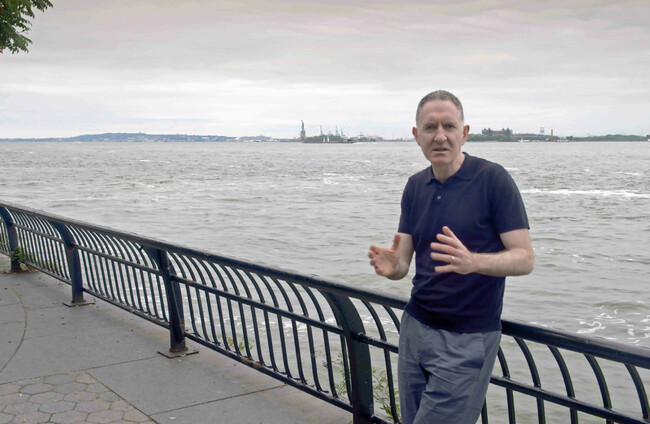
WHILE WELL-KNOWN BROADCASTER Cormac Ó hEadhra was researching a programme on the American Revolution, he discovered that a British officer bearing his own surname surrendered on behalf of Britain to George Washington and his forces after the crucial Battle of Yorktown in 1781, thus ending Britain’s rule in the US.
This was General Charles O’Hara, a namesake rather than a direct relation, who served as senior adjutant to General Cornwallis, and the British military commander was so ashamed that he claimed to be ill on the day he was required to surrender formally. He ordered O’Hara to carry out that duty in his place.
It was while researching for the programme that the RTÉ broadcaster – presenter of the Late Debate and his eponymous Saturday show – discovered the particular connection of the Ó hEadhra family had with that period.
Historian Pádraig Lenihan of the University of Galway, who took part in the documentary, said that General O’Hara was descended from the Ó hEadhra clan of Sligo, and that his father had also been a senior officer in the British Army.
“By the year 1780, O’Hara was a senior officer in the British Army with a great deal of experience,” said Ó hEadhra.
“He was sent to America, but by this stage the British were swimming against the tide in the war.”
The presenter explained that the general had devised a plan to greatly intensify the war against the Americans, having concluded that the British could not win the war, and in a letter he wrote on 1 November 1780, he proposed a “harsh, brutal policy.”
He wrote at the time: “I mean a war of desolation where the object is only to ruin and devastate and not make establishments. This idea is shocking to humanity but however dreadful, it must be undertaken.”
It was not long after that the decisive battle of the revolutionary war took place at Yorktown, where Washington’s forces defeated the British Army. Historians suggest that shame would not allow Lord Cornwallis, the British commander, to carry out the formal surrender himself, and instead he claimed to be unwell. He ordered General O’Hara to carry out that duty, which he did.
This namesake connection prompted Ó hEadhra to say, during the programme:
My ancestors surrendered America, my ancestors made America, so to speak.
There are many other human stories told in this two-part documentary which focuses on the role of the Irish in the creation of the US, and it was this aspect that drew Ó hEadhra to take part in the film, and from which he derived great satisfaction.
“That’s what I enjoyed about it – I love history, but it was the human stories that really captured my attention,” he said.
Fish Creek
Among the stories told in the programme is what happened at Saratoga Springs, on either bank of Fish Creek. An account of it is given by Roger Lamb, a writer from Dublin who served as an officer in the British Army, describing a time when there was a ceasefire between the British Army – which had marched down from Canada – and the Americans, with commanders from both sides talking to one another.
“He saw an English soldier on one side and an American soldier on the other running into the river towards each other, and, to cut a long story short, they were two brothers who had been fighting against each other unknowingly – they hadn’t seen each other in years. Their name was Maguire, from County Cavan,” he said.
“Roger Lamb describes the embrace they gave each other in the river, and how they cried ‘oh brother, my brother’, with soldiers on both sides thinking they were looking at two madmen.”
Many other Irish figures are also described in the programme in terms of their role in the revolution – among them Stephen Moylan of Cork, a member of a wealthy family from the city on the River Lee, who served as a senior advisor to George Washington.
In a letter he wrote in January 1776, he was the first person to use the country’s name as it would come to be known – the United States of America.
The stories are also told of John Dunlap, a Tyrone man from Strabane, who printed the American Declaration of Independence; John Barry of Wexford, who was awarded the title ‘Father of the American Navy’; and Margaret Corbin, the pioneering woman who was among the most inspiring women of the Revolution. Poets in Ireland were composing Irish-language songs at that time, celebrating the outcome of the Revolution.
According to Ó hEadhra, it is not generals and famous figures who achieve freedom on their own, and that “the participation of ordinary people was more important than anything else”.
And this documentary does not shy away from the division now growing in America – a division fuelled by differing perspectives on the principles espoused by figures like Washington and the Irish who fought alongside him, in establishing a society that would be fair and equal.
Among the historians taking part in the programme is Molly Hester, a former lecturer at Harvard University, who says that talk of America celebrating 250 years of its independence brings to the surface feelings about “freedom, human rights and the moral values on which America was founded.”
“We are looking around us and asking ourselves whether the public and the government are demonstrating those same moral values today – the same feelings America began with.
“It’s difficult to say, really, whether the spirit of America and the spirit of the revolution is still fighting for people’s rights, and that is the thing we must grasp and hold in our hearts on America’s Independence Day, the 4th of July.”
Part one of Réabhlóid Mheiriceá – Na Laochra Gael/The US Revolution – the Irish Heroes will air at 9.30pm on 1 July on TG4, with part two airing a week later on 8 July.
The Journal’s Gaeltacht initiative is supported by the Local Democracy Reporting Scheme.

To embed this post, copy the code below on your site










have your say