TheJournal.ie uses cookies. By continuing to browse this site you are agreeing to our use of cookies. Click here to find out more »
Dublin: 11 °C Tuesday 21 May, 2013

Investigations into plane crash which killed instructor and trainee pilot

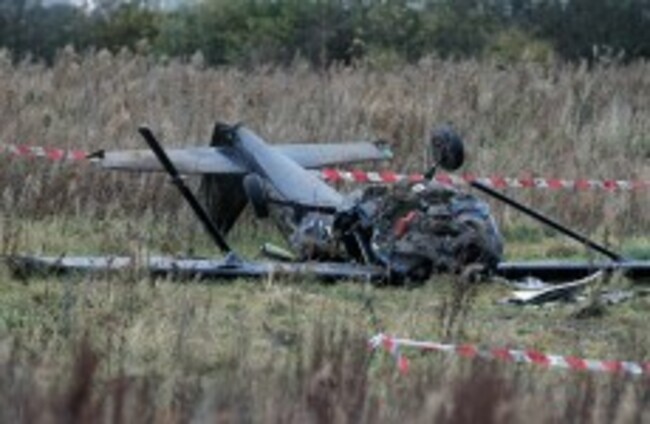
Gardaí and the Air Accident Investigation Unit are probing the crash near Birr which killed two men yesterday evening.

The scene of the crash this morning.
Image: Niall Carson/PA Wire/Press Association Images

TWO INVESTIGATIONS INTO the light aircraft crash which killed two men near Birr in Co Offaly yesterday are under way today.

Both Gardaí and the Department of Transport’s Air Accident Investigation Unit (AAIU) are investigating the circumstances of the crash in which an instructor and a trainee pilot died.

The pair have been named locally as Niall Doherty, the instructor, and his trainee Damien Deegan.

The Irish Aviation Authority (IAA) said this morning that the Air Traffic Control centre at Shannon notified emergency service just before 5pm yesterday when the aircraft – a Cessna 150 - disappeared off the radar.

Investigators from the AAIU were on the scene last night and the IAA said this morning it would co-operate fully with investigations.

Speaking to RTÉ’s Morning Ireland, aviation expert Gerry Bryrne said that “one of many things” could have caused yesterday’s crash but appeared to rule out the possibility that weather played a factor.

He said that visibility in darkness could have been an issue.

Read: Two dead after light aircraft crash in Co Offaly

Read next:

Comments (17 Comments)

  • Very sad news, condolences to the family.

    Reply
  • Have been there lost my brother in a light aircraft Cessna also deepest sympathy to both family’s

    Reply
  • @Paul , Twin engines planes, especially twin props can also be lethal when one engine fails, Google “Vmc” . Besides, we don’t know if it was engine failure.

    Reply
  • @William, I tried to enter this discussion earlier but my post landed in the wrong place. It is simply down to the decision of the individual as to whether they accept the risk or not…………..passengers included. If you ban single engine aircraft you include helicopters which often save lives as opposed to take them. The General Aviation community is made up mostly of Private Pilots that fly these type of aircraft safely and mostly without incident. It’s a very enjoyable hobby/pastime but yes, this this incident is an unfortunate reminder of the fragility of life.

    Reply
  • How dangerous are these single engined planes? There was a very experienced pilot died in the UK recently near Biggleswade.

    Reply
    • How dangerous are single engined cars? People die in them every single day.

      Reply
    • Paul, flippant comment. If your car engine dies you don’t. Furthermore there are thousands of times the number of car journeys daily in comparison to single engine plane journeys. Maybe single engine planes should be banned.

      Reply
    • Because, Paul, cars don’t drop out of the sky when their engines fail.

      Reply
    • If we’re going to ban everything that might possibly kill you, we should probably start by banning getting out of bed in the morning.

      People who fly single-engine planes are aware of the risks involved, the same as people who skydive, or snowboard, or cross the road. If you don’t feel that the risk inherent in flying a single-engined plane is justified, then don’t fly a single-engined plane – but equally, don’t try to prevent me from doing so, should I assess the risk/reward equation differently from you.

      Reply
    • @Rory: planes don’t drop out of the sky when their engines fail either.

      Reply
    • Paul, the guy in Biggleswade was killed as he took off and the engine failed. He hadn’t enough speed to manoeuvre back to the runway and was too high to avoid being killed when the plane hit the ground.

      Your point is 100% invalid because there are many laws where society decides that the risk is not worth it. You’re not allowed make that decision of yours re car safety belts and flying has many regulations to try and keep it safe.

      My point stands that with one engine a plane is at risk if it fails at an importune time.

      Reply
    • And my point remains that every single person who takes off at the controls of a single-engined plane is aware of the risks, and accepts them. As you’ve pointed out, there are regulations that govern the safety of flying, and it’s about as safe as it can usefully get.

      People will die in single-engine plane crashes, just as they will die in twin-engine plane crashes, and 747 plane crashes, and car crashes, and skiing accidents, and falling-down-the-stairs accidents. The same argument that you make for banning Cessna 150s can be used to argue for banning 747s, or motorbikes, or stairs.

      Reply
    • Paul, no the same argument can’t be made. You’re avoiding the issue here. 747′s have 4 engines, cars don’t crash if the engine fails, you’re very unlikely to die in a twin engine plane even if one engine fails, BUT you can die if the engine fails in a single engine plane. In fact even twin engine passenger planes were not allowed to cross the Atlantic until relatively recently when it was proved they were now safe.

      It doesn’t matter that you understand the risks. I’ve already addressed that. Many people understand the risks of not wearing a seat belt but it’s still illegal not to do so. There’s also the risk to your passengers. Your opinion of the risks is not relevant if someone else is killed.

      If you want to argue that single engine planes are very rarely involved in fatal crashes because they have one engine then that’s fine. I don’t know the answer to that but your other arguments are illogical.

      Reply
    • Remember that Air France Airbus 330 that crashed off the coast of Brazil a few years ago? Two engines, neither of which failed. Planes sometimes crash; engine failure isn’t necessarily the most common reason for them to crash, even in single-engined planes. I’m thinking of an incident near Abbeyshrule a few years back where the fuel system failed – you can have twelve engines and you’re still going to be making a forced landing if that happens.

      Sure, if your only engine fails then you’re in bigger trouble than if you had more engines, but that’s an accepted risk – not only by pilots of Cessna 150s, but of F16s as well. Your argument is that pilots should have that decision taken away from them, and that the tens of thousands of single-engined planes in the world should be permanently grounded. That’s exactly analogous to banning motorbikes because the risks of driving them are higher than those of driving a car.

      Your seatbelt analogy is fatally flawed also. Yes, you can be required to wear a seatbelt, because the only cost involved to the driver in being required to do so is minor annoyance if (for some strange reason) he doesn’t want to wear it. By contrast, requiring someone to have two engines on their plane is more than a minor inconvenience to the owners of planes with only one.

      Engine failure is something pilots train for. It’s quite often survivable. It’s just one of many, many things that can go wrong when you’re flying. You assess the risks, you take your chances, sometimes it ends badly – exactly the same as getting into a car.

      Finally, flying a multi-engined plane is much harder than a plane with one, and expecting beginning students to master the complications involved in handling multiple engines before they’ve mastered the basic flight controls is just silly.

      Reply
    • Paul, The Air France crash was an incredibly bad pilot error, he pulled up and instead of diving when he stalled. Not relevant to this discussion. I didn’t say engine failure was the only cause of a crash.

      The seat belt simply contradicts your point re drivers being allowed to take risks. The state decides what risk is acceptable. I’m simply asking should single engine planes be deemed an unnecessary risk. Furthermore there are many very expensive safety features built into modern cars.

      The law doesn’t have to ground all single engine planes, it could simple make it illegal to build them any more.

      Your final paragraph may be true. I don’t know but I doubt it.

      It seems to me that single engine planes are an anachronism.

      BTW F16 pilots have an ejection seat and a parachute.

      I think we’ve trashed this enough.

      Reply
    • My last paragraph may be true, but you doubt it? Bloody hell.

      Tell you what: imagine driving a car with two engines, two gearboxes and two accelerators, as well as duplicate gauges for all the things a pilot needs to know and that modern cars hide from their drivers: oil temperatures and pressures, cylinder head temperatures, manifold pressures, all that fun stuff. And imagine having to learn how to deal with the incredibly challenging handling that results from one of those engines failing, and the car pulling continuously to one side as a result.

      Now tell me that you think it would be better for a learner driver to start out in a car like this instead of a single-engined car.

      I’ll agree with you on one thing: we’ve argued about this enough. I’ll leave you with one final thought: the fatality rate in single-engine aircraft crashes is somewhere around the ten percent mark. Make of that what you will.

      Reply

Add New Comment