TheJournal.ie uses cookies. By continuing to browse this site you are agreeing to our use of cookies. Click here to find out more »
Dublin: 11 °C Thursday 20 June, 2013

Explainer: What did the EU leaders agree overnight in Brussels?

The leaders of the Eurozone countries have agreed to allow bailout funds be used by banks. What’s it all about?

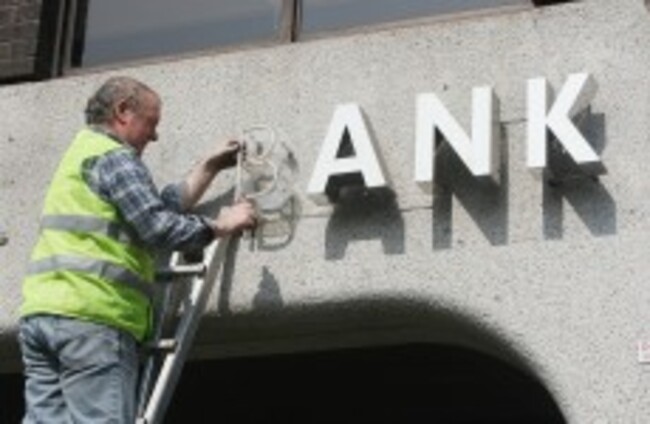
The agreement reached by Eurozone leaders means the arrangement for Anglo Irish Bank's promissory notes could be torn up and replaced.
Image: Niall Carson/PA Archive

THE IRISH GOVERNMENT has hailed what it describes as a “seismic shift” in European economic policy – after the leaders of the Eurozone countries agreed to a deal which hopes to separate banking debts from national ones.

Enda Kenny said that while the nuts and bolts of the deal had yet to be worked out, the deal would mean a vast improvement on the terms of Ireland’s banking debts – while Eamon Gilmore also insisted that any deal for other countries would be applied retroactively to Ireland.

But what’s it all about? What’s the problem with things as they are? What have the leaders actually agreed to? And are there any question marks?

Here we’ve tried to explain the basis of what the leaders have agreed.

A background

Firstly, a quick revisit of the background. Greece became the first Eurozone country to enter a bailout in 2010, with Ireland following in November of that year. Portugal has since followed, while Spain and Cyprus are on the way.

The causes of the difficulties in each country are not all the same, however. While Greece and Portugal were forced into bailouts largely because of difficulties in government funding, in Ireland and Spain’s case the problem relates to the banks.

In 2008 the Irish government had agreed to guarantee the entire liabilities of the banking sector, hoping to soothe the nerves of investors who felt the banks might not have the means to meet their liabilities as they fell due.

While by all accounts the government believed its guarantee would never be called in (Brian Lenihan memorably called it the “cheapest bailout in the world”), over time the government was called upon to bail out most of the country’s banks.

The end result is that Ireland had to put so much money into its banks that investors – on top of its difficulties balancing its own budget – then began to wonder whether the Irish government itself was creditworthy enough to merit being lent to.

Eventually they started charging Ireland so much money that it simply became unaffordable – sending Ireland into the arms of the EU and the IMF for its money.

What they agreed

Spain has recently found itself heading in a similar path – with its banks looking like they would need the government’s help to ensure they survived any significant round of mortgage defaults.

The size of Spain’s problems, however, meant Europe needed to take another look at its system – because while Ireland’s bailout came to €67.5 billion, with that money also funding the government as well as the banks, Spain suggested it might need a whopping €100 billion for its banks alone.

In Spain’s case, because the bailout was not directly funding the government itself, questions arose as to whether the bailout money would be given directly to the banks, or be sent through the government – adding the money to the national debt.

Ultimately – apparently at the insistence of Germany – it was decided that the money would go directly to the Spanish government, which in turn would then give the money to its banks.

This was received pretty badly though – with the cost of borrowing for the Spanish government shooting up, as investors suspected the same fate could befall Spain as had already happened to Ireland.

In a single sentence, this is what the Eurozone leaders have agreed to change: when Spain’s banks will be receiving bailout funds, the money will go directly from the new bailout fund – the European Stability Mechanism – being established in two weeks’ time.

In a significant move, the Eurozone heads of government specifically agreed to examine how this principle would be applied in Ireland’s case – splitting, as far as is practicable, the link between the government and the banks.

The mechanics of how this will be done will be considered by the Eurozone finance ministers when they next meet.

1b52067a-5abb-4753-aac5-e2428b5cc08a

Pros and cons

Assuming the same principle applies to Ireland as will apply to Spain, and the banks will get their recapitalisation funds from the ESM, there are a few question marks that still remain.

Firstly, it should be noted that most of the money needed by the Irish banking sector has already been put in by the government – there isn’t (touch wood) any need for further cash, and the banks have already been recapitalised to the extent they need, with the end result being that the government owns a majority in every Irish bank except for Bank of Ireland, where its stake is around 15 per cent.

Though the government’s long-term plan is to sell the banks again, it hasn’t arranged any sort of mechanism where it would automatically be repaid the money it’s put in so far. In other words, once the money is put in, it’s gone – and can only be recovered if the bank is sold off altogether.

The question therefore arises about whether any mechanism allowing the ESM to recapitalise the banks could allow Ireland to back out of this. That is: would the likes of AIB be able to give its money back to the government, reducing the government’s ownership, if it was able to substitute this money with money it borrows from the ESM?

That’s a major question – because if the answer turns out to be Yes, Ireland will be able to recoup tens of billions that it’s used to recapitalise the banking sector.

A tangible effect

A more certain prospect is what the Taoiseach calls a ‘re-engineering’ of the deal on the promissory notes held by Anglo Irish Bank, or rather the Irish Bank Resolution Corporation as it’s now officially known.

In that case, the money hasn’t all been handed over yet – with the government making the infamous annual repayment of €3.06 billion at the end of every March instead, something it’ll probably be doing for the next 16 years or so.

If this could be financed by the ESM, the Irish government would no longer have to make these massive annual cash payments – but that’s not to say that it gets off entirely. Don’t forget: the Irish government still owns 100 per cent of Anglo.

If Anglo is able to borrow from the ESM to repay the Central Bank for the cash it got using its promissory notes, it’ll still ultimately be up to the government to make sure that money is repaid.

The advantage, however, is that replacing one loan with another presents the possibility to totally renegotiate the timetable for repaying this back – reducing the overall cash burden on the government, and freeing up money to be used in other ways.

Read: Taoiseach: Irish debt burden on the tax-payer to be ‘re-engineered’

More: Gilmore says new eurozone deal is a ‘game-changer’ for Ireland

  • Share on Facebook
  • Email this article
  •  

Read next:

Comments (40 Comments)

  • Thanks for that Gavan.

    Reply
  • If the. Government can recoup 10s of billions from the banks does this mean that it can invest this money in infrastructure and get the domestic economy growing again?nBecause if this is so its great news!n

    Reply
  • Can I ask a dumb question?

    This new deal in Europe. I see how it helps Spain – there are private banks there that need bailing out. The state don’t want to take on the debt that is necessary to recapitalise them so they have successfully gotten the ESM/EFSF to do it instead. Great for Spain.

    This arrangement will now retrospectively apply for us – so the promissory note will be torn up and Anglo etc will be refinanced from the ESM rather than via money our Central Bank printed and were going to recoup and tear up over the next 20 years.

    Here’s my question. As we own Anglo and AIB how does this really change things for us?Ultimately the state still owes all the money – for Spain it means that the banks remain prviate and are being directly funded by Europe. For us they’re still just another arm of the state so regardless of how they get their funding, it’s still owed by us as a country.

    We will have to agree with Europe to remove the bank guarantee and leave ESM on the hook for the debts or “sell” Anglo and AIB to ESM for it to be of any benefit I would have thought? Or am I missing the point?

    Reply
    • Good question. Realistically the advantage is that it provides an opportunity for a blank canvas in terms of when we have to make our repayments. The annual €3.06bn repayment for the promissory notes could be replaced with something more more manageable, with smaller repayments spread over a far longer time.

      While the government (as the owner) is still on the hook, the fact that the banks themselves would owe the money means that it could also be easier to spin those banks off and sell them back into private hands. Nobody would buy AIB if they were taking on an institution that was still tied at the limb to the Irish government in terms of money flowing in and out, but they might buy it if it’s dealing with a direct European authority which, to all intents, would be acting no differently than a central bank.

      Reply
    • So it’s as I thought. For now this is just a balance sheet/accounting change from an Irish perspective. Cue the next epic topic of discussion for the next 18 months. Can we get ESM to take on the banking debt?The answer to that is likely to be dependent on how much trouble Spain and Italy (and Greece) are in this time next year. The more trouble they’re in, the better off we are unfortunately.

      Reply
    • There is no such thing as a dumb / stupid question. However there are plenty of stupid / ludicrous answers.
      (Not referring to the answers to your question)

      It is astonishing how often the essential fundamental obvious necessary question is not asked

      Reply
  • I find it rather galling that this was only considered when Spain needed a bailout. It seems a much more logical way of using bailout funds. Were we not important enough for this kind of consideration 2 years ago?

    Reply
    • Unfortunately, Chan, a collapse of Spain’s banking system would have a far greater effect on the stability of the Euro than what has happened in Ireland. Also worth noting that the approach to bank financing in Europe and the priority for growth has undergone a sea-change since the election of Francois Hollande in France. It’s not an increasingly irrelevant Britain that the Taoiseach should be looking to, but France.

      Reply
    • Obviously not. Just shows what our European “partners” actually think of us: expendable paddies.

      Reply
    • Yea Desmond, obviously Spains problems would have had a greater knock on. Its not about that though, its about what is the best way to distribute bank bailout funds, regardless of how big or small the bailout? I mean, that question should be asked at the start of any negotiations and the answer should be the same for everyone.

      Even if a deal is somehow worked out to apply this retroactively to all the money we put into the banks, a significant amount of damage has already been done(in terms of cost of borrowing, subsequent budgets since the bailout etc.) because this wasnt considered for us 2 years ago.

      Reply
    • Ah Cmon Stephen, when are you going to realise that most of these countries have cities have the population of Ireland?
      Why should they bother changing everything to suit a small population?
      You dont have to like it, but there it is

      Reply
    • They didn’t do it this way for Ireland because the government decided to pay it with our money.

      Reply
  • Nice to see some leaders standing up for their national interests. Kudos all round to Spain and Italy and France.

    Reply
  • Thank you Spain. Thank you Italy. This deal goes to show what can happen when leaders take their courage in their hands and say “enough is enough”. While Enda & Eamonn will try to claim credit for this “coup” we know it only came about because Spain & Italy held firm, or as the media called it last night “held the summit to ransom” on this issue.

    It would be great if we had Leaders with such courage.

    Reply
  • It’s a very interesting move anyway. If we can get the money back out of the banks and shift their debt into the ESM we’ll be doing well.

    Essentially we’ll be letting the banks from the different countries dip into the ESM and the liability will be spread throughout the EU, as opposed to just on the back of the taxpayers in individual countries.

    Given our maximum exposure to the ESM as taxpayers is €11bn in the case it gets fully used we as a country have the potential to benefit hugely from this.

    Seems to be good news overall. I’m not a fan I all this propping up of private companies but if it’s going to happen, as Europe seems to want it to, then at least the burden will be shared and weighted on the various countries in a much more fair and inclusive way.

    Good stuff.

    Reply
  • After listening to our minister for finance, I dont get the feeling we should celebrate just yet, seemingly the deal is a great breakthrough for the Country LONG TERM, we are still facing a woeful budget….

    Reply
  • Thank you Gavan, that was needed!

    Reply
  • Yeah, this is still bull.

    The money printed out of thin air is still lent to us at interest. Since we cannot print our own money, the interest will never be paid off, as it wont exist in the first place.

    This isnt a deal as the tax payer is still “on the hook” nonsense.

    Fiscal union, the rothschilds win and conquer europe without dropping a bomb or firing a single bullet.
    Everything else is just baseless rhetoric and goal posts that constantly move.

    As Mayer Amschel Rothschild said:
    “Give me control over a nation’s currency and I don’t care who makes the laws.”

    Reply
  • So basically we (the increasingly rare Irish taxpayers) are still on the hook for the cash beacuse we didn’t get “the Spanish deal” at the time! We might be able to restructure the loans though. This is a bit of a step forward but really nothing significant. We still have to pay it all back. There is nothing equitable about this kind of deal. If we originally got the same deal as Spain then the state would not have recapitalized the banks and we would not have the sovereign debt. Based on your analysis here Ireland will be further punished (as compared to Spain) for having being good Europeans and doing what we were told to do by the European powers.

    It should be possible (and the only fair deal) to put us in roughly the situation we would be in now if we had received “the Spanish deal” at the time of the guarantee. Let’s not confuse actual sovereign debt incurred to run the country with that incurred bailing out the banks. Of course the former is our debt.

    Reply
  • Ireland amounts to nothing more in the overall Euro Zone economic outlook than an offshore nuclear testing atoll or a kind of test lab located way down the corridor from the office where the experiments are devised. When the rot was getting out of hand in the more important bigger economies then something was done. If there is anything we can learn from this it’s that the Euro Zone/EU is not a community of equals, it’s a community where the forces of market economics outweigh the niceties and well meaning policies of post war integration and smaller countries isolated by location and economy of scale are reduced to sycophantic, begging bowl approaches answered only in the interest of keeping the experimental lab rat living to complete the observations and devise the next strategy and approach. The new deal fits hand in glove for Italy, Spain but the Irish landscape littered with the fall out of the disastrous bank guarantee/bailout and the toxic combination of the NTMA/NAMA where the citizen of the state is lumbered with the results of the corruption and mismanagement of our banking, political, and corporate management structures.

    Reply
    • …is completely another story.

      Reply
    • Could not agree wit you more. I find it hugely worrying that people are willing to accept that this change in policy is only possible because of the economic size of Italy and Spain. What started off as a group of countries looking to trade on equal terms has become a conglomerate of the four larger economies and the rest are just tagging along. What happened to solidarity and equal partnership? I expect that I should be treated as equal to my counterpart in Berlin as to my fellow European in Athens, but no, this has just proved that in Europe all are equal but some are more equal than others.
      With regard to it being necessary for the bank to return our money-pigs will fly that day or I shall eat my hat.

      Reply
  • 16 years? Jaysus.

    Reply
  • Still a bankrupt slave.

    Reply
  • All smoke and mirrors in my opinion. The money is still only going to be printed for the purpose of band bank debts. And someone is still going to have to pay it back somewhere. These same banks will be useless unless they have huge debt write offs applied to them. Cue the Irish tax payer. Why do I get the feeling that the money we’ve (the taxpayers) poured into the banks will be the money written off. We, the people, will have been relieved of tens of billions for nothing only corporate profit. So in essence money will be printed to make bankers wealthy again just after the public coffers have been emptied and still not one banker has been held to account. Remember people, banks, unlike every other private enterprise, never go bust. Some scam if you can get away with it.

    Reply
  • To me nothing has changed. The debts/loans have been extended over a longer timeframe so our children and grandchildren will be repaying these debts in 50 years time. Clearly Germany and Merkel (eyeing her re-election in 2014) have won out. No money will be printed to wipe out debts. I saw a headline that a stimulus package has been agreed. This is needed but again it is more long term debt. A 2 year credit union loan has been extended to 10 years.

    Reply
  • i dunno is allowing private banks access to public funds ever a good idea. i no its not the case in ireland as theyre mosts nationalised or part nationalised, but a lot in europe aren’t

    Reply
  • what about the 10 bilion is it we have to contribute to bailout fund

    Reply

Add New Comment