TheJournal.ie uses cookies. By continuing to browse this site you are agreeing to our use of cookies. Click here to find out more »
Dublin: 6 °C Friday 24 May, 2013

Oireachtas committee to visit Leitrim to discuss fracking

Initial investigations suggest there could be a major gas reserve in the north-west of the country – but the possible use of fracking to extract the gas is highly controversial.

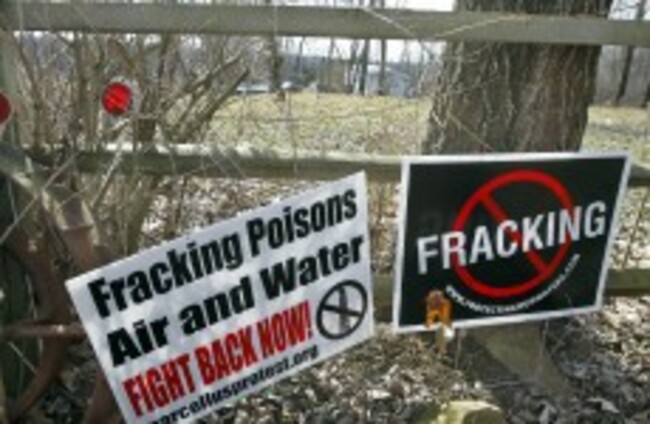
Image: AP Photo/Keith Srakocic/File

THE OIREACHTAS COMMITTEE on Transport is to visit North Leitrim to talk to people in the area about their opinions on fracking.

The 21-member cross-party committee is investigating the possible environmental implications of allowing fracking to be used in Ireland.

Fine Gael TD Tom Hayes said the committee wants to talk to people who live in the area where fracking could potentially take place to gauge the level of opposition or support.

Initial investigations in the north-west of the country have suggested that there could be a major gas reserve in north-west Ireland. However the use of fracking to extract the gas remains controversial. A number of countries, including France and Bulgaria,  have already moved to ban fracking or introduce tight restrictions around it.

“The debate is particularly charged in the northwest of the country, where areas of Leitrim and Fermanagh are being assessed for their suitability for fracking,” said Hayes.

“We heard that any development might significantly impact on farming and tourism in the northwest, and pose a risk to groundwater supplies”.

Minister for Communications, Energy and Natural Resources Pat Rabbittee has said that the government will not award any licences for fracking until the Environmental Protection Agency finishes its research, which was commissioned following concerns raised by residents in the northwest and southwest of the country.

Initial investigations in the north-west of the country have suggested that there could be a major gas reserve in north-west Ireland.

The company which has a licence for the area has said that the gas could be a major boost for the economy, bringing hundreds of jobs and a supply of gas for years to come.

However local politicians, environmentalists and residents have urged caution over the controversial technique and a number of county councils in the area have already moved to ban fracking in their areas.

Fracking is a technique of extracting gas from pockets in underground work by pumping water and chemicals underground at high pressures to break the rocks and release the natural gas.

Read: EPA fracking study reveals potential impact on groundwater and earthquakes >

Video: What the frack? Music video explains what fracking is all about >

Read next:

Comments (34 Comments)

  • A case of the blind leading the blind , there would be far more sense in getting the full information on fracking , the pros and cons , there’s plenty of info from New York and other US states who have debated the issue extensively , inform the public and then send a committee to find out the opinions , there is little doubt people are not fully aware or informed enough about fracking to be in a position to have anything other than a half informed talking shop at at the moment. Arse about face,

    Reply
  • Why would the Oireachtas Transport Committee visit Leitrim to gauge the public’s views regarding fracking? The Environment Committee or Energy Committee I would understand but Transport???

    Reply
  • About the only thing we have going for us is our most famous natural resource – unspoilt landscapes, clean air and waterways. Unfortunately our gov won’t think twice about jeopardising what we have to make a quick buck. There is no return from fracking. Miniature earthquakes,
    Toxic sludge pits, (more) toxic chemicals in your water, air pollution.
    NO TO FRACKING

    Reply
    • EMD 13/10/12 #

      our what? Are you living in a different Ireland or what? Our country is already an environmental disaster zone with fracking just adding to that.

      Reply
    • From a purely financial point of view there is more long term gain from Tourism, fishing etc. than the short term, alleged, gain from fracking. Tourism in the North west provides more sustainable jobs than fracking ever would

      Reply
  • The press are missing the big statement by EPA in that committee hearing.

    The EPA will not oversee exploration of Shale Gas. In fact it was very unclear as to who would oversee and regulate Shale gas exploration.

    Reply
  • Well said, Tom White. We have all the science on our side to ban fracking. The general public still seems oblivious to that though. Just a reminder – bans or moratoria in half of Europe – France, Bulgaria, Romania, the Czech Republic, Austria, parts of Germany, the Netherlands, Spain, full ban in Vermont in the US, moratoria in New York and New Jersey, ban on the way in Québec. Now they ALL couldn’t be wrong, could they?

    Reply
  • Oireachtas committee to visit Leitrimto discuss fracking… more like Oirechtas committee sent by Tamboran resources to convince people its ok to frack up your county.

    Reply
  • its too dangerous leave it there till a New method of extraction is discovered seen a documentary a while ago about fracking in America countless towns and villages left with poisonous water, farm animals dying people getting sick. one bloke in it was able to turn on his tap hold a lighter to the water and it would go up in a flame we would be mad not to ban this.

    Reply
  • In the New York Post, Phelim McAleer – co-producer/director of the forthcoming Frack Nation – relates the amusing story of how Matt Damon and co were driven to increasingly desperate measures to make their Promised Land movie look vaguely credible.

    I broke the news that “Promised Land” was about fracking and now I can reveal that the script’s seen some very hasty rewriting because of real-world evidence that anti-fracking activists may be the true villains.

    In courtroom after courtroom, it has been proved that anti-fracking activists have been guilty of fraud or misrepresentation.

    There was Dimock, Pa. — the likely inspiration for “Promised Land,” which is also set in Pennsylvania. Dimock featured in countless news reports, with Hollywood celebrities even bringing water to 11 families who claimed fracking had destroyed their water and their lives.

    But while “Promised Land” was in production, the story of Dimock collapsed. The state investigated and its scientists found nothing wrong. So the 11 families insisted EPA scientists investigate. They did — and much to the dismay of the environmental movement found the water was not contaminated.

    There was Wolf Eagle Environmental Engineers in Texas, a group that produced a frightening video of a flaming house water pipe and claimed a gas company had polluted the water. But a judge just found that the tape was an outright fraud — Wolf Eagle connected the house gas pipe to a hose and lit the water.

    Other “pollution” cases collapsed in Wyoming and Colorado. Even Josh Fox, who with his Oscar-nominated documentary “Gasland” first raised concerns about flammable water, has had to admit he withheld evidence that fracking was not responsible.

    BTW, Gazprom is a major contributor to the anti-fracking “movement,” Curious.

    Reply
    • Ah well.. phelim mc aleer Mrs said that locals should decide these things in her latest steamboat speech so there’s going to be no fracking in fermanagh and Leitrim.

      Didn’t Adu Dhabi and one of the major gas co.s reveal lately they were going to export lng from US. So that’s us gas producers in cohorts with OPEC too..

      I believe the judge in the wolf eagle trial has a few other problems of his own relating to some election leaflets.

      See above for dimmock and pavilion latest.

      Turns out even the co2 emissions drop in US was more likely due to renewables and recession than gas.

      And then there’s the fact that 85percent of Texas oil and gas wells weren’t inspected last year.

      And the multi billion pound impairment charges ..a.d SE subpoenas..Chesapeake having to refinance at 10% when bernanke is throwing money out for free. its such good business that drilling for gas has collapsed.

      Reply
    • It Is clear that the Anti Frackers are doing more harm to their own cause that anybody else, they are loud and brash,( a empty bottle makes most noise ) but they are not the voice of the locals…..How can we take them seriously ? We needs jobs and investment in this country, we need our industry to be more competitive… in the real world we need to exploit the natural Gas below our feet.. the sandal wearing, vegetarian “anti” group have no interest in the economic benefit that the gas industry could bring to our country . most will never work…
      All of the locals want clean air and water , But they also want jobs for their children, wages and salaries spent in the area benefit everybody.
      We must proceed with caution , but we must proceed.

      Reply
    • Lets Frack.. care to reveal your name. I’m local. The petitions that went round this area came back over 90 percent wanting a ban against Fracking. You say you want jobs, but for example there are 900 jobs at risk in Angling industry in Fermanagh alone where this industry is set to take place.
      Then there’s the public health studies that are only starting – its a bit hard to do a public health study in the US, when the companies refuse to tell you what’s in the chemicals- so its up to the fracking industry to come clean first and get their act together. From what we do know things aren’t looking very good – eg the formaldehyde levels from one gas well flare are 3-4 times permitted levels even at a distance of 16Kms (10 miles away).
      The big issue is that Shale gas is not competitive. Using USGS figures for well recovery rates and using recent European reports then its doubtful that Tamboran can produce gas at anything less than $18-25 dollars/mcf breakeven .. allow a 25 percent margin so that the country and Tamboran get something out of it and you’re looking at 22-30 dollars/mcf range for Lough Allen gas. At those price points renewables are as profitable. The Shale industry is losing 10bn dollars/quarter in the US.
      Tell me how an industry which is losing 40bn dollars/year, despite having benefits of lax or no regulation, skilled workforce, financial incentives, ready built infrastructure, willing land leasers, and extensive geological knowledge on their Shales is of use to the Irish economy in general or the Leitrim/Fermanagh one in particular. Currently you as a taxpayer are paying for the ghost estates in NAMA that abound in Leitrim.. That’s bad enough but imagine having to rescue a ‘ghost’ shale industry that goes bust midway through its cycle.

      As for the vegetarian sandal wearing unemployed comments, you show your true colours, and you hide behind a non de plume. Its one thing to want to have jobs for ones sons and daughters (not too sure there’s that many jobs for women in this industry), but I think I’d prefer not to poison my children’s air and water and the local food and drink products.

      Show me some peer reviewed studies on the jobs front, and argue the economic case (btw the briefing paper to the Northern Ireland assembly was pretty dismissive of Tamboran’s figures). Perhaps you should take a closer look at Tamboran’s well model — the one that says the gas will flow for 28 years ? The society of Petroleum Engineers would be a good place to start on that as even they caution against the modelling approach Tamboran is taking. Barnett shale wells have an average economic life of 7 years. And what Tamboran propose hasn’t been done anywhere in the world.

      So no – WE MUST NOT PROCEED. The precautionary principle MUST be applied. Full public health impact studies must be completed. Currently the Irish government is being fined 30K euros a day for the septic tanks issue. How big do you think the fines are going to be for Shale Gas ?

      Reply
  • NO TO FRACKING, IN THE WHOLE OF IRELAND

    Reply
  • No frigging fracking!!

    Reply
  • Water, water everywhere and ne’r a drop to drink.

    Reply
  • sadly it is going to go ahead regardless of what anyone thinks I’m just happy the money is going to stay in Ireland and between this and oil off the west coast we will be out of recession and back on top….oh wait we don’t keep the money here forgot we were sold out

    Reply
    • It is unlikely much money will be kept in the country.
      Also, the jobs created would have to go to those with the skills and experience to frack. Irish people do not have these skills.

      Reply
  • More licencing.

    Reply
  • Hello and much love to all who oppose fracking. I worry about all our Sacred Springs in Ireland if our present government allow fracking to go ahead. My family and i and many of our friends have been using our Wells and Springs for generations to “draw” water for our homes, for drinking and cooking. In the Springs that have not been effected by dumping, bad farming practices and Chernobyl, the water is a pure, clean and a vital source of life for many thousands of people in this country. Fracking will POISON these Springs and render them useless for many generations to come, if not for all time. The Druids and then the Irish Saints used these Springs to heal and envibe people for thousands of years, so its high time the government, elected by the people started to listen to and stand up for the people of this fair Island and fight to preserve what is good and sacred instead of subscribing to greed and in the process destroying our lush green land and rendering it uninhabitable for our future generations. Please help to SAVE OUR SPRINGS. Very concerned citizen…………….

    Reply
  • tell them to frack off theres enough mutants in leitrim without poisoning there water aswell

    Reply
  • NIMBY even if it created a few jobs

    Reply
  • Anyone who has based their opinion on fracking on the gaslands propoganda film is an idiot.

    Fracking is a safe process that wont result in flaming tap water . Anyone opposing fracking seems to have 0 background in engineering or the petrochems industries.

    Reply
    • SMcB 13/10/12 #

      Clearly safe given that Fracking is banned in France….

      Reply
    • Yes , because the laws frances government make up constitute scientific fact….

      Reply
    • Oh well just as well the recent USGS report in pavilion agrees with the epa scientists and supports the view that fracking contaminated the water there. Then there’s the problematic scientific fact that dimmock water is polluted with thermogenic Marcellus Shale gas. And the professor peter styles UK govt advisor has stated that the lough Allen basin shouldn’t be fracked because there’s an aquifer below the Shale and its too shallow.

      Reply
  • Cylon 13/10/12 #

    Fracking toasters

    Reply
  • Many new reports coming out at the moment that give some balance to the hysteria and scare mongering we hear from the ” Anti frackers” a new report has been published in NZ, and the British reports all available on line.

    We are not going to burn in our beds, our animals are not going to die , the gas wells will not explode, and our houses will not fall down..clearer heads will make the decisions. we will have a natural gas industry and life will go on

    Royal Society of London
    Shale gas extraction in the UK: a review of hydraulic fracturing
    The health, safety and environmental risks associated with hydraulic fracturing
    (often termed ‘fracking’) as a means to extract shale gas can be managed
    effectively in the UK as long as operational best practices are implemented and
    enforced through regulation. Hydraulic fracturing is an established technology that
    has been used in the oil and gas industries for many decades. The UK has 60 years’
    experience of regulating onshore and offshore oil and gas industries.
    Concerns have been raised about the risk of fractures propagating from shale
    formations to reach overlying aquifers. The available evidence indicates that this
    risk is very low provided that shale gas extraction takes place at depths of many
    hundreds of metres or several kilometres. Geological mechanisms constrain the
    distances that fractures may propagate vertically. Even if communication with
    overlying aquifers were possible, suitable pressure conditions would still be
    necessary for contaminants to flow through fractures. More likely causes of possible
    environmental contamination include faulty wells, and leaks and spills associated
    with surface operations. Neither cause is unique to shale gas. Both are common to
    all oil and gas wells and extractive activities.
    Ensuring well integrity must remain the highest priority to prevent contamination.
    The probability of well failure is low for a single well if it is designed, constructed
    and abandoned according to best practice. The UK’s well examination scheme
    was set up so that the design of offshore wells could be reviewed by independent,
    specialist experts. This scheme must be made fit for purpose for onshore activities.
    Effects of unforeseen leaks or spills can be mitigated by proper site construction
    and impermeable lining. Disclosure of the constituents of fracturing fluid is already
    mandatory in the UK. Ensuring, where possible, that chemical additives are nonhazardous
    would help to mitigate the impact of any leak or spill.
    Concerns have also been raised about seismicity induced by hydraulic fracturing.
    Natural seismicity in the UK is low by world standards. On average, the UK
    experiences seismicity of magnitude 5 ML (felt by everyone nearby) every twenty
    years, andof magnitude 4 ML (felt by many people) every three to four years. The
    UK has lived with seismicity induced by coal mining activities or the settlement
    of abandoned mines for a long time. British Geological Survey records indicate
    that coal mining-related seismicity is generally of smaller magnitude than natural
    seismicity and no larger than 4 ML. Seismicity induced by hydraulic fracturing is
    likely to be of even smaller magnitude. There is an emerging consensus that the
    magnitude of seismicity induced by hydraulic fracturing would be no greater than
    3 ML (felt by few people and resulting in negligible, if any, surface impacts). Recent
    seismicity induced by hydraulic fracturing in the UK was of magnitude 2.3 ML and
    1.5 ML (unlikely to be felt by anyone). The risk of seismicity induced by hydraulic
    fracturing can be reduced by traffic light monitoring systems that use real-time
    seismic monitoring so that operators can respond promptly.

    Reply

Add New Comment