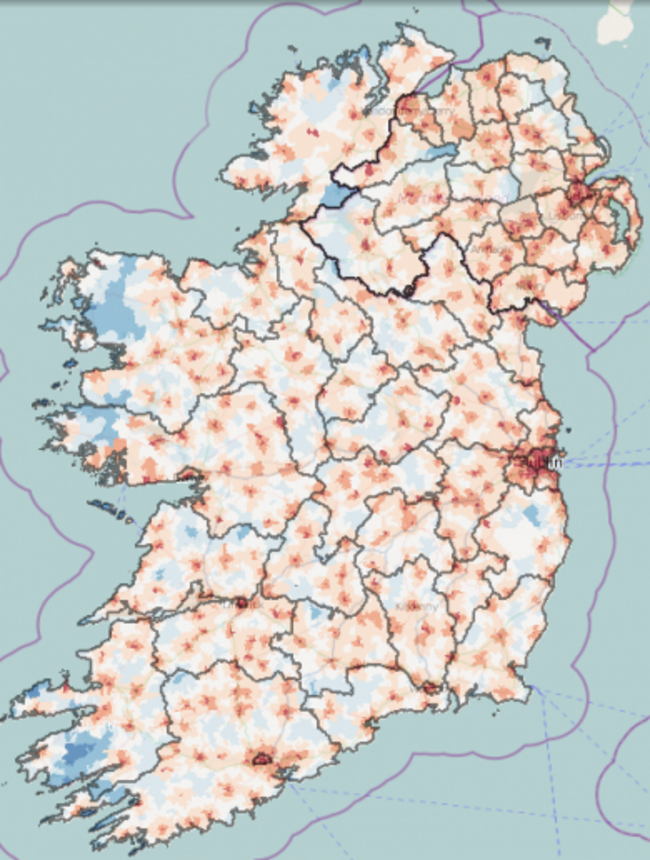
A RESEARCH OBSERVATORY based at NUI Maynooth have unveiled a new online mapping tool that aims to show exactly how some parts of Ireland are covered by hospitals or schools.
The accessibility map, produced by the All-Island Research Observatory, highlights areas based on their proximity to facilities like hospitals, primary schools and secondary schools.
It also allows users to see what parts of the country are best served by airports, rail stations and even A&E wards.
The idea of the project is to underline how some parts of the country are relatively more deprived than others, in terms of coverage of particular services, with particular emphasis on how this changes depending on whether someone lives in the Republic or the North.
The map was launched at the International Centre for Local and Regional Development conference in Dundalk during the week.
The creators believe that the data offered by the tool gives “a unique insight into the cross-border distribution of facilities and services and is also an important step forward in the understanding of the spatial distribution of deprivation on an all-island basis.”
Among the data that can be gleaned from the map is that average travel times to services in Northern Ireland – and in particular the travelling time to medical care – are lower than those in the Republic.
The average commuting time to a 24-hour A&E ward for a person living in Northern Ireland is 16 minutes, while in the Republic that time is 21 minutes – though it can rise to over 60 minutes on the country’s western fringes.
Roscommon – which lost its 24-hour emergency department last year – has the longest average wait, with an average travel time of 40 minutes to a 24-hour unit.
The map can be accessed on the AIRO website.


Comments (15 Comments)