TheJournal.ie uses cookies. By continuing to browse this site you are agreeing to our use of cookies. Click here to find out more »
Dublin: 16 °C Sunday 19 May, 2013

Poll: Nature or nurture – which has a bigger effect on a child’s development?

Experts have claimed this week that violence is a “preventable disease” as children who receive love and fair discipline do not become violent adults. Do you agree or do you think heredity, or nature, has a bigger impact on how a child turns out?

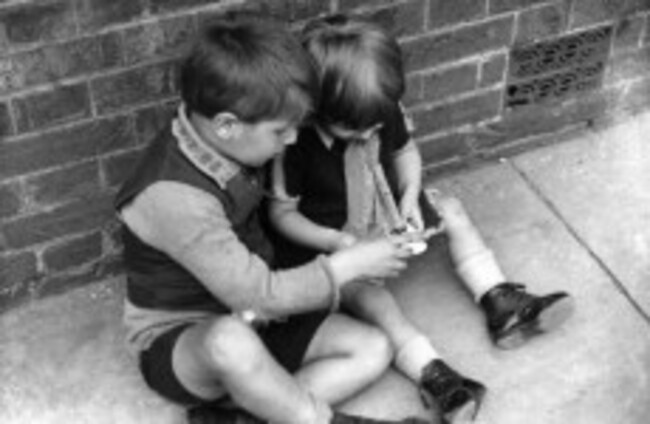
Image: Between The Wars/Topham Picturepoint/Press Association Images

THE NATURE VERSUS NURTURE argument has been debated at length and, this week, new research has claimed that the root causes of violence and anti-social behaviour are developed in the first three years of life.

A seminal study, conducted in New Zealand, showed that nurses could predict the criminal tendencies of children 18 years in advance – just by watching them play as infants.

Clinical Criminologist George Hosking, an international expert on the prevention of violent crime, says a cycle of abuse can be perpetuated through generations. He also believes it can be successfully broken with early intervention methods.

This argument seems to present the case that people’s environment – and not their heredity – has a bigger effect on a person’s development. It also reasons that a changing environment can alter one’s behaviour and disrupt a cycle of violence.

So, today, we ask what do you think? Which has a bigger effect on how a child turns out – nature or nurture?


Poll Results:


Read next:

Comments (39 Comments)

  • Certainly small babies can be observed to have their own unique temperament

    Reply
  • Most junior infants teachers could probably make predictions with equal accuracy to the nurses in this study.

    I don’t know which is most important, but I suspect they are, and will always be, near impossible to separate when it comes down to individual children, no matter what studies on larger populations say. But I don’t agree that stressing the importance of early intervention is assuming that nurture has the bigger effect. Even if you start with the assumption that nature is the most important, nobody would argue that a child’s environment and the way they are treated is irrelevant. If anything giving most weight to nature would mean early intervention is even more necessary, since nurture would have more work to do.

    Reply
  • When did we decide to take away the responsibility a person bears for taking their own decisions and making their own actions? By allowing them to blame their genes or their parents for how they turned out you allow people off the hook and absolve them of the responsibility they should face up to.
    Plenty of people have shit lives and are brought up in broken homes who don’t turn out to be scumbags you know(I’m one of them). We can either choose to be criminals or we can choose to get over our pasts, stop blaming our parents and our genetics for all our problems and just get on with life trying to be better than the previous generation,not in a condescending way but by making social progress and moving away from the cycle of poverty . Believe it or not we control our own destines , that’s not to say nature and nurture cant have an influence or that its easy to overcome these factors but we can either take the easy choice and become the lazy, ignorant and angry people circumstances pushes us toward becoming or we can fight that so called destiny and by working hard becoming educated and rejecting that way of life for ourselves.

    Reply
  • We’re all naturally selfish, in as much as our natural inclination and instinct is to protect ourselves, feed ourselves, do what is best for ourselves. But the vast majority of us can manage to live with other people successfully and occasionally with great generosity – that’s the nurture, and the fact that it can overcome our natural instincts means that it’s actually very strong.

    Reply
  • One of the great behaviourist psychologists once said, “Give me a dozen healthy infants … and I’ll guarantee to take anyone at random and train him to become any type of specialist I might select – doctor, lawyer, artist… [or] thief.” (J. B. Watson, Behaviourism, 1931, p. 104).

    Through my own research, I can confirm that he was correct.

    http://i40.tinypic.com/2nrhpbn.jpg

    Reply
    • its time to rubbish all this ‘all babies are born innocent nonsense’ spouted by the bleeding hearts. when you breed horses you don’t use a weak horse or breed.

      The rules of genetics applys to all living things on this planet folks. we are not ‘gods creatures’ we are just organisms.

      Reply
  • Am I the only one who sees the lol factor in settling a matter of scientific fact by popular vote? What difference does it make to the truth of the matter that the majority have an opinion that’s one way or the other? Do you need any expertise at all to give an informed opinion about something like this?

    Oh, journal… :D

    Reply
  • This question seems to be well behind the curve regarding the way that professionals who are involved in the many facets of child development are looking at these ideas .
    In decades past there was much angst regarding nature Vs nurture .
    It really comes down to the same type of question regarding Light — is it a particle or is it a wave ??
    The answer seems to be that it depends upon how you look at it . Examined as a wave — light behaves as though it must be a wave — whilst examined as a particle — then it is always a particle .
    Human potential is significantly affected by both nature — genetic inheritance — and by nurture — the entire environment in which it can thrive or fail . Nature can provide predispositions to interact in various ways .Occasioning causes can trigger those predisposed reactions . Nurture can either counter or reinforce the predisposed reactions and attitudes .

    Reply
  • Hmmm. Lots of compelling work been done on how people perceive the personality of babies according to their own way of thinking or belief systems, including parents… babies are also affected by their environment from a very young age (and before birth) – they are adapted to soak it all up and learn very fast…

    Reply
  • What is the earthly point of asking joe public the nature nurture question which psychologists and researchers have been trying unsuccessfully for decades to answer.

    Reply
    • You beat me to it!

      Reply
    • Obviously Joe Public took offence to your very valid point Saffron.
      On an entirely unrelated matter, I’m voting for nurture.

      Reply
    • Modern Psychologists who research these phenomena have an important part to play in determining the functioning of ‘Ego’, but they can never truely understand or penetrate these psychological realities of our Human Existence because they don’t consider the deeper possibilities of Metaphysical Law such as Karma, Transmigration or Re-Incarnation etc… Science split itself into ‘parts’ to began Objectifying Matter about 500 years ago to attain an understanding of the material world and as a consequence now to objectify human behaviour. As Einstein said ‘everything is relative’ therefore scientific understandings are not ‘Absolute’ ie. At present scientific observations are delimited or determined by time or space – unlike Life. – Joe Public

      Reply
    • It is pertinent to attempt to determine what people believe on the Nature vs Nurture debate. It’s just a survey.

      Where you stand on this can reveal a lot about you.

      If you say Nurture, then you are probably more likely to believe that social inequality is to blame for most crime.

      If you say Nature, you are probably more likely to believe in the dismantling of the Welfare State.

      Reply
    • To gage public opinion on the matter. Academics and scientists are leaning towards nurture by the way.

      Reply
  • So does anyone actually have an opinion? I’d go nurture…..although I do think there is evil out there regardless.

    Reply
  • Darn! Selected nature in the survey by accident, but I meant to select Nurture. Science has been moving more towards the Nurture side for some time now – especially since recent understanding of brain ‘plasticity’, which now makes it problematic to look at scans of differences in people’s brains and put them down to inherited or fixed factors. Consider though, whether we are formed by nature or nurture, since we now understand more about the outcomes, why do we still persist in judging and locking up people who have likely had very difficult childhoods, rather than helping them? Sometimes I think that if I wasn’t an atheist I might become a Christian just so I could preach compassion, understanding and forgiveness, and there but for the grace of god go I, etc. etc.

    Reply
  • Children are born like a “tabula rasa”, a “blank slate” to which we, the adults that surround them begin to fill and create the moment they are born!

    Reply
  • Let him quote “Trading Places” and let’s have a heated debate !

    Reply
  • Nature builds your body from the ground up.
    Nurture means how well you feed and water that body while growing and fully grown.
    Bad nurture can kill of course.
    (A slightly daft debate actually.)

    Reply
  • Speaking as a psych student, from what I have gathered over my time studying, tabula resa isn’t well supported. Also, the applications of brain plasticity research seem to suggest that "use it or lose it" gets the human species very far… Interesting to see the majority are sympathetic to self-determination. Free will debate anyone?

    Reply
  • Great to see so many people get hot under the collar about this ;-). You realise there is some guy from trinners setting this up so he can quote these "results" in his thesis…?

    Reply
  • It’s not a question of nature versus nurture…how we nurture is a biological process, but plastic and dynamic. It’s really a question of what elements of who we are were formed strongly by nature or strongly by nurture. They cannot be separated completely hence the scientists difficulty of choosing one over another. Habits and other behaviour may be acquired through interacting with our environment but how they are programmed into the brain is biological. The quiz though is interesting as it finds out were people’s intuition leads them and the focus on criminality needs reflection….

    Reply
  • The severity of the environmental stressors are important. If a child were to be raised in a oxygen depleted environment, obviously nurture would win hands down. As environmental stressors became less severe then nature would gradually take over. Much like a potted plant, were a seed will take on the characteristics of its predecessor if environmental factors are right.

    I think in industrialized democracies which have many social programs the difference between prosperity of people is largely determined by their innate abilities.

    Reply
  • ask the pope and his followers,the buggers, they’ve got the answer, they know whats best for children

    Reply
  • The debate over this issue is over. It is no longer a political issue but one where people debate and take sides. It is now an issue where people look at the scientific evidence presented and the conclusions drawn by people in that field (psychology is not a science). This argument has become so bogged down in meaningless rhetoric masking the fear of having determined attributes or a self centred view of human nature where the greed is good. As Steven Pinker said in his book The Blank Slate ” you can always tell your genes to go jump in a lake”.

    Reply
  • JSLeFanu 08/10/11 #

    Before voting “Nature” I knew the overwhelming majority would choose Nurture. That’s a product of people wish to believe they, and their parenting, are the determining factor between the embodied virtue of their own children and the flagrant vice of the neighbors children. It’s a nice thought but most likely it’s complete fantasy.

    Reply
  • breading will break out in the eye of a needle

    Reply

Add New Comment