TheJournal.ie uses cookies. By continuing to browse this site you are agreeing to our use of cookies. Click here to find out more »
Dublin: 2 °C Saturday 25 May, 2013

Column: Our degrading prison system is a shameful vision of the past

Our jails haven’t changed all that much since the damp corridors of Kilmainham – and visitors lose their dignity almost as much as inmates, writes court reporter Abigail Rieley.

Abigail Rieley

THIS MONTH AT THEIR annual conference, the Irish Prison Officers Association complained that the chronic overcrowding and lack of resources in Irish prisons was making their jobs near impossible.

I’ve been spending a lot of time delving into a more Dickensian style of justice over the past few months.  When Dickens’ Bleak House was first serialised in the mid-1850s, Dublin’s Kilmainham Gaol was still an unreformed mass of men, women and children forced to desperate measures by years of famine.  If you ever have the chance to take the tour, look beyond the political stars who helped to create the State we live in and look at the ordinary cells in the old part of the building. They’re tiny, cold and dark.  In those days there wouldn’t have even been glass on the windows so on cold nights the winter wind would bite at inmates trying to sleep. Exercise was minimal, a shuffling circuit of a tiny yard, whose high grey walls hid all but the pale blue of the sky. The prisoners were put to hard labour, and forced to survive on a diet of not much more than bread and water.  If you had money things were a little easier as deep pockets could buy all kinds of luxuries from the underpaid, easily swayed prison guards.

Over a century and a half later it’s easy to assume that things are far more humane – and they are, of course.  There’s no longer hard labour and the windows in modern prisons do have glass in them, but listening to the prison officers, there’s still a long way to go.

I’ve only been inside a prison once and that was to a remand prison, where those who are awaiting trial, or extradition, or deportation are sent.  These are men who have not been convicted of any crime.  They are not serving a sentence, even if they are awaiting a trial.  The prison, Cloverhill, is classified as a medium security institution. I’ve spent enough time working in the courts to be somewhat cynical when it comes to guilt or innocence but the fact remains that our justice system centres on the presumption of innocence.  If there’s no conviction, in the eyes of the law, there’s no guilt.

OK so practically, any remand prison is going to contain at least some prisoners who will one day be fully guilty in the eyes of the law. They will inevitably be pretty nasty individuals even before that sentence is handed down, because real life doesn’t have the same level of distinction that the law has when dealing with this tricky subject of guilt and innocence. When people end up in a remand prison before standing trial it’s generally because for one reason or another they haven’t qualified to be out on bail. It’s complicated.

A grim experience

I’d got to know the visitors’ centre attached to Cloverhill while I was covering a trial in the attached courthouse over several long weeks in the spring of 2007.  It’s a great service for the families who come to visit the prison. Toys for visiting kids, tea and coffee and the women who staff the place are always happy to offer words of advice and support. It was set up by the Quakers and the walls are bright with children’s pictures.  The pictures might have to be taken down though – prison authorities have ruled they’re a fire hazard.  The women who run the place are most proud of  the so-called Unity Quilt – its squares made by visitors, prison officers, solicitors and staff at the centre – which is due to hang above the service hatch to welcome anyone who comes in with a brightly-coloured gesture of humanity.  It’s not up there yet though.  It’s had to be sent away to be treated with fire retardant. Completion date and cost unknown.

The visitors’ centre is one of the few signs of humanity you’ll see when you visit the prison though.  It’s a pretty grim experience.  When you apply for a visit you are given a time with the strict instruction that you arrive fifteen minutes ahead of time for your half-hour visit.  I was booked in for a two o’clock appointment and sat nursing a cup of tea while the clock ticked past the hour, waiting for the prison officers to finish their lunch and come and open the hatch.

Once you’re checked off the list, had your ID checked and you’ve left mobile phone, bag, coat etc in the lockers provided, it’s time to walk across the car park to the prison itself.  Heavy metal doors slide back to let you through in increments with frequent stops for more ID checking.  The security check is stiffer than the ones you find in Irish airports – a full body scan and pat down, shoes off, the lot.  Then it’s through a rabbit run of high wire fences to another automated metal door that lead to the prison proper… sort of.

The visit itself takes place in one of a series of rooms.  Well, when I say rooms… It’s not like you see on TV.  There’s no cubicle with speaker phone hung on the wall, no large room with bare tables and plastic chairs, nothing like those tense scenes from Hollywood when the heroine confronts the bad guy.  There’s a large room that’s been divided into smaller rooms.  The smaller rooms have two glass walls and along their length are little benches positioned in front of a hatch like the kind you find in a bank or a dole office.  There’s no speaker phone.  You have to raise your voice to be heard through the metal grille set into the ledge in front of you.  The rooms alternate: ones with open doors for the visitors and ones with a blue metal door down one end and a caged box for a prison officer at the other.  There was something about the place that reminded me of an  old aquarium or a calf shed.  Somewhere to go to view, not to have any kind of meaningful conversation.

Little dignity

Most of the other visitors on the same slot as me were young mothers wrangling hyperactive toddlers.  They leaned low over the metal grilles and tried to murmur a private conversation over the din.  The kids ran up and down the room, bored and shrieking, ignoring the taps on the glass from their dads as they tried to attract their attention.  They’ll grow up with memories of seeing daddy in that grim cattle shed that won’t be tempered by the bright colours of the visitors centre quilt.  Couples put hands up to the glass to simulate contact under the bored gaze of the prison guard. The women took it all in their stride, accepting the grim normality, just the way things were.

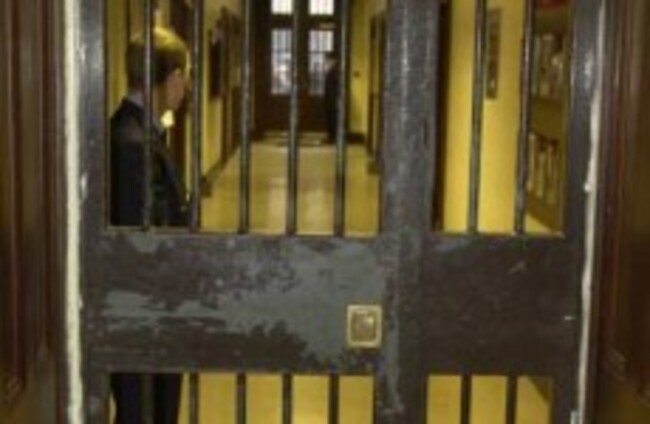
I know prisons are meant to be a deterrent and contact is banned to prevent the passing of drugs or other contraband but it didn’t seem to offer much dignity to those having to shout to make themselves heard.  It all felt a long way away from the holiday camp that we’re told Irish prisons have become.  I only saw the tip of the iceberg as a visitor but it really didn’t feel all that much different from the the Victorian corridors of Kilmainham.

Irish rates of recidivism run at about 40 per cent – and you don’t have to cover the courts for long to be unsurprised by this depressing statistic.  Earlier this year the Council of Europe Committee for the Prevention of Torture castigated the Irish prison system, calling it “degrading” and “debasing”, and citing the hundreds of prisoners forced to slop out their cells each day.  The tabloids run a steady stream of stories about mobile phones and drugs being freely available in the majority of Irish prisons. The system as it stands doesn’t work but it’s going to take a serious rethink to change it.  Overcrowding needs to be dealt with. There should be greater support for those leaving prison so they don’t slide straight back into their old lives.  It’s easy to say, harder to do – but something needs to be done.  Maybe rather than viewing the problem in isolation we should take a leaf out of the Scandinavian approach of viewing the issue holistically; treating each offender as an individual with an individual path to where they are and individual needs afterwards.

Surely it’s worth a try anyway?

Abigail Rieley is an author and journalist who has written two books about recent murder trials, Devil In The Red Dress and Death On The Hill, and also covers trials for the Sunday Independent. She blogs at abigailrieley.com. See facebook.com/abigailrieleywriter.

Read next:

Comments (17 Comments)

  • They say that you can judge a society on the way it treats it’s prisoners and in the state of it’s prisons. Forget about those that are guilty of aggravated crime for one moment. In this day and age people such as those that don’t pay motoring fines ,maybe due to unemployment ,are likely to be incarcerated, be it for a short spell in Mountjoy. It’s a hellhole, you don’t need to go into it, just read the reports of inmates murdered inside over the last few years. More hangings have taken place in it since hanging was abolished. Yes many are beyond rehabilitation and the public needs to be protected but most, if given some opportunity earlier on could be steered clear of a life of crime. The fact is that money is rarely spent on enhancing problem areas as is being done in Ballymun. It’s usually invested in enhancing the lives of those with advantage. .. the north side still has no light rail service even though the airport is there. Instead they paid 40 million for a site in Thornton in an agricultural area to hide all societies problem people including those that are criminally insane, some of which are “non forensic” patients that cannot be held in normal psychiatric units. To all the ” hang em high” people here… neither staff nor inmates should be subjected to 19th century conditions in a 21st century progressive society. . Even in the US states ,where capital punishment is on the statute, conditions in the prisons are better than Mountjoy. It’s the usual Irish solution to an Irish problem, sweep it under the carpet and it will go away. It won’t.

    Reply
  • you shouldn’t base your article on just your experience of a visit in one prison. You give a one sided opinion which is unfair to the thousands of prison staff who have to work in a different environment from what the tabloids portray.

    Reply
  • being a Quaker has helped me form my opinions on this, and she isnt basing the story on workers at the prisons, she is basing it on what she sees and my opinion is what you see, is mostly what you get.

    Reply
  • Deprivation of liberty is not a punishment !
    The punishment element should begin immediately after the criminal is incarcerated – Manual work, prison uniforms and an almost military style regime should be the norm.
    it is AFTER this that the rehabilitation should kick in, not along side it.

    Early release for good behaviour should be a real exception and concurrent sentencing abolished.

    Surely incarceration is to protect the innocent members of the community who were victims of crime ?

    the ‘prisoners rights’ organisation = the ultimate oxymoron

    Reply
  • i am not so sure this is an unfair critique of a prison.
    how many nursing homes do you have to see or psychiatric hospitals or social housing blocks, no social housing suitable for disabled people, undercutting pensions of elderly and sick, A&E overcrowding, not enough money for nursing home care and the difference between private and public health care, we are an absolutely shambolic society, with little care for the least fortunate.
    no where in my mind seems to be of any benefit to the least able.
    nursing homes are homes for bewildered and dumped with depressed people sitting around in hard chairs, and it just goes on.
    all reports by good journalists will say the truth, i am not at all sure this isnt the truth. In fact i can figure that its most defo the truth.

    Reply
    • And what experience of prisons do u have that helps u to form the opinion that this article is true?

      Reply
    • The system doesn’t work because there is too much money spent on pandering to criminals, sky sports,best of food, best of health care and schools and practical training as in workshops (metal and wood) . Every cut for public sector takes money away from d warders who don’t get enough to begin with for what they have to deal with, cuts in training and facilities. The government wants reform but won’t pay for it. Pre release programs all cost money but when it costs 94k per year to house an inmate it would make more sense to cut down on recidivism and keep them out of jail once released.

      Reply
  • With the greatest of respect for victims of crime it’s a real pity that some of the commentators don’t appear to have read the entire piece. It is an opinion based on observation. This is what journalism is about – observe, consider, report. The effect of prison conditions on recidivism is well documented. Here is just one study -
    http://ftp.iza.org/dp3395.pdf – to quote from the abstract alone :
    “We find that a harsher prison treatment does not reduce former inmates’ criminal activity. The extent of overcrowding and the number of deaths do not decrease the probability to be re-arrested.”
    This American study is also enlightening : http://bit.ly/lpsByn
    Of course there is a need for justice and fairness and the old adage about a reactionary is just a recently mugged liberal still holds. But on the other hand the principle of rehabilitation is not as much for the betterment of the individual as much as it is absolutely necessary in order to protect society from it’s failures. Yes, we do fail whole swathes of people – and they in turn fail us. ‘Man In Pub’ speak is neither considered or constructive. It hastens the day for a total brutalisation of society when thuggery wins out.

    Reply
  • This article epitomises what is wrong with peoples attitudes.
    Not one inmate ever stopped to think of the rights or their victims.
    This is ridiculous…

    Reply
  • Maybe if we brought back hard labour we would not have as many re-offenders…….

    Reply
  • Every person in the prisons checked themselves in, they all knew what they were doing and where they’d end up when the committed the crimes so therefor should NOT complain, their own decisions got them there. The old, it’s not their fault, they came from an underprivileged background argument is another thing that pisses me off, a lot of people come from under privileged backrounds yet don’t break the law. It comes down to choice…if I do this I could end up in prison…prison is punishment, not pleasant..I think they have it too good in prison as it is!

    Reply
  • You could spend billions on deprived areas or so called and it will not change the mentality of people,so cut the bull.I am fed up with selfish Junkies getting money spent on them.We all know that crime would be halved if these selfish bastards where put on an Island and locked away from decent people.I have no sympathy for this lot and resent any of my taxes being wasted on this lot.

    Reply
  • Good Christ, maybe we should just let the scum that belong behind bars out and put them up in 5 star hotels and hire people to wipe their arses so they wont have to wash their hands. Stick to writing fiction pet.

    Reply
  • The bad conditions do not seem to have an effect on reoffending,but compared to some of the Eastern European countries they are like a 5 star hotel.

    Reply

Add New Comment