TheJournal.ie uses cookies. By continuing to browse this site you are agreeing to our use of cookies. Click here to find out more »
Dublin: 11 °C Monday 20 May, 2013

Column: The markets are holding us hostage – but here’s our escape route

We’re running scared from the financial bogeymen, but our governments could easily take control, writes Martin O’Dea.

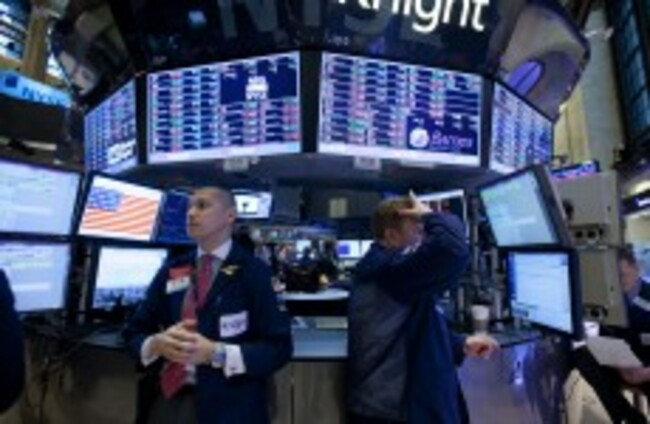
Traders on the floor of the New York Stock Exchange
Image: Jin Lee/AP/Press Association Images

Today, leading economists urged the government to postpone the repayment of billions in promissory notes to Anglo Irish Bank creditors – a move that is likely to be resisted by European authorities.

Here Martin O’Dea argues that the financial markets should not dictate our fates – and sets out a way our governments could take control if they wanted to.

THERE ARE MANY levels at which to assess the current financial crisis in Europe. One of those at the higher level involves the discord between political bodies and financial markets and how this power battle is playing out.

There has been talk of financial transaction taxes from Angela Merkel and finance ministers from Austria and Belgium as well as France. The concept is seen to originate with John Keynes in 1936 and was applied particularly in 1972 by Nobel winning economist Jim Tobin. There have been alterations in the interim as analysts try to find ways to minimise the impact on market activities and to dissuade companies from fleeing to destinations where any such tax does not exist. There seems a reasonable chance developing over the last decade or so that a global financial transaction tax could be employed to attempt to bridge growing income inequality, somewhat, and also to provide a fund to deal with many major social issues; though, of course, this remains to be seen.

European countries have pushed hard for the introduction of a FTT tax since 2008 and, in fact, Sarkozy of France has recently introduced a 0.1% on certain transactions (though not on bonds) in the hope that others will follow. The G20 did not reach agreement on a universal Tobin Tax, and so Europe proposed to move ahead within its own ‘borders’. The proposed EU FTT will apply to the country where the financial operator is based, and so for example a German bank could not avoid the tax by having transactions take place from a different base.

The UK, despite two-thirds support for this type of tax among its citizens has opted out, and so the outcome of this issue remains unresolved. In as much as the ‘market’ can be seen as a singular entity, there must be disquiet at this concept and some of the negotiations around indebted sovereigns must hinge on some brinkmanship in this battle. The investors and fund managers, in the most, whose jobs entail achieving maximum return for their clients will naturally look at this tax as an unwelcome proposal for their balance sheets. They also look at burden sharing on debts in a similar way.

‘It’s easy to feel that the markets have all the cards’

It is easy enough to feel that the markets have all the cards here – it is certainly what the Irish government states quite openly; ie that they have no choice but to follow instructions from the ECB and commission and that they are behaving in the only way that they can as markets would not allow any deviation; and so ‘Armageddon’, ‘bombs going off’ etc is the language that is suggested if we force the issue of debt clearance with Europe or if Europe generally pushes the issue with the markets.

There is a very strong argument of logic put forward by David McWilliams and others for a long time now that, in fact, this position is inherently wrong – that markets can only invest in what is coming and so would quickly reinvest in countries that shed unbearable debt burdens, because this gives them a chance to grow and makes them more worthy of investment. Iceland seems to provide some support to this argument, as they took a massive hit when declaring bankruptcy and saw fairly immediate growth thereafter as the issues were ‘dealt with’ and the country and economy reeled but then began to move on.

There are obviously many others who say that this is too big a risk and what happens if the speculators bring down the house. It is easy to sit and think, how did we come to this, how did we find ourselves in a system where the markets dictate to the politicians.

The context of all of this is truly of astounding proportions now. Even a cursory glance at twentieth century politico-economic history shows the dangers in economically disenfranchising a people and how when all moderate options point to economic oblivion there is provided a breeding ground for extremism.

These arguments seemed extreme themselves just a few years ago, but an objective look at Europe and Greece particularly as well as the local Irish example of incredibly damaging social impositions under the somehow surreal stipulation to pay banking debts with taxpayers’ money to a value such as currently taking place.

One can see the potential hazards. Anger will continue to mount as the drip feeding of the shocks of €3.1 billion to Anglo promissory notes comes again in March and again and again for a decade. And, of course, in the context of a comment from a slightly heady Taosieach at Davos implying that ‘we all went “mad with borrowing”’ and people reel from the frustration that whatever they have borrowed they have to pay back while also covering these banks borrowings, really makes it beyond a serious issue for Europe, and an imperative one for the maintenance of order at this point.

‘We have forgotten that our representatives actually hold the strongest hand’

Regarding this seeming stranglehold of the markets then – this is one of the major difficulties, but it can also be the source of the solution, for we seem to have collectively forgotten that politicians (representing us the majority) actually hold the strongest hand. They make the laws. They have national judiciaries, police and militaries ensuring their ability to do so as well as many international fora with domestic popular support to resist the market influence (and if McWilliams etc are right – even the markets themselves would support governments eventually standing up for themselves).

So bearing in mind all of this, what could politicians do? Well, they might put the following financial logic forward to the key financial institutes as matters of fact. It is already planned by the European commission that there will be a financial transaction tax in 2014. It will be 0.1% against the exchange of shares and bonds and 0.01% across derivative contracts. It is forecast to raise €55 billion per anum. A European treaty must allow governments to tell markets that if massive write downs of government debts are not now taken as we dictate, the financial transaction tax will be 0.3% against the exchange of shares and bonds and 0.03% across derivative contracts.

Markets are not really thinking entities; people go to work and do what their bosses wish in an attempt to continue to pay their own mortgages and care for their dependents as well as progress in their own careers. Their bosses pressurise them for return as a means of passing on the systemic pressure that comes on their jobs and performances from shareholders.

Shareholders can be a whole myriad of personas, often financial institutes themselves and pension, insurance funds etc. So it is clear that markets cannot, as currently constructed, grow social consciences. By definition there is only one motive that markets can comprehend. The future of technological development and better informed and educated populations and the peace and prosperity that can arise from that await resolution of this crisis.

The resolution of the crisis awaits massive write down of debts, and in the Irish case the allowing of bankrupt banks to go bankrupt. European leaders must speak the language of the markets – but explain in that language that they are in charge and that they will not allow continuing social collapse on their watch.

Martin O’Dea lectures in Management and Human Resource Management at the Dublin Business School. This post originally appeared at TASC’s Progressive Economy blog.

Read next:

Comments (16 Comments)

  • Far too much common sense in this article, so no doubt it will be ignored and looked back on in years to come by others who will wonder why those in power were too stupid (or refused) to see the logic.

    Reply
  • In the short term we are going to default anyway, so do it now and get it over with.

    Reply
    • I disagree. So long as the money we are being given by the ECB/IMF/EU is more than we are repaying then it makes sense to stay on the gravy train as long as possible, and then default in style. Let’s take advantage of the German (and French etc) politicians’ reluctance to tell their populaces that their banks are bust.

      Reply
  • Ardo Ci 15/02/12 #

    Look, the money men have been in charge for the last 250 years. It’s just that their connivances to eventually rule the world are being flushed out. Accountancy is the cancer of society. Stop the rot. McWilliams is right. Burn them. It’s only numbers on a computer screen anyway. Money used to be backed by gold but that’s all gone now and deregulation on an international scale (thank you Uncle Sam) means there’ really is no such thing as money. Just look at the QE trick any Central Bank can initiate at the drop of a hat. If money was real they wouldn’t be so free with it. It’s a con. Does anyone know where Fitzpatrick is by the way or has he been forgotten about already, having brought his country to its knees? A man was jailed for not paying his dog licence and this guy is on the loose – what sort of society do we live in! Not one I care to live in. Democracy is gone – it’s now a Bankocracy! Soon it will be a totalitarian one as well.

    Reply
  • Ciaro 15/02/12 #

    Any write down on bank debt repayments needs to be seen as such as not as ” default”.

    Reply
  • ill eat my shorts if we dont default

    Reply
  • I agree that we will default anyway, as our debt is unsustainable to keep, so why don’t they the eu get rid of the debts, and we can start again on a clean slate, with the greeks and the others who are in trouble?

    Reply
  • I’d disagree with almost everything in this article except the fact that this debt will eventually have to written off.
    The Tobin tax is a nonrunner. Those institutions that don’t flee to tax havens will simply pass them on to consumers. Strangling growth either way.
    This idea that the markets are attacking politicans and/or societies is also nonsense. The markets are simply refusing to lend money to nations that have shown they are incapable of managing their own finances.
    The article also seems to miss the point that the political establishment and banking elite are in bed together.

    Reply
  • If I can reply to Donal McCarthy’s comment – I thought I was suggesting that markets are not big clubs but people going to work for financial institutions within organisational and cultural structures and with systems in place that have as their underlying motif financial gain in transactions. I believe I also highlighted that in many cases the monies used for initial entrance may well be pension or insurance funds as their base. I believe the concept of what exactly a Tobin Tax or a Financial Transaction Tax is or can be is open to alteration to make it fit for purpose, and the purpose I am trying to highlight is linked to these earlier points. I do not believe that what we see as ‘the markets’ or essentially those who collectively and individually select interest rates at which our sovereign may borrow can or will understand any reasoning other than monetary. I also do not believe that when they are faced with a loss v bigger loss scenario ‘they’ or ‘it’ doesn’t get all angry or frustrated or desperate as much of Europe’s citizenry are currently – it simply acts and moves on. My central message then – and I may well not have the appropriate financial education to make the point well – is – can not the European political establishment (which is already bringing in a Financial Transaction Tax in 2014) use this avenue of political might to offer the markets an option where an acceptance of a means to unburden citizens from unsustainable debt makes financial sense to them.

    Reply
  • This article contradicts itself. It correctly acknowledges that markets are not thinking entities and then goes on to suggest that we try and blackmail these same entities. Also, the type of markets that will be most impacted by a Tobin Tax are not sovereign bond markets.

    Reply
    • By saying that markets are not thinking entities, he states that they will not and can not develop social consciousnesses. As a result, the only way to deal with them effectively is through financial measures, as money is the only real factor that will affect the markets.

      Reply
    • Markets are not entities. They are a collection of individual actors. This the kind of low-brow view of the markets as some sort of big club that goes on holidays together and sends Christmas cards. We are also ‘the markets’ because we want to sell in the markets.

      A Tobin tax will only have an impact on markets that have a high volume of trading. The sovereign bond markets are not such a market, so he is not even suggesting we try to blackmail the right markets.

      I don’t have a problem with a properly instigated multi-lateral Tobin tax at all, especially with automated trading becoming more and more prevalent.

      Also, it is astonishing that anyone who has any financial education at all would call for a massive write downs of sovereign debt. Who does he think holds this debt? Some kind of James Bond type villain? The sovereign debt is largely held by other countries, banks and pension funds. A write down equates to a real loss.

      Reply
  • Bond holders in Irish banks should get repaid. That’s only fair. But it is not a “default” to tell them that the repayment will be made on Irish terms. And that may mean repaying over a, say, ten year term instead of three to five year term on existing notes. It is nonsense to pay off short term bond by borrowing new money. It’s rather like the Ponzi schemes we’ve seen of late.

    The message should be simple: We’ll pay you back when we raise the cash! Not by refinancing at a higher interest rate or contributing to the continuing banker fraud.

    Reply
    • Bond holders in Irish banks are speculators who took a risk lending to the banks. That is how the system works, the interest rate paid reflects the risk that the investors take. By stone-walling the repayments the government has eliminated the risk for investors. The investors knew the risks when they invested, they should not get their money back if the business they invested in doesn’t have the financial resources to pay them.

      Reply
  • iBob101 15/02/12 #

    The Tobin tax is just another tax. If I buy a share for €100 and then sell it again for €100, why on earth should I pay a tax?

    p.s. Sarkozy only implanting it to try to get re-elected. Britain will never implement it. Same for many other global financial centres. Any country that implements it just loses business to those who don’t.

    Reply

Add New Comment