TheJournal.ie uses cookies. By continuing to browse this site you are agreeing to our use of cookies. Click here to find out more »
Dublin: 11 °C Saturday 25 May, 2013

Column: The media is selling insecurity – but we don’t have to buy it

Eating disorders therapist Emma Murphy describes how images in the media affect her patients – and suggests a simple task for anyone considering a trip to the newsagent.

Emma Murphy

AS AN EATING disorders therapist, the majority of clients who come to me have poor body image.  And it is not surprising.  Insecurity sells.

It sells magazines, it sells beauty products, it sells cosmetic surgery and procedures from anti-ageing facials to Botox, it sells diets.  So the more magazines write and print about looks and bodies, the more advertising space they can sell to cosmetic companies and diet systems.

There is no point in being naive about this, these are multi-billion dollar industries worldwide.  So what do magazines do to support this type of advertising? Sell insecurity, so we will buy the latest cosmetic/diet/hair product.

Part of the buzz is around a key media issue, the use of Photoshop to digitally alter photos, as in these pictures. In 2009, Kelly Clarkson’s Photoshopped picture appeared on the cover of Self magazine. Just days after the cover was launched, Kelly appeared on a national US breakfast TV show, proving that she looked nothing like the photo.

Inside the magazine, Kelly’s interview appears. She says: “My happy weight changes, sometimes I eat more; sometimes I play more. I’ll be different sizes all the time. When people talk about my weight, I’m like, ‘You seem to have a problem with it; I don’t.’

When confronted, rather than apologising, the Self editor responded: “Yes, of course we do post-production corrections on our images. Photoshopping is an industry standard,” she stated. “Kelly Clarkson exudes confidence, and is a great role model for women of all sizes and stages of their life. She works out and is strong and healthy, and our picture shows her confidence and beauty. She literally glows from within. That is the feeling we’d all want to have. We love this cover and we love Kelly Clarkson.”

This example alone – and there are many more – show how the images women torment themselves by comparing themselves and finding themselves wanting, are not real. Models, celebrities and ads in magazines represent a false perception of women – women who are fat, blemish, wrinkle and cellulite free. Real women like this do not exist.

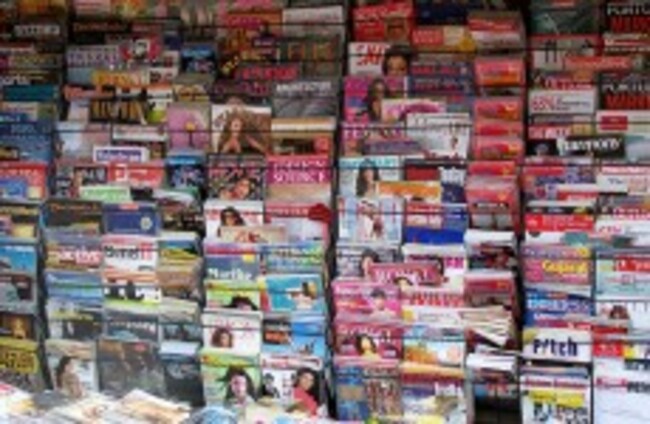
If you read magazines (and this goes for both women’s and men’s magazines), I invite you to set aside some time, either right now, later today, or sometime soon when you know you have about an hour to spare.  Go get several of your back issues and a sheet of paper and a pen.  Taking one magazine at a time, do the following research:

Magazine content
1. How many pages does the magazine have?
2. How many pages are devoted to articles on diet, ‘healthy’ eating, body shape or ‘beauty’?
(You can divide the number of pages (2) by the number of pages (1), and multiply by 100 to get the percentage of the magazine devoted to diets, body image and beauty).

Magazine advertising
3. How many advertisements are in the magazine in total?
4. How many ads are for beauty products? Diet or ‘healthy’ food products?
(For the stats, divide (4) by (3) and multiply by 100)

Positive messages
5. How many pages are devoted to the empowerment of women or men, or believing in yourself, or achieving goals in either your personal or work life that do NOT refer to either your looks, body image or diet?
(For the stats, divide (5) by (1) and multiply by 100)

How helpful do you think it is to allow yourself to be bombarded by these false images, telling you how you should look, when the models and celebrities themselves don’t even look like that? What might you be better spending your money on? And I don’t mean an expensive day/night cream, or Botox.

There are around 400,000 women and men in Ireland struggling with an eating disorder – anorexia, bulimia or binge eating disorder. Eating disorders result in 80 (reported) deaths a year. There are an estimated 1.2 million sufferers in the UK, and over 30 million in the USA. Men represent 20 per cent of sufferers, and the age range is from as low as 9 years, to beyond 60. These figures are reported, diagnosed numbers only.

I would never definitively state that the media can directly cause eating disorders, but I can say that they contribute significantly to low self-esteem, poor body image, body image dysmorphia and low self-worth. I know, because I see it every day in my clients.
Magazines cost you money, emotional energy, self-esteem. Don’t buy into it any more.  Say NO to being sold insecurity.

Emma Murphy is an eating disorders therapist with a private practice at Sandyford Wellness Centre, Dublin 18. Emma has developed an online program for adult women and men struggling with food and/or body image.

Visit the website at turninginstitute.com and follow her blog at eatingdisorderecovery.com. Part of this post was originally published in a blog on August 13 2011.

Read next:

Comments (18 Comments)

  • Well said.
    It’s difficult enough avoiding the messages from media, it’s even more difficult when society are making these negative messages the norm’.

    Reply
  • I thought this article was going to be about the economy, where no doubt the media is also contributing to our sense of insecurity.

    Reply
  • Great article though.

    Reply
  • Waffler 13/12/11 #

    if the media is making us insecure why are we more obese than ever?

    Reply
    • Hi Waffler,
      I’m the author of this article, and you’ve asked a very loaded question there!

      1. First, Binge Eating Disorder is a recognised Eating Disorder and it is a psychological disorder that develops, like other eating disorders, as a coping mechanism for stress, dealing with difficult emotions or feelings of being out of control. It also contributes to obesity. BED sufferers suffer with low self-esteem, low self-worth and feelings of worthlessess, and these feelings will have preceded the weight gain (so they are not from being obese, although that doesn’t help either). The media definitely contributes to these feelings.

      2. Not everyone who is obese has an eating disorder, sometimes it’s a lifestyle/diet/exercise issue, and education is paramount in order to change habits and routines that contribute to poor eating and lack of exercise. However, the media don’t help here either – and you only have to check out magazines at this time of year for articles such as “The Perfect Christmas Dinner”, or “Crafty Canapes for Christmas” etc, not to mention the numerous ads, cooking shows and other Christmas food related activity in the media that can really overwhelm us – the messages are “Indulge”" “Enjoy!” “Eat all of these delicious Christmas foods!”

      3. Whatever about the media, you’ve also brought up another of my hobby horses, the global food industry. We have more food available to us than we can EVER need in the developed world, but manufacturers process it beyond all recognition from its natural state, and add in highly addictive, fattening, nutritionally valueless ingredients, two of which are corn syrup (sometimes labelled ‘fructose’) and aspartame, and there’s hundreds more. Because of these radical changes in food manufacture, the US now has a new phenomenon, the obese child who is also malnourished.

      An apple today has only 1/3 of the nourishment it had in the 1940’s due to intensive farming. Cereals for e.g. bread are now completely broken down in extreme processing, then put back together with added sugar, salt, lots of other stuff and finally “fortified with ADDED Vitamins and Minerals!” which are artificially manufactured and nothing resembling the actual minerals and vitamins that would have originally been in the bread had it been made the way your mammy made it – mixing it with water/milk, a pinch of salt and a raising agent. For a practical example, next time you are shopping, pick up an Irish bakery made Spelt Bread, then an Irish manufacturer’s new Spelt & Honey Bread, and compare the ingredients list. (Hint: bakery’s has four, manufacturer’s has 14).

      There is no doubt that people need to be educated on food and nutrition, as well as media manipulation, in order to safely and healthily navigate their way around a healthy body image and reasonable lifestyle.

      Finally, although we have both used the word obese here, I must say that you can be big, and fit and healthy, and you can be slim/thin, and extremely unfit and unhealthy. So I would ask people not to make assumptions about someone’s health, based solely on their size. Some of my seemingly normal weight clients with Bulimia are one step away from a fatal heart attack, other, heavier clients ran the marathon this year. Size does not equal health.

      Thanks for asking a valuable question Waffler.

      Reply
    • Common sense ,if you grew up in the 70s/80s junk food was a sometime treat now a lot of kids eat it every day.If you wanted to talk to you’re mates you had to get off you’re arse and find them now you just message.A lot of parents I’ve met dont have the time or sometimes the skill to produce healthy meals like past generations .I have a load of teenage relations and there smarter than the media gives them credit ,probably more so than we were at there age.

      Reply
    • As long as big food, like big oil, control the governments, nothing will change. We need to educate ourselves.
      And with regard to the article, I think it’s one of the saddest things of western society that as women, we measure our self worth by how much we eat/weigh. What’s even sadder, is that the media enables us to justify hurting ourselves in this way.
      Unfortunately, it’s hard to escape from. Even if a person does recover, it’s with them for the rest of their lives.

      Reply
    • Emma I’m sceptical by nature and several things you’ve said stand out to me.

      Why is the word healthy repeatedly in inverted commas in your article? Is healthy eating not to be encouraged? If a doctor tells a morbidly obese patient to eat healthily, is that doctor doing more harm than good?

      Also – in your comment above, you say that an apple you’d get today only has 1/3 of the nutritional value of an apple you’d have got in the 1930’s due to intensive farming. With respect, this seems preposterous and I would really appreciate it if you could point me in the direction of where you got that information?

      In your article you denounce adverts for diets and healthy eating yet in your comment above you denounce adverts for Christmas dinners and indulging. It’s confusing.

      You say that artificially manufactured vitamins and minerals are not the same as naturally occurring vitamins and minerals. This is simply wrong. Vitamins and minerals are merely chemical compounds, and vitamin c you’ll get in an orange is the exact same chemical composition as that you’ll get in a laboratory. I think you mean that from a nutritional perspective, it’s obviously more beneficial to eat an orange than to take a vitamin tablet.

      And size does correlate with health. Like it or loath it, BMI is a useful method for calculating healthy weight. As is waist size. Thats why there was a national initiative to encourage people to measure their waists so as to ensure try weren’t putting themselves at risk of heart attack.

      Reply
  • Having had problems with eating disorders in the past, I gave up buying or perusing this type of magazine. The images they sell are not real, and in some cases not even possible! I picked one up recently and was shocked that people are expected to pay so much for pure advertising! Page after page of beautiful, ethereal, extremely airbrushed and slender twenty somethings in ridiculous poses (looking vacuous or bored for the most part). Not one interesting or enlightening article! I picked up New Scientist instead. Still some ads but at least something relatively interesting.. Thanks for the article Emma!

    Reply
  • I find women’s magazines to be very contradicting. They show off the newest fad diet, use photoshopped images of women, and are also “shocked” when a famous woman has put on a bit of weight (and usually look the most healthy they ever have!). At the same time, they will use articles about “loving yourself, no matter what your size.” The messages are confusing.

    Love yourself? Oh yeah, but only as long as you’re pretty and skinny.

    Reply
  • Great article well done . Most of the magazines are rubbish anyway and nobody should believe a thing in them.

    Reply
  • Dee Mac 13/12/11 #

    I only buy psychologies magazine although yes it does have many beauty campaigns it is a very good magazine and focus is on well being. It is one that I recommend to friends and appears to be if u pardon the phrase “intelligent” it writes of social issues and concerns and is not directed at the vulnerable readers . It is in fact the only magazine that once finished I feel good !!

    Reply
    • Psychologies is a great magazine, I read it myself!

      Reply
    • I don’t buy magazines.Not any more. However I believe having had my first child last year, that there is taboo surrounding the depression a woman feels after childbirth with the shape of her body. Not clinical / post natal or any other medical depression. Good old fashioned despair at the way your body has changed. I think this article is excellent – for many women the terrible battle to try and restore some of what you had before actually leads to binge eating. I found myself obsessing over how the hell some celebrities restore their figures after childbirth but I’ve come to realise that it doesn’t matter. I’d recommend yoga, sensible eating and a dose of reality. You need to educate yourself about how best conquer bad lifestyle habits and try to stick to them. I’m so glad however that the internet wasn’t around when I was a teenager – it simply bombards young women with unreal (digitally altered) images.

      Reply
  • Good article Emma, I’ll definitely try that exercise, though my magazines of choice are The Economist and Runner’s World.

    Incidentally, do you think a magazine like Runner’s World contributes to insecurity? Because the whole point of it is to help people improve their fitness and performance – both by following tips in articles, as well as buying from it’s advertisers.

    Reply
    • Hi James,
      I can’t say I read Runners World so I wouldn’t presume to comment on a particular publication. I do know however that a large US fitness oriented magazine recently pulled an article they had published on eating disorders, as it was incredibly badly informed and not backed up by any clinical input, it was likely to do far more harm than good. The outcry against this article was swift and strong and it is to their credit that they pulled it and apologised for it. Without commenting on runners in particular, there would be a correlation between competitive sport and eating disorders – over-exercising is a common form of ‘purging’, and I would simply caution anyone in a competitive sport who is also struggling with an eating disorder to try and get help sooner rather than later, as the combination of eating disorder behaviours (bingeing, purging, restricting and taking laxatives) along with the sometimes punishing physical exercise they put themselves through is a potentially fatal combination as it puts huge pressure on the heart. I would hope that any publication around sport would try to ensure they were up to date with the latest nutritional research and would recommend balanced, healthy diets that do not involve any restriction of a particular food group (we all need protein AND carbs – high protein diets are not healthy), and encourage the correct amount of calories for someone who is engaging in higher than usual levels of exercise. With regard to sports magazines contributing to insecurity, well, it’s slightly different if the audience all shares a common interest, e.g. running, but yes, maybe they do. As a reader of Runners World, do you think it does?
      Thanks for the post. Emma

      Reply
  • Great Article Emma! Hope you are well.

    Reply

Add New Comment