We need your help now

Support from readers like you keeps The Journal open.

You are visiting us because we have something you value. Independent, unbiased news that tells the truth. Advertising revenue goes some way to support our mission, but this year it has not been enough.

If you've seen value in our reporting, please contribute what you can, so we can continue to produce accurate and meaningful journalism. For everyone who needs it.

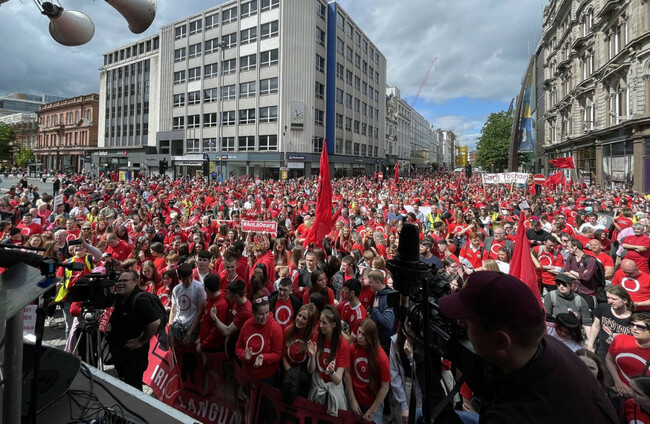
Tá súil le na mílte bheith páirteach sa mórshiúl ar son cearta teanga atá le reachtáil i mBaile Átha Cliath inniú. Bhí 12,000 i láthair ag an Lá Dearg i mBéal Feirste i 2022. Foras na Gaeilge

Conradh na Gaeilge Today's protest is about achieving equality for our language and its speakers

Irish speakers and Gaeltacht supporters believe that government policies north and south are short-changing their community.

The original Irish language version of this article is available to read here.

EQUALITY. AN IRISH word that has been gaining popularity among the public for some years now. What exactly does it mean in the context of the Irish language and the Gaeltacht? Well, it is very simple in principle: that we are treated with respect, as fellow citizens on this island, whether in the south, north or in the Gaeltacht. And that the state and the authorities deal with us based on our specific characteristics and needs. 

What is needed, then, to achieve that equality? There are a number of essential basic elements involved in making that constitutional vision a reality.

The first is that we should have the right to see, use and promote the Irish language. That the people of the Gaeltacht should have the right to build a house and raise a family in their own native areas. That anyone who wishes to have the right to a place in an Irish-medium school, at nursery, primary or secondary school level. That everyone should have the right to learn the language through a satisfactory system in our English-medium primary and secondary schools, north and south. And that we should have the right to access basic daily services through our native language. The right to live, with respect, in our own language of choice.

None of these rights arise without will. Even where we achieve them as rights, they are certainly not implemented without some will and understanding of the Irish language and its speakers. Will from our political class, appointed and elected by the public to promote our wishes as citizens, who are designed to give effect to the constitution in the south, and the peace agreements in the north. Will from Ministers in both jurisdictions to act according to word. Understanding from the officials in the state system of the Irish language and the specific needs that apply to us. And a willingness from the public to challenge oppression, disregard and any attacks on the language and its speakers.

Thirdly, fair play is a central cornerstone of equality. That the state deals fairly with the language when designing education policies, housing policies and arranging funding. In the next few weeks, the government will be preparing and agreeing a Budget for the coming year. That budget will be a major test for this government in terms of their vision and commitment to the language and the Gaeltacht. Will there be a fair deal?

Sadly, history tells us that no state concedes anything from the top without pressure from the bottom.

There is one thing that ties the above – rights, will and fairness – together, and that is the community. We have always learned that we can make a difference when we demand change with one voice. Today, at CEARTA, that is what we will do. We will walk together and we will stand together, as a language and Gaeltacht community. We will not accept a straw instead of a broom, with half-commitments that are not given any representation or investment in them.

That is exactly why we take to the streets, to take back that power. Looking back through the annals of history, we see communities that stood up for the Irish language and the Gaeltacht, communities that took to the streets and gave an open, strong and public challenge to the Government. After more than a century of statehood in the north and statehood in the south, we are still fighting day and night for a better future, for equality. We are now at a crucial juncture in this journey.

These are demands that are not only legitimate, but also reasonable.

That the historically unequal base level of funding for the Irish language and the Gaeltacht and the resulting denial of language rights to the community over the years be recognised and that adequate funding be made available through the appropriate state agencies to serve the Irish language and Gaeltacht community equally. 

That it be ensured that the Gaeltacht community has the right to live in their native area, that the appropriate provision be made available to ensure this and, as a result, help to safeguard and strengthen the language as a community language in the same areas.

That every school pupil, north and south, will have the right to attend Irish-medium education, if they so wish, and that to that end, both governments will provide the appropriate satisfactory provision. That every school pupil choosing English-medium education, north and south, will have the right to have a satisfactory Irish language learning experience, and that to that end, the appropriate satisfactory provision will be provided.

That all language rights, language legislation and government commitments achieved over the past few years will be fulfilled and implemented without further delay.

It is up to us, the public, to push these changes forward. They will not come about any other way. Let us never wait for goodwill, let us demand it.

This is the next big chapter in the story of the Irish language movement. Today, at 1.30pm in Dublin, we will walk together for rights, for equality, for the Irish language and the Gaeltacht.

Ciarán Mac Giolla Bhéin is the President of Conradh na Gaeilge. The CEARTA demonstration takes place today, beginning at Parnell Square at 1.30pm and progressing through the city centre to Dáil Éireann.

Readers like you are keeping these stories free for everyone...
A mix of advertising and supporting contributions helps keep paywalls away from valuable information like this article. Over 5,000 readers like you have already stepped up and support us with a monthly payment or a once-off donation.

Close
40 Comments
This is YOUR comments community. Stay civil, stay constructive, stay on topic. Please familiarise yourself with our comments policy here before taking part.
Leave a Comment
    Submit a report
    Please help us understand how this comment violates our community guidelines.
    Thank you for the feedback
    Your feedback has been sent to our team for review.

    Leave a commentcancel

     
    JournalTv
    News in 60 seconds