We need your help now

Support from readers like you keeps The Journal open.

You are visiting us because we have something you value. Independent, unbiased news that tells the truth. Advertising revenue goes some way to support our mission, but this year it has not been enough.

If you've seen value in our reporting, please contribute what you can, so we can continue to produce accurate and meaningful journalism. For everyone who needs it.

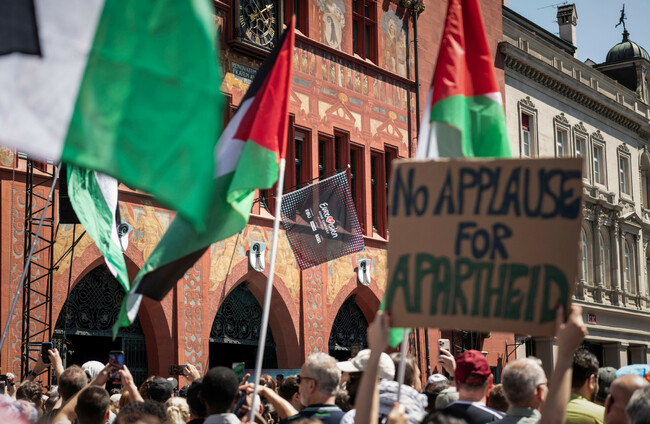
Protests against Israel's involvement in Eurovision gained momentum over the last several years due to its killing of tens of thousands of people in Gaza. Alamy Stock Photo

Johnny Fallon How Eurovision makes its decision on Israel will have long and lasting impact

Eurovision and its organisers are facing a serious challenge, writes commentator Johnny Fallon.

THE EUROVISION SONG Contest is facing one of its biggest challenges in 70 years. More importantly, the European Broadcasting Union (EBU) is now facing a serious threat to its role and remit.

The EBU is an important body. Like any union, it defends its members rights, promotes standards and ethics and has been an important voice for journalism over decades. Of course, most of us are not aware of its day-to-day work. We only come in contact with it through its neat little spin off ‘The Eurovision Song Contest’.

Throughout some trying times and tumultuous decades, the rules of the contest and the EBU have allowed it to navigate many difficult scenarios. However, that world is changing. What we are witnessing is a struggle between those who believe the EBU should stick to its principles that served it well and those who believe there is a new reality that must be faced.

In truth, it’s not always so simple. The rules and principles of the EBU have sometimes been used or stretched to suit a narrative, but they would claim to have always found a way to make a decision that remains within those rules. The decision of RTÉ and the Dutch, Slovenian, Icelandic and Spanish broadcasters to threaten to boycott the contest next year means the EBU is now desperately searching for a solution.

The rules

If you don’t know these rules by now, it’s worth having a broad review to understand their predicament.

It is TV stations that enter the contest, not countries or governments. The actions of a government are not to be imposed onto a TV station. The EBU decides membership and contest participation on whether the TV station meets the rules and obligations of the EBU.

For this reason, TV stations from Britain, Spain, Turkey, Armenia, Greece, and even the genocidal war in Yugoslavia were not forced to account for the actions of their governments at different points. Only if they themselves had done something wrong.

It is understandable that the TV stations that make up the membership of the EBU are reticent to allow other members hold them accountable for the actions of their government. The Russian invasion of Ukraine was a clear case in point. Many countries immediately and politically felt Russia should not be allowed to take part. However, the EBU needed a reason for this.

Eventually, they were quite clear that the Russian state broadcaster could not demonstrate independence from the government and on those grounds the broadcaster was to be expelled.

Israel’s broadcaster

KAN, the Israeli broadcaster, presents a different problem. Thus far, they have easily demonstrated independence from Government. Indeed, the RTÉ statement was notable for how it called out its support of KAN apart from the conflict.

However, some broadcasters have come to feel that this situation is untenable. That the conflict in the Middle East is different on scale or attitude to anything seen in the EBU region before.

These broadcasters feel that times have changed and such a conflict and actions cannot be ignored and some politics must enter the process for the wider good. They believe the process could become similar to Olympics or UEFA who take such decisions based on political developments.

This is a major test. Interestingly, Tim Davie of the BBC said that the EBU was “working through all the processes by which they would be satisfied to make a decision one way or the other”. We can be pretty sure that this means the EBU is searching for a way that its current rules can be applied to force a clear decision here or at least allow members a say without changing the nature of the contest.

Germany and Italy are very opposed to an expulsion without proper grounds. While it’s easy to dismiss this as being are more aligned politically with Israel there may also be more than a hint of fear among these broadcasters. What if a government is elected in their countries that abuses human rights? Will they then be expelled even if they speak against it?

Decision time

So, coming down to a decision. The easiest way out is if KAN were to say they are annoyed at the unfair statements and simply withdraw for a year themselves. A protest of sorts. This has not seemed likely so far but would suit most members. It would allow the EBU to continue more important work in supporting KAN and its independence.

Without this, though, the EBU must decide first of all if it can find the technical reason or breach that might allow a decision within the current rules.

If this fails, they must decide that the time has come to change the nature of the contest. It may need to split contest participation and EBU membership (precedents exist but would need to be firmed up) and perhaps come to some new rule about promotion of values in public or some such words that will allow countries be excluded from the contest.

This will change the nature of the show. It will mean the EBU must decide who is right and wrong in political situations in the future and therefore will need a set of strict guidelines to accompany that new reality.

It will be a difficult few days, but the threat of losing multiple contestants at this point means that it can no longer be ignored. It is decision time for the EBU, and how it formulates and then articulates that decision will have a long and lasting impact.

Johnny Fallon is a political commentator, director of Carr Communications and author of ‘Party Time: Growing up in Politics’.

Readers like you are keeping these stories free for everyone...
A mix of advertising and supporting contributions helps keep paywalls away from valuable information like this article. Over 5,000 readers like you have already stepped up and support us with a monthly payment or a once-off donation.

Close