Welcome to our Public Beta Site - What does this mean?
Dublin: 10 °C Wednesday 16 May, 2012

The road from perdition

A YEAR AGO today, I promised that I would return in a year and evaluate the claims made by the yes side in the second Lisbon referendum, and the state of the country generally. Thanks to TheJournal.ie, here are my thoughts, if anybody cares to read them.

In the past few weeks I saw off a friend in rural Galway who has departed to Australia, with his wife and young children. He was a good and decent man, a hard worker, a saver with a loving home. He never drove a sports car or had apartments in Spain, but he just couldn’t keep it going here anymore.

Watching this is breaking my heart. Like many people, I’m sitting near numb as my country is driven into the ground, her children into exile and her future sold to those that should have been forced to eat their investment failures.

One year ago last week, Pat Cox took to the back of a lorry on Merrion Square and unveiled a billboard that framed the choice that the Irish people faced in the imminent re-run of the Lisbon referendum. A signpost pointing us to two possible destinations – recovery, or ruin.

With a political gun pointed at their heads by the three main parties, most media, and a range of lobby groups, the Irish people voted in what they believed to be the national interest. Blinded by fear, they had not noticed that the entire political establishment, like a bunch of drunken student pranksters, had flipped the sign around before showing it to them. One year on, we are closer to ruin, and farther from recovery, than could have been imagined possible.

One of the roles of failure, both in nature, and economics is to clear away the dead wood, and provide the space for fresh growth and regeneration. We live in a country with a gangrenous banking system, but rather than amputating it, we’ve chosen to keep their corpses on life support. We are allowing their poison to tranfuse freely into the rest of the economy, and it is a serious mistake.

In the Irish case, we have abolished the freedom to fail for the very group of people who have wreaked the most harm on our economy. Ordinary people are finding their businesses and their jobs failing every day, and they are being forced to start over and begin again. But our banks? Our political ‘establishment’? Are they taking this pain?

No. While very many young families with large mortgages are reduced to having to borrow a few Euro from their aging and worried parents just to make ends meet, the government has its hand in our pockets, taking from us and giving to people most of us have never met, and who don’t care about our country, or community.

By 2014, according to Dr. Contstantin Gurdgiev of TCD, every single citizen’s share – from infants to grandmothers – of our overall national debt will be €51,830. That figure does not include the billions taken from the national pension reserve fund to further prop up the banks. Our Government is willingly going down this path, and this is the price you will have to pay. It is madness.

Does anybody think that the old arguments that the “costs of borrowing will explode if we do nothing” hold any credibility when the costs of borrowing – if it is even available any longer – have exploded anyway? The only difference is that the amount borrowed is much more – and the cost is higher than that of Iceland, which did nothing. And yet Lisbon was supposed to save us from Iceland’s fate.

This philosophy of government has failed utterly. We now have the spectre of the EU Commissioner telling us that we must become a high tax economy – instead of being free to focus on growth and renewal. A whole generation instead condemned to stagflation and depression.

Businesses cannot grow when they are facing higher taxes to pay debts for banks who will not lend back to them in turn. A healthy property market cannot grow when the Government insists on drip-feeding repossessed properties onto the market over the course of a decade. That is a recipe for a depressed market, artificial interference, and stagnation.

Our political leaders have lost their senses. The current crop of politicians are treating us, and our children like a limitless credit card. They simply do not believe that it is your money, to them, it is all theirs, and it is merely a matter of deciding how much you get to keep. They are committed to the idea that they can fix everything that they have broken, and that they can force the markets to do their bidding. Nature, and the world, is laughing at them.

We now have a choice. We can stay on the track now supported almost completely by the entire political establishment, or we can embrace an alternative.

A growing economy will raise revenues, and decrease welfare expenditures. The best way to lower the structural deficit is not by squeezing more out of a shrinking pie, but by baking a bigger pie. We need a government that focuses all of its energies not on creating jobs, but on helping those who do. Instead of raising corporate taxation, we should be cutting it further. Instead of learning the false lesson that we did not have enough regulations, we should realise that the truth was that we had bad regulators.

There is nobody who seriously argues that the Government did not have the tools to control the banking system – we all know that it simply did not have the competence. Yet we have a Labour Party that thinks that the lesson of the bust is that it should be harder to do business, not easier. If anybody thinks that swamping our private sector with more red tape is the way out of this crisis, well. They are just wrong. It has never worked. Anywhere. Ever.

We need confidence and faith – not in politicians, but in ourselves. Enda Kenny will not restore this nation to greatness, and we all – even those young Fine Gael supporters and TDs who do their duty to their party ably – know it in our hearts.

The Labour party, cynically, used a builders helmet in their Lisbon jobs posters. Eamon Gilmore is now a spokesman for the people’s anger. But we cannot shout ourselves out of this crisis, nor can we tax our way to jobs, or regulate our way to recovery. In one of his wiser moments, it was Churchill who correctly said “the man who thinks he can tax his way out of a recession is a man who thinks he can stand in a bucket and lift it by its handle”.

To complete our tour of the country’s prospective leaders with Brian Cowen – well. Brian Cowen is a tragic figure at this stage, along with much of the dead wood that sits around his cabinet table advising him to carry on.

There is no party with a vision for economic growth in this country. Sure, there are those with a hodge-podge of ideas – most of which involve more government spending and more government interference – but there is no party with a vision. No clear set of ideas that lay out where we want to be in 20 years and how, by working as a community, we can get there.

We made a mistake a year ago, when we allowed ourselves to be scared by predictions of doom. Predictions of doom are the stock in trade of the Irish establishment. They do not like your instincts, so they scare you into submission. Well, this time, it wasn’t the bogeyman de jour that got us here – it was them.

They will tell you that letting bondholders get burned would “ruin ireland”, just as they told you Lisbon would bring jobs and get us off this road. They will shout phrases like “systemic importance” at you when in your heart you know that the only thing which is systemically important is our confidence in our own ability to get ourselves out of this mess.

And so, instead of voting for real reform – reform that could have addressed Europe’s long-term cultural, economic, strategic, and demographic challenges, we voted for a fudge. We were told it would make the EU more democratic – but we are still being lectured by unelected commissioners. We were told it would speed up decision making, but we still have the spectacle of a Europe unsure of how to move forward, and being taken less seriously by existing and growing powers. We were told it would protect our interests, but we are more exposed than ever. This is what happens when we let others shape our future, instead of seizing it ourselves.

So, for my small part, I would appeal to our people to stick around, and to talk to their children.

Tell them we have a hard but exciting road ahead.

That we have to make changes. That we will help our family and our neighbors where they need help, in the way our grandparents before us did.

Tell them to work that bit harder, that we have to be better than the kids going through Eton and Harvard and all the elite schools of China and India, that to survive and succeed, we will need to have the edge, be that bit better.

And tell them that giving more of their money to government is most often not the best way to help themselves or others. Tell them that the people who are the most careful about how they spend their money are those that earn it by their own sweat, never governments. Tell them that they are their own best hope.

For myself I’ll draw some inspiration from the cry that once was heard across these Provinces, but is now rarely uttered by those that have forgotten where we came from:

God Save Ireland. Its going to be a mighty task. But Ireland, with our deep roots and proud history, is able for it.

Read Next:

Comments (16 Comments)

  • John Flynn 03/10/10 #
    Report this comment

    Is Declan Ganley about to rev up for the next General Election. We are up to our eyes in it. The Goverment are apparently prepared to throw open the doors of the Dept. of Finance & let the opposition sus things out. Why dont each of them prepare a four year plan, plain and simple with no bullshit, present it to the people of the country & let the electorate decide. As for Ganley, we are in enough trouble.

    Reply
  • Darragh Doyle 03/10/10 #
    Report this comment

    It’s an interesting article but without anything new here. Like John above, I’d like to see a plan that says “If we do this, this will happen” – and by “we” I don’t mean just politicians, I mean everyone. I refuse to accept there’s no money in the country – I refuse to accept there’s no way we can help ourselves but we do need to be shown a way to do so. What are the changes we have to make?

    Reply
    • John Flynn 03/10/10 #
      Report this comment

      Darragh is spot on. What are the changes ?. The people have to know up front what, as individuals, the price of saving the Nation is going to cost them.

  • Adam Ripon 03/10/10 #
    Report this comment

    Saturday, October 2, 2010
    Other factors Taxpayers pay for wreckless bankers.

    This article focuses upon the ‘Average Joe’ that is most likely to accumulate debt from the results of the 2008 recession. Throughout the bubble of instant finance, and one hundred percent mortgages you may notice you have been trapped in the economic cage of excessive monthly repayments and increasing debt.

    Throughout the Celtic tiger boom years of overloaded free-cash-flow we no longer witness the open coffee mornings in our local banks or pen handouts – it’s very unlikely you are welcomed with a warming smile from the employees. The 100% mortgage leaflets are no longer displayed in store, and banks are increasingly unwilling to lend.

    The banks have cost the Irish state an estimate forecast of thirty four billion Euro, and with January’s 2011 cuts to extract a minimum of three-billion out of the economy – the taxpayer once again have the responsibility for bailing out the wreckless bankers and government officials.

    The number of people sentenced to prison has increased dramatically before the recession. In 2007 there was 11.934 people sent to prison, in 2009 that number has increased by a staggering 29 percent to 15,425.

    The cost to the Irish taxpayer to house one inmate for one year is estimated at 84,000 Euro. This demonstrates that the bank bailout is much higher than the NAMA bailout package alone, and has not induced other external factors of cost.

    The 29 percent increase of inmates to prison is not surprising, the social behavioural pattern has changed dramatically, while some are reluctant to revert to beans on toast for dinner, and while others are willing to take risks to make money the prison service struggles under increased pressure.
    One thing is certain, if your searching for long-term employment , it may be ideal to apply with the prison service.
    http://adamripon.blogspot.com/

    Reply
  • aka @ evertb 03/10/10 #
    Report this comment

    Declan,

    Welcome back and thank you for an insightful article.
    However while it very clearly points the finger at what is wrong in Ireland at the moment and why we are in this situation it offers very little solutions.
    With all due respect, suggestions that we tell our children that “we have a hard but exciting road ahead” are empty rethoric.
    Honestly Declan, I believe that you are capable of offering what Ireland needs right now however this article does no more than what Labour, FG & (god help us) SF have been doing. We need solutions and action. We no longer need analysis and finger pointing. Any sane person can see what’s wrong with Ireland, what caused it and who is responsible. We need to act on that knowledge, cut out the dead would, let those that are failed fail and put our shoulders under the private sector. Because that is where our future lies. As you say yourself, we do not need more regulation, we just need better regulation.
    The same goes for the government, we do not need more government involvement, we need less. We do not need more taxation, we need less. We need to get money flowing int he economy and the only way to do so is by lowering taxes and lowering the costs of starting and running a business. And if a few financial institutions will have to fall by the wayside than let this be so. The pain caused by that will be short and sharp and less damaging than the cancerous growth that is NAMA which will cripple us forever and might even kill us in the end.
    I have been witnessing people leaving Ireland because they couldn’t make a living here for the last few years but recently I am witnessing some of the best people who should be the future of this country deciding to leave because they have lost hope in this country and have decided to abandon ship. And this, Declan, is a terrible indictment.
    So Declan, your country needs you. Are you up for it?

    Reply
  • Report this comment

    I’ve been bothered all morning by the introduction to this piece. The body copy is the usual blather, of course, but the intro really struck me.

    “A year ago today, I promised that I would return in a year.” The two mentions of “year” are clumsy of course, but the portentous promise to return really reminded me of something. I couldn’t figure what seemed so familiar about it.

    And then the penny dropped. The promise to come back to see if everything is OK – it’s from Chris de Burgh’s “A Spaceman Came Travelling”: http://www.youtube.com/watch?v=pGsD6Q2v0xg

    The Leader of Libertas didn’t wait as long as Christy’s spaceman, of course, but still. We always knew there was something different about Declan Ganley. Who would have thought it was an extra-terrestrial matter?

    Reply
  • Gabriel Donohoe 04/10/10 #
    Report this comment

    The crux of the problem to most of Ireland’s woes is the creation of money.

    We have allowed private banking cartels to create virtually all of the world’s money and have given them autonomy over all the world’s economies. They – and they alone – create money out of thin air, determine interest rates, and choose who gets credit (loans) and who doesn’t. Governments are impotent in matters of money and the economy and are completely subservient to the banks.

    In short, the banksters wield enormous power by deciding the day-to-day running of the world. They use this power selfishly, to benefit their shareholders and executives – not for the benefits of the people or their national economies.

    This power of money creation must be taken from these gangsters and returned to the people where it belongs. Money should be created out of something of value – not out of debt as is the present system. Things of value could be part of national infrastructure such as roads, harbours, bridges, railways, canals, etc.; also green energy, schools, hospitals, universities, and so on.

    The money created for these projects would be created directly by government and not borrowed from private banksters; there would be no debt and no interest to be paid.

    If we adopted such a system Ireland could have full employment and great national prosperity with 2 years or less. It would reinvigorate the whole country and give us hope, happiness, and a bright future for our children and our grandchildren. The only people who would shout down such a scheme are the very banksters who caused the mess we are in now. They would lose their ill-gotten wealth and privileges. Certain economists and government lackeys and mainstream media would also shout down the scheme because they have been sucking the hind tit of the banksters for too long.

    It is time the people learned what is truly going on in the country and to do something about it.

    These ideas are explored more in certian articles on my blog, if anyone cares to read them.

    According to Henry Ford: “It is well enough that the people of the nation do not understand our banking and monetary system for, if they did, I believe there would be a revolution before tomorrow morning.”

    http://foolscrow.wordpress.com

    Reply
  • David Hartery 07/10/10 #
    Report this comment

    Nice article, can’t disagree with most of the content..

    Question though, where is the analysis of why Lisbon caused any of this? Or even analysis of the fallout of Lisbon at all? Lots of stuff about government being ineffective etc – but that was the case before the Lisbon referendum. Hardly the conclusive explanation of why you were right all along you promised in the first paragraph.

    Regarding an increase in corporate taxation rates, that has to be agreed unanimously by the Council of Ministers. I don’t think we have got to a level of economic bondage that we are so beholden to our “European overlords” that any Irish party would commit political hara kiri of that scale. yet.

    Realistically, Lisbon has done incredibly little, as those who were rational on the “yes” side said would happen. This was an argument over an administrative adjustment that got blown out of all proportion by both sides. But I would gladly listen to your arguments otherwise. Just actually make them next time.

    Reply
  • Barry Sweeney 07/10/10 #
    Report this comment

    Good man Declan, reads like a modern day Mein Kampf

    Reply
  • Gerard Cunningham 07/10/10 #
    Report this comment

    If Ganley is now ‘returning as promised’ (I don’t remember that promise), why was Libertas wound up last month? What’s the point of this article? Apart from a bit of anti-EU rhetoric, it wouldn’t be out of place on the lips of any random politician. Is “Work harder and sing God Save Ireland?” all that Ganley has to offer?

    Reply
  • Gerard Cunningham 07/10/10 #
    Report this comment

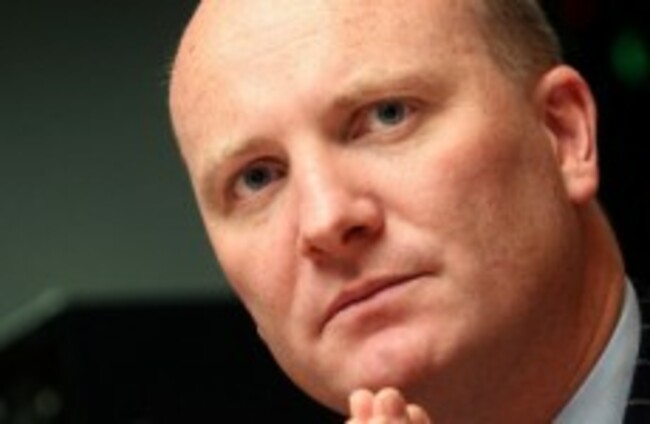
    Very cheeky photo of Declan Ganley in prayerful mode, by the way. Kudos to your photo ed.

    Reply
  • Pascal Mcdaid 14/10/10 #
    Report this comment

    buaic cruthú gaillimhe lámh gaél as béarla http://www.binnsinn.com

    Reply
  • Conor McHugh 14/10/10 #
    Report this comment

    As creepy right wing nonsense goes, it’s unimaginative.

    Reply
  • Alan Farrell 18/10/10 #
    Report this comment

    I was never pro Lisbon , however when Mr Ganley said the only jobs that would be going , would be going the Politician’s way he was 100% correct . Europe is a good forum for a larger trading block but its proving disastrous for countries like Ireland as Political Union draws closer . The simple sad fact is that if we created 100,000 jobs next week in Ireland , there would be 200.000 East Europeans here to fill them with cheap labour . Allowing the accession countries enter our labour market was just another short sighted policy dreamed up by Bertie Ahern to provide cheap labour for his friend’s the developer’s.

    Reply

Add New Comment