We need your help now

Support from readers like you keeps The Journal open.

You are visiting us because we have something you value. Independent, unbiased news that tells the truth. Advertising revenue goes some way to support our mission, but this year it has not been enough.

If you've seen value in our reporting, please contribute what you can, so we can continue to produce accurate and meaningful journalism. For everyone who needs it.

Alamy Stock Photo

'Liberation Day' and its fallout Trump thrives on the uncertainty and chaos he's created

Our columnist assesses the new world we’re all waking up to this morning, The World According to Trump.

IT’S THE ORDINARY preface for anyone lacking the requisite training in what is often pejoratively labelled “the dismal science” to set out prior to commenting, so let me abide by convention. I’m not an economist, but…

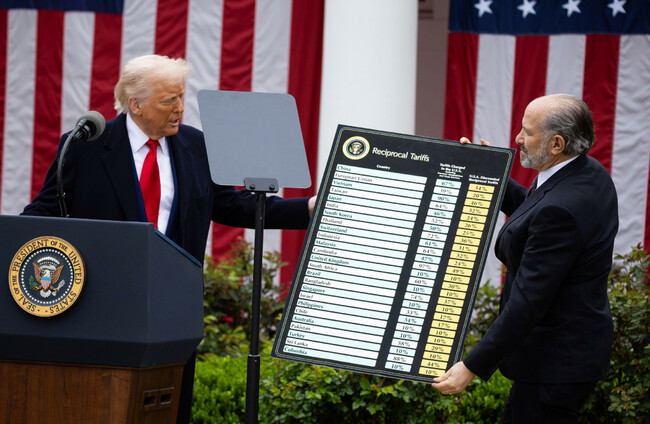
“Liberation Day” is in the history books. President Donald Trump, with the aid of a small chart in windy conditions in the White House’s fabled Rose Garden, finally revealed the precise contours of the tariffs he intends to impose on imports to the United States: 10%, as a baseline, 34% on China, 20% on the European Union, etc, etc.

He did so in front of a diverse crowd – ranging from American autoworkers, to businesspeople, to high ranking members of the US Senate and House of Representatives, to his cabinet secretaries. The 10% tariff comes into effect on the 5th; the upper figures are to be implemented on the 9th. The period for negotiating less unsettling and damaging alternatives is exceedingly brief.

And just about every credible economist is convinced that these tariffs will have a profoundly negative impact on the world and its inhabitants. So what is President Trump – whose approval ratings are, in light of his extreme words and deeds since 20 January, relatively robust at 47.7% in RealClearPolitics.com aggregated data – at with this gambit?

Bring them to heel

An objective analysis suggests that, while he may be fulfilling a campaign pledge by ploughing ahead, these tariffs are not necessary and entail a major risk. So why do it – apart from a frightening, albeit rather conspiratorial, proposition offered by US Senator Chris Murphy that they are a tool “to compel loyalty from every business that will need to petition Trump for relief?”

Crucially, what is animating the bombastic billionaire is a deep conviction that the US gets screwed on the global stage by friends and foes alike. Tariffs are, in his mind, a forceful means of righting that wrong. Backers of these punitive measures, including the influential Peter Navarro, maintain, despite perceived wisdom and precedent, that they will benefit their country immensely.

Importers will not pass significant costs on to Americans because it is the “indispensable market”; they will instead suck up most of the bill and still make a profit. The tariffs will generate enormous sums for the government coffers and will facilitate huge tax cuts. Simultaneously, US corporations, to evade tariffs, will repatriate operations, jobs and tax revenue home. Goods manufactured there will enjoy a competitive advantage and a new golden age will commence.

It warrants repeating: this ideal scenario would seem to depend on a de facto suspension of the central tenets of economics and the chance of its arising is vigorously denied, near unanimously, by the experts. It appears far more likely that consumers will be adversely affected, that economic activity will shrink, and that widespread recession will follow. The probability of the latter has increased dramatically during the past 24 hours according to many forecasts.

Playing with fire

President Trump is uniquely exposed, and arguably a victim of his own success, in the event that Americans start to feel harsh consequences swiftly. He has admitted that there might be “disturbance” in the wake of tariffs. This anticipated blow, in the form of having to pay more for goods and services, can be shouldered for a time by traditional, affluent Republican voters. That numerous swathe of less well to do individuals and families who comprise a vital component of the unwieldy Trump coalition cannot do so. One would suspect that they will turn on the man they believed was their saviour if their pre-existing struggles worsen.

GOP officeholders and aspirants whose names will be on the ballot in 2026 recognise this reality and are reported to be very apprehensive behind the scenes regarding the tariffs. They won’t speak publicly for fear of offending the man their core supporters would lie down in traffic for. And President Trump’s political calculus as to the thoughts of the faithful at the moment is captured by Fox News columnist David Marcus.

This “had to happen sometime. So, why not by a president who isn’t running again? If it’s a disaster a year from now, then Democrats will storm back into power. But that’s the risk, there is also potential reward. We’ll see.” And conservatives who disdain tariffs continue to assert that there is “no cause for panic.”

Blowback for Ireland

In Ireland, the pharmaceutical industry may have received a temporary reprieve. Commerce Secretary Howard Lutnick and others have made it abundantly clear that temporary is the key word. There is a lot of merit to the points that the extent of long-term investment that has been made in Ireland cannot be overestimated and that this crisis of finite duration can be mitigated.

That said, future expenditure – not solely by pharmaceutical companies – here is in jeopardy and there may be an imminent relocation of some production, employment and tax liability as a conciliatory gesture. And this is without contemplating the prospect that President Trump and the US Congress could seek to amend relevant provisions of federal law that allow corporate entities to easily avail of more favourable tax regimes.

Irish exporters of food and drink to the US are undoubtedly worried about their viability. Job losses look unavoidable. Frantic discussions within the European Union will occur to stave off the worst, and Irish officials will put forward our specific case, even as there is internal dissonance in the most appropriate approach and response to tariffs, especially with respect to the tech sector. How open the Trump administration is to negotiating is anyone’s guess.

In sum, this is economic upheaval, “big league” in the lingo of the man who has created it. The sense of uncertainty and chaos, which President Trump evidently thrives off, is inescapable. On “Liberation Day,” as he was heard to proclaim to a massive international audience of stakeholders hanging on his every utterance, he kept a campaign promise he made to the American people.

We’ll soon discover, perhaps quite painfully, whether they wish Donald Trump had been lying, as is his wont, on tariffs.

Larry Donnelly is a Boston lawyer, a Law Lecturer at the University of Galway and a political columnist with TheJournal.ie.

Readers like you are keeping these stories free for everyone...
A mix of advertising and supporting contributions helps keep paywalls away from valuable information like this article. Over 5,000 readers like you have already stepped up and support us with a monthly payment or a once-off donation.

Close
36 Comments
This is YOUR comments community. Stay civil, stay constructive, stay on topic. Please familiarise yourself with our comments policy here before taking part.
Leave a Comment
    Submit a report
    Please help us understand how this comment violates our community guidelines.
    Thank you for the feedback
    Your feedback has been sent to our team for review.

    Leave a commentcancel

     
    JournalTv
    News in 60 seconds