We need your help now

Support from readers like you keeps The Journal open.

You are visiting us because we have something you value. Independent, unbiased news that tells the truth. Advertising revenue goes some way to support our mission, but this year it has not been enough.

If you've seen value in our reporting, please contribute what you can, so we can continue to produce accurate and meaningful journalism. For everyone who needs it.

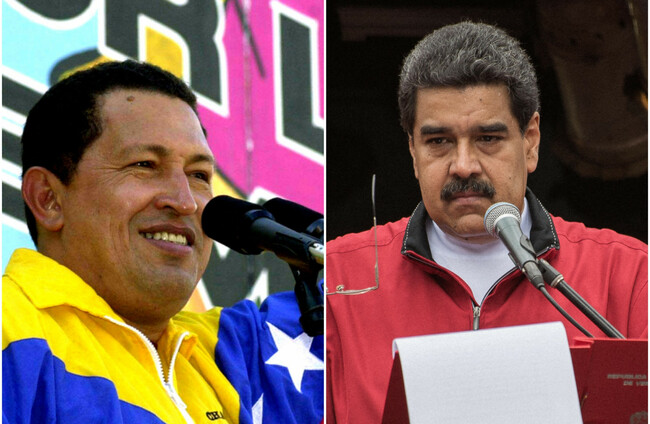
Hugo Chavez, left, ran Venezuela before Nicolás Maduro.

Venezuelan woman in Ireland Trump has raised alarms, but Maduro deserves no sympathy

No matter what happens next, Liliana Fernández says many Venezuelans will just not weep for Maduro.

LAST UPDATE | 9 Jan

THERE’S NO DOUBT that so many people are sharing differing views on recent events in Venezuela. The sudden military operation by the US took everyone around the world by surprise, except for most Venezuelans, who were keenly waiting for this moment for months, if not years.

I was nine years old when I attended my first protest against the late Hugo Chávez (Maduro’s predecessor and mentor), even though most of my family were Chavistas back then, part of the many who supported Nicolás Maduro’s predecessor, Hugo Chávez. I hated the arrogance of Chavistas back in the days when oil prices were very high, and they created their unique political apartheid for those opposing Chávez; people were required to be a party member or loyal to him to be able to access public jobs, government contracts or even public services, such as subsidised food and social housing.

Some believe that the end of Maduro’s regime is a dangerous and worrying turn for Venezuela, and that Donald Trump’s military extraction of Maduro marks a dark departure from the international rule of law. Others will tell you that Venezuela is far better off under US ‘rule’ than one more day under Maduro.

Unfortunately, most Venezuelans are so desperate for regime change that they do not even question Trump’s reported greed over our country’s natural resources and genuinely think that he is there to help us. All of the above is true, and we should question it all.

Why do we celebrate the end of Maduro?

For me, and many others, whatever way you weigh it up, Maduro’s regime repressed and tortured thousands of people and financially strangled our economy, leading people to complete humiliation and starvation. Millions of Venezuelans have celebrated the overthrow of Maduro as a dictator and have largely not questioned the interests of the United States in our territory. This is partly because our country has endured such devastating economic, humanitarian and political crises for many years, as a result of an authoritarian regime that began under Chávez and continued under Maduro after Chávez’s death in 2013.

While people abroad question the US violation of international law through military intervention, Venezuelans see it as a possible opportunity to end the daily human rights violations carried out by their own government’s military and intelligence forces.

Ultimately, the oil revenues that many people worry about have never reached regular Venezuelans’ pockets under Maduro, especially since oil prices plunged in 2014, way before US oil sanctions. Venezuelans have tried everything humanly possible to be ruled by a legitimate Venezuelan government that truly cares about the country’s development and the improvement of its people’s living conditions. Today, 50% of the population lives in extreme poverty, earning an average minimum monthly salary of €2.50. Our families in Venezuela literally survive because we send remittances from abroad.

The Trump effect

Are we guaranteed a better outcome through US intervention? No. Unfortunately, we are dealing with a US administration that clearly prioritises American economic interests over the political and humanitarian crisis facing Venezuelans, which often makes decisions without authorisation from Congress.

The US breach of International law also brings geopolitical challenges in its treatment of our continent as a backyard. This is a stance most recently outlined in the US National Security Strategy in November 2025, which calls to “reassert and enforce the Monroe Doctrine to restore American preeminence in the Western Hemisphere.”

As Venezuelans, we may feel hopeful on the one hand that Maduro’s removal could mean recovering our country from misery and from the constant threats faced by those who oppose the regime. On the other hand, we may feel deeply concerned about the intentions of the Trump administration and the lack of clarity surrounding the transfer of power to our opposition leaders — overwhelmingly backed by the Venezuelan people after winning a landslide majority in last year’s presidential elections. They were utterly ignored and stolen by Maduro’s 26-year-long regime.

We must remain hopeful, however, that our opposition leaders will attempt to fill the democratic vacuum that has been left and will push to be included in the negotiation process from an early stage. We hope they will work towards a power transition that places the interests of the Venezuelan people above all else.

What next for Venezuela?

After Maduro’s capture by the US on 3 January, his regime released a national decree granting emergency powers to the head of state to detain any person in Venezuela who celebrated or supported Trump’s actions.

Article 5 reads “The national, state, and municipal police bodies shall immediately undertake the search for and arrest, throughout the entire national territory, of any person involved in the promotion or support of the armed attack by the United States of America against the territory of the Republic”.

At least 14 journalists were arrested, and more than 65 civilians were arbitrarily detained. In terms of the next phase, the US Secretary of State, Marco Rubio, finally revealed yesterday a three-phase plan for a transition in Venezuela which, according to him, “will benefit the Venezuelan people, not corruption, not the regime.”

The plan consists of three phases: “stabilisation,” “recovery,” and “transition.” In the first phase, the United States would take between 30 and 50 million barrels of oil and sell them on the market, while controlling how the revenues are distributed. According to Rubio, it is only in the second phase that the process would involve opposition leaders, address amnesties, and consider the release of political prisoners. He did not provide much detail about the third phase, but noted that there may be some overlap between the first two phases.

This plan seems to be mainly focused on the US economic interests above the political and humanitarian crisis facing Venezuelans. Local people understand there is no such thing as a free lunch, and the United States will seek to take a significant share of our resources, as they seem to be doing already.

Opposition matters

We must remain very critical of the entire process as Venezuelans and demand the prioritisation of the immediate release of political prisoners, as well as the inclusion of Venezuelan opposition leaders in all negotiations. Having said that, a few days ago and in the midst of this chaos, Donald Trump dismissed the importance of the main opposition leader, María Corina Machado, claiming that she does not have the support of the Venezuelan people.

This is ultimately not true. Whether or not one agrees with her conservative politics, she has the backing of the vast majority of Venezuelans, both inside the country and in the diaspora. However, Machado may have missed a political opportunity to present herself with a plan, possibly as a peace guarantor, as the recent Nobel Peace Prize recipient, and to advocate for a peaceful democratic transition in Venezuela.

By doing so, she could have strengthened the role of Venezuelan opposition leaders as key players in the early negotiations between the US administration and Delcy Rodríguez (Maduro’s successor). There is an uncomfortable silence among the population regarding Machado’s lack of leadership, direction and guidance at a time when people’s tension and fear over the unknown are palpable.

Additionally, a number of people in my home country and abroad believe there may be a conspiracy behind the smooth removal of Maduro — carried out without major military upheaval — and the rapid swearing-in of Delcy Rodríguez as interim president. These events have raised suspicions that Maduro’s closest allies may have been the ones who effectively handed him over to the United States. Internally, there appears to be significant power tension among key and potentially dangerous figures within the regime, all competing to remain in control of the country in exchange for continued access to Venezuela’s oil market and favourable terms with Trump.

Therefore, our demands as Venezuelans should focus on accountability and on ensuring a transparent, internationally monitored transition in Venezuela, with opposition leaders playing a central role in negotiations and decision-making. We must continue to pressure for the immediate release of political prisoners and question why this is not being prioritised in the first place within the US threefold process. How can we ensure that opposition leaders are meaningfully involved in negotiations, and will they truly be able -and willing — to protect the country from having all its resources extracted by the United States?

We must also ask what will happen to the key actors within Maduro’s regime who control the military, oil and strategic positions in government and ask how much time will pass until new elections are called. Who and how will oil royalties and contracts be negotiated, and how can we ensure that these resources are distributed fairly among the Venezuelan people while taking environmental consequences into account?

“A wealthy country”

Venezuela has potentially the biggest oil reservoirs in the world, but its extraction will take years and billions of dollars in investments. I believe that once in power, opposition leaders should be focusing on discussions about a transition to green energy rather than promoting a “drill, baby, drill” approach, which would have tragic consequences for the planet and for local communities.

Unfortunately, without opposition leaders taking an early stand in this negotiation and transition process, there is no one truly safeguarding the interests of the Venezuelan people, and that is deeply concerning. Also, we must ask: if the US truly cared about Venezuelans, shouldn’t they be acting as negotiators and middlemen, instead of attempting to “run” our country?

So, while you watch all of this play out on your screens in the coming weeks, try to consider all of these concerns that we have. Venezuela is a complex case, so we must be sensitive to its people while remaining critical throughout this process.

I am not sure what Trump’s intervention will mean for us and the rest of the region, long-term, but I can say one thing for sure: you will find it difficult to find a single Venezuelan here or there who will weep for Maduro and his friends.

Liliana is an equal rights activist for underrepresented groups in Irish democracy.

Readers like you are keeping these stories free for everyone...
A mix of advertising and supporting contributions helps keep paywalls away from valuable information like this article. Over 5,000 readers like you have already stepped up and support us with a monthly payment or a once-off donation.

Close
JournalTv
News in 60 seconds