TheJournal.ie uses cookies. By continuing to browse this site you are agreeing to our use of cookies. Click here to find out more »
Dublin: 10 °C Saturday 25 May, 2013

Taoiseach urged to press Cameron on Troubles legacy

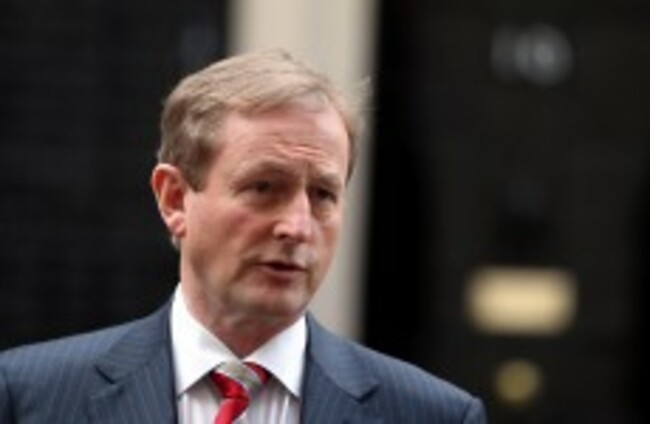
Enda Kenny is due to travel to London tomorrow for meetings with the UK prime minister.

Enda Kenny speaking outside Downing Street after a meeting in January
Image: Sean Dempsey/PA Wire/Press Association Images

TAOISEACH ENDA KENNY has been urged to press UK prime minister David Cameron to take action on the legacy of the conflict in Northern Ireland, when the leaders meet in London tomorrow.

The Taoiseach will travel to 10 Downing Street tomorrow for a meeting which Kenny has said will focus on trade links.

However, Sinn Féin president Gerry Adams has said the meeting is an opportunity to press for action on disputed issues arising from the Troubles.

He said the UK government had refused to honour commitments in the Good Friday, Weston Park and St Andrew’s Agreements, adding: “Mr Kenny needs to tell David Cameron that this is unacceptable.”

Adams cited calls for inquiries into several incidents including the murder of solicitor Pat Finucane, the Dublin and Monaghan bombings, and the 1971 Ballymurphy Massacre, in which 11 people were killed by British security forces in Belfast.

He claimed Cameron had stepped away from the peace process since coming into power.

“Since the election of the Tory/Lib Dem coalition the British prime minister has detached himself from the continuing promotion and development of the peace and political processes,” Adams said.

The Taoiseach also needs to impress on the British Prime Minister the need to bring forward a timetable for the implementation of all of the outstanding aspects of the Good Friday, Weston Park and St. Andrews Agreements.

Adams said other issues included the need for a Bill of Rights and an Irish Language Act in the North.

More: Referendum on united Ireland ‘inevitable’ – Adams>

Read next:

Comments (26 Comments)

  • I cannot understand the attitude of successive southern governments in relation to the Dublin/ Monaghan bombings. You can bet your last euro that if the southern government were implicated in a bomb attack on British soil the situation would be different. I truly hope that Enda Kenny shows the moral fortitude that previous Taoisigh did not and presses Cameron for co-operation on this matter. Anything less and he is failing the people of Dublin and Monaghan affected by the attacks.

    Reply
  • The Barron Report 2003 “The Government of the day showed little interest in the bombings. When information was given to them suggesting the British authorities had intelligence naming the bombers, this was not followed up.”

    Can you see a FG/Lab really investigating a former FG/Lab coalition?

    Reply
  • Kenny Chickened out of the Chinese human rights issues, so if you believe that he is going to do this with Cameron forget it!

    Reply
    • We have absolutely no influence over china, but the UK and Ireland are heavily dependant on each other economically. Enda lecturing the Chinese would be like bringing a tickle-me elmo to a shooting range.

      Reply
  • Mr Adams is right to be concerned about laxity surrounding inquiries into various atrocities but he needs to look in the mirror every morning.

    Reply
  • “To take action on the legacy of the conflict in Northern Ireland”.
    I respectfully suggest that Mr.Adams change the record and concentrate on issues that will benefit the all people living on this island presently. I think it is unlikely that a British prime minister will vindicate the Provisional IRA activities during the troubles and just as unlikely that Enda Kenny will ask him to do so.

    Reply
  • the terrorist needs to shut up. His hypocrisy is sickening

    Reply
  • Adems of SF/IRA is a legacy of the North and we have to listen to this psychopath and his fellow assassins who sent letter bombs and planted more bombs that killed and maimed kids and adults. This guy and his followers have cost more than the bank bailout will ever cost this country The cheek of him to lecture or advise on how to behave – Shut up Adems and stay up there with your killer friends.

    Reply
  • IRISH GOVERNMENT DRAFT LEGISLATION TO AMEND THE CONSTITUTION.
    Add to Article 29 the following sections:
    7.
    1. The State may consent to be bound by the British-Irish Agreement done at Belfast on the day of 1998, hereinafter called the Agreement.
    2. Any institution established by or under the Agreement may exercise the powers and functions thereby conferred on it in respect of all or any part of the island of Ireland notwithstanding any other provision of this Constitution conferring a like power or function on any person or any organ of State appointed under or created or established by or under this Constitution. Any power or function conferred on such an institution in relation to the settlement or resolution of disputes or controversies may be in addition to or in substitution for any like power or function conferred by this C
    onstitution on any such person or organ of State as aforesaid.
    3. If the Government declare that the State has become obliged, pursuant to the Agreement, to give effect to the amendment of this Constitution referred to therein, then, notwithstanding Article 46 hereof, this Constitution shall be amended as follows:
    i. the following Articles shall be substituted for Articles 2 and 3 of the Irish text:
    “2. [Irish text to be inserted here].
    3. [Irish text to be inserted here]“.
    ii. the following Articles shall be substituted for Articles 2 and 3 of the English text:

    “Article 2

    It is the entitlement and birthright of every person born in the island of Ireland, which includes its islands and seas, to be part of the Irish nation. That is also the entitlement of all persons otherwise qualified in accordance with law to be citizens of Ireland. Furthermore, the Irish nation cherishes its special affinity with people of Irish ancestry living abroad who share its cultural identity and heritage.

    Article 3
    1. It is the firm will of the Irish nation, in harmony and friendship, to unite all the people who share the territory of the island of Ireland, in all the diversity of their identities and traditions, recognising that a united Ireland shall be brought about only by peaceful means with the consent of a majority of the people, democratically expressed, in both jurisdictions in the island. Until then, the laws enacted by the Parliament established by this Constitution shall have the like area and extent of application as the laws enacted by the Parliament that existed immediately before the coming into operation of this Constitution.
    2. Institutions with executive powers and functions that are shared between those jurisdictions may be established by their respective responsible authorities for stated purposes and may exercise powers and functions in respect of all or any part of the island.”
    iii.
    the following section shall be added to the Irish text of this Article:
    “8. [Irish text to be inserted here]“.
    and
    iv. the following section shall be added to the English text of this Article:
    “8. The State may exercise extra-territorial jurisdiction in accordance with the generally recognised principles of international law.”
    4. If a declaration under this section is made, this subsection and subsection 3, other than the amendment of this Constitution effected thereby, and subsection 5 of this section shall be omitted from every official text of this Constitution published thereafter, but notwithstanding such omission this section shall continue to have the force of law.
    5. If such a declaration is not made within twelve months of this section being added to this Constitution or such longer period as may be provided for by law, this section shall cease to have effect and shall be omitted from every official text of this Constitution published thereafter.
    STRAND ONE
    DEMOCRATIC INSTITUTIONS IN NORTHERN IRELAND.
    1. This agreement provides for a democratically elected Assembly in Northern Ireland which is inclusive in its membership, capable of exercising executive and legislative authority, and subject to safeguards to protect the rights and interests of all sides of the community.
    The Assembly
    2. A 108-member Assembly will be elected by PR(STV) from existing Westminster constituencies.
    3. The Assembly will exercise full legislative and executive authority in respect of those matters currently within the responsibility of the six Northern Ireland Government Departments, with the possibility of taking on responsibility for other matters as detailed elsewhere in this agreement.
    4. The Assembly – operating where appropriate on a cross-community basis – will be the prime source of authority in respect of all devolved responsibilities.
    Safeguards
    5. There will be safeguards to ensure that all sections of the community can participate and work together successfully in the operation of these institutions and that all sections of the community are protected, including:
    (a) allocations of Committee Chairs, Ministers and Committee membership in proportion to party strengths;.
    (b) the European Convention on Human Rights (ECHR) and any Bill of Rights for Northern Ireland supplementing it, which neither the Assembly nor public bodies can infringe, together with a Human Rights Commission;.
    (c) arrangements to provide that key decisions and legislation are proofed to ensure that they do not infringe the ECHR and any Bill of Rights for Northern Ireland;.
    (d) arrangements to ensure key decisions are taken on a cross-community basis;.
    (i) either parallel consent, i.e. a majority of those members present and voting, including a majority of the unionist and nationalist designations present and voting;.
    (ii) or a weighted majority (60%) of members present and voting, including at least 40% of each of the nationalist and unionist designations present and voting.
    Key decisions requiring cross-community support will be designated in advance, including election of the Chair of the Assembly, the First Minister and Deputy First Minister, standing orders and budget allocations. In other cases such decisions could be triggered by a petition of concern brought by a significant minority of Assembly members (30/108).
    (e) an Equality Commission to monitor a statutory obligation to promote equality of opportunity in specified areas and parity of esteem between the two main communities, and to investigate individual complaints against public bodies.
    Operation of the Assembly.
    6. At their first meeting, members of the Assembly will register a designation of identity – nationalist, unionist or other – for the purposes of measuring cross-community support in Assembly votes under the relevant provisions above.
    7. The Chair and Deputy Chair of the Assembly will be elected on a cross-community basis, as set out in paragraph 5(d) above.
    8. There will be a Committee for each of the main executive functions of the Northern Ireland Administration. The Chairs and Deputy Chairs of the Assembly Committees will be allocated proportionally, using the d’Hondt system. Membership of the Committees will be in broad proportion to party strengths in the Assembly to ensure that the opportunity of Committee places is available to all members.
    9. The Committees will have a scrutiny, policy development and consultation role with respect to the Department with which each is associated, and will have a role in initiation of legislation. They will have the power to:
    • consider and advise on Departmental budgets and Annual Plans in the context of the overall budget allocation;.
    • approve relevant secondary legislation and take the Committee stage of relevant primary legislation;.
    • call for persons and papers;.
    • initiate enquiries and make reports;.
    • consider and advise on matters brought to the Committee by its.
    10. Standing Committees other than Departmental Committees may be established as may be required from time to time.
    11. The Assembly may appoint a special Committee to examine and report on whether a measure or proposal for legislation is in conformity with equality requirements, including the ECHR/Bill of Rights. The Committee shall have the power to call people and papers to assist in its consideration of the matter. The Assembly shall then consider the report of the Committee and can determine the matter in accordance with the cross-community consent procedure.
    12. The above special procedure shall be followed when requested by the Executive Committee, or by the relevant Departmental Committee, voting on a cross-community basis.
    13. When there is a petition of concern as in 5(d) above, the Assembly shall vote to determine whether the measure may proceed without reference to this special procedure. If this fails to achieve support on a cross-community basis, as in 5(d)(i) above, the special procedure shall be followed.
    Executive Authority
    14. Executive authority to be discharged on behalf of the Assembly by a First Minister
    and Deputy First Minister and up to ten Ministers with Departmental responsibilities.
    15. The First Minister and Deputy First Minister shall be jointly elected into office by the Assembly voting on a cross-community basis, according to 5(d)(i) above.
    16. Following the election of the First Minister and Deputy First Minister, the posts of Ministers will be allocated to parties on the basis of the d’Hondt system by reference to the number of seats each party has in the Assembly.
    17. The Ministers will constitute an Executive Committee, which will be convened, and presided over, by the First Minister and Deputy First Minister.
    18. The duties of the First Minister and Deputy First Minister will include, inter alia, dealing with and co-ordinating the work of the Executive Committee and the response of the Northern Ireland administration to external relationships.
    19. The Executive Committee will provide a forum for the discussion of, and agreement on, issues which cut across the responsibilities of two or more Ministers, for prioritising executive and legislative proposals and for recommending a common position where necessary (e.g. in dealing with external relationships).
    20. The Executive Committee will seek to agree each year, and review as necessary, a programme incorporating an agreed budget linked to policies and programmes, subject to approval by the Assembly, after scrutiny in Assembly Committees, on a cross-community basis.
    21. A party may decline the opportunity to nominate a person to serve as a Minister or may subsequently change its nominee.
    22. All the Northern Ireland Departments will be headed by a Minister. All Ministers will liaise regularly with their respective Committee.
    23. As a condition of appointment, Ministers, including the First Minister and Deputy First Minister, will affirm the terms of a Pledge of Office (Annex A) undertaking to discharge effectively and in good faith all the responsibilities attaching to their office.
    24. Ministers will have full executive authority in their respective areas of responsibility, within any broad programme agreed by the Executive Committee and endorsed by the Assembly as a whole.
    25. An individual may be removed from office following a decision of the Assembly taken on a cross-community basis, if (s)he loses the confidence of the Assembly, voting on a cross-community basis, for failure to meet his or her responsibilities including, inter alia, those set out in the Pledge of Office. Those who hold office should use only democratic, non-violent means, and those who do not should be excluded or removed from office under these provisions.
    Legislation
    Minister.

    26. The Assembly will have authority to pass primary legislation for Northern Ireland in devolved areas, subject to:
    (a) the ECHR and any Bill of Rights for Northern Ireland supplementing it which, if the courts found to be breached, would render the relevant legislation null and void;
    (b) decisions by simple majority of members voting, except when decision on a cross-community basis is required;
    (c) detailed scrutiny and approval in the relevant Departmental Committee;
    (d) mechanisms, based on arrangements proposed for the Scottish Parliament, to ensure suitable co-ordination, and avoid disputes, between the Assembly and the Westminster Parliament;
    (e) option of the Assembly seeking to include Northern Ireland provisions in United Kingdom-wide legislation in the Westminster Parliament, especially on devolved issues where parity is normally maintained (e.g. social security, company law).
    27. The Assembly will have authority to legislate in reserved areas with the approval of the Secretary of State and subject to Parliamentary control.
    28. Disputes over legislative competence will be decided by the Courts.
    29. Legislation could be initiated by an individual, a Committee or a Minister.
    Relations with other institutions
    30. Arrangements to represent the Assembly as a whole, at Summit level and in dealings with other institutions, will be in accordance with paragraph 18, and will be such as to ensure cross-community involvement.
    31. Terms will be agreed between appropriate Assembly representatives and the Government of the United Kingdom to ensure effective co-ordination and input by Ministers to national policy-making, including on EU issues.
    32. Role of Secretary of State:
    (a) to remain responsible for NIO matters not devolved to the Assembly, subject to regular consultation with the Assembly and Ministers;
    (b) to approve and lay before the Westminster Parliament any Assembly legislation on reserved matters;
    (c) to represent Northern Ireland interests in the United Kingdom Cabinet;
    (d) to have the right to attend the Assembly at their invitation.
    33. The Westminster Parliament (whose power to make legislation for Northern Ireland would remain unaffected) will:
    (a) legislate for non-devolved issues, other than where the Assembly legislates with the approval of the Secretary of State and subject to the control of Parliament;
    (b) to legislate as necessary to ensure the United Kingdom’s international obligations are met in respect of Northern Ireland;
    (c) scrutinise, including through the Northern Ireland Grand and Select Committees, the responsibilities of the Secretary of State.
    34. A consultative Civic Forum will be established. It will comprise representatives of the business, trade union and voluntary sectors, and such other sectors as agreed by the First Minister and the Deputy First Minister. It will act as a consultative mechanism on social, economic and cultural issues. The First Minister and the Deputy First Minister will by agreement provide administrative support for the Civic Forum and establish guidelines for the selection of representatives to the Civic Forum.
    Transitional Arrangements
    35. The Assembly will meet first for the purpose of organisation, without legislative or executive powers, to resolve its standing orders and working practices and make preparations for the effective functioning of the Assembly, the British-Irish Council and the North/South Ministerial Council and associated implementation bodies. In this transitional period, those members of the Assembly serving as shadow Ministers shall affirm their commitment to non-violence and exclusively peaceful and democratic means and their opposition to any use or threat of force by others for any political purpose; to work in good faith to bring the new arrangements into being; and to observe the spirit of the Pledge of Office applying to appointed Ministers.
    Review
    36. After a specified period there will be a review of these arrangements, including the details of electoral arrangements and of the Assembly’s procedures, with a view to agreeing any adjustments necessary in the interests of efficiency and fairness.
    Annex A
    Pledge of Office
    To pledge:
    (a) to discharge in good faith all the duties of office;
    (b) commitment to non-violence and exclusively peaceful and democratic means;
    (c) to serve all the people of Northern Ireland equally, and to act in accordance with the general obligations on government to promote equality and prevent discrimination;
    (d) to participate with colleagues in the preparation of a programme for government;
    (e) to operate within the framework of that programme when agreed within the Executive Committee and endorsed by the Assembly;
    (f) to support, and to act in accordance with, all decisions of the Executive Committee and Assembly;
    (g) to comply with the Ministerial Code of Conduct.
    CODE OF CONDUCT
    Ministers must at all times:
    • observe the highest standards of propriety and regularity involving impartiality, integrity and objectivity in relationship to the steconstituencyship of public funds;
    • be accountable to users of services, the community and, through the Assembly, for the activities within their responsibilities, their steconstituencyship of public funds and the extent to which key performance targets and objectives have been met;
    • ensure all reasonable requests for information from the Assembly, users of services and individual citizens are complied with; and that Departments and their staff conduct their dealings with the public in an open and responsible way;
    • follow the seven principles of public life set out by the Committee on Standards in Public Life;
    • comply with this code and with rules relating to the use of public funds;
    • operate in a way conducive to promoting good community relations and equality of treatment;
    • not use information gained in the course of their service for personal gain; nor seek to use the opportunity of public service to promote their private interests;
    • ensure they comply with any rules on the acceptance of gifts and hospitality that might be offered;
    • declare any personal or business interests which may conflict with their responsibilities. The Assembly will retain a Register of Interests. Individuals must ensure that any direct or indirect pecuniary interests which members of the public might reasonably think could influence their judgement are listed in the Register of Interests;
    STRAND TWO

    NORTH/SOUTH MINISTERIAL COUNCIL
    1. Under a new British/Irish Agreement dealing with the totality of relationships, and related legislation at Westminster and in the Oireachtas, a North/South Ministerial Council to be established to bring together those with executive responsibilities in Northern Ireland and the Irish Government, to develop consultation, co-operation and action within the island of Ireland – including through implementation on an all-island and cross-border basis – on matters of mutual interest within the competence of the Administrations, North and South.
    2. All Council decisions to be by agreement between the two sides. Northern Ireland to be represented by the First Minister, Deputy First Minister and any relevant Ministers, the Irish Government by the Taoiseach and relevant Ministers, all operating in accordance with the rules for democratic authority and accountability in force in the Northern Ireland Assembly and the Oireachtas respectively. Participation in the Council to be one of the essential responsibilities attaching to relevant posts in the two Administrations. If a holder of a relevant post will not participate normally in the Council, the Taoiseach in the case of the Irish Government and the First and Deputy First Minister in the case of the Northern Ireland Administration to be able to make alternative arrangements.
    3. The Council to meet in different formats:
    (i) in plenary format twice a year, with Northern Ireland representation led by the First Minister and Deputy First Minister and the Irish Government led by the Taoiseach;
    (ii) in specific sectoral formats on a regular and frequent basis with each side represented by the appropriate Minister;
    (iii) in an appropriate format to consider institutional or cross-sectoral matters (including in relation to the EU) and to resolve disagreement.
    4. Agendas for all meetings to be settled by prior agreement between the two sides, but it will be open to either to propose any matter for consideration or action.
    5. The Council:

    (i) to exchange information, discuss and consult with a view to co-operating on matters of mutual interest within the competence of both Administrations, North and South;
    (ii) to use best endeavours to reach agreement on the adoption of common policies, in areas where there is a mutual cross-border and all-island benefit, and which are within the competence of both Administrations, North and South, making determined efforts to overcome any disagreements;
    (iii) to take decisions by agreement on policies for implementation separately in each jurisdiction, in relevant meaningful areas within the competence of both Administrations, North and South;
    (iv) to take decisions by agreement on policies and action at an all-island and cross-border level to be implemented by the bodies to be established as set out in paragraphs 8 and 9 below.
    6. Each side to be in a position to take decisions in the Council within the defined authority of those attending, through the arrangements in place for co-ordination of executive functions within each jurisdiction. Each side to remain accountable to the Assembly and Oireachtas respectively, whose approval, through the arrangements in place on either side, would be required for decisions beyond the defined authority of those attending.
    7. As soon as practically possible after elections to the Northern Ireland Assembly, inaugural meetings will take place of the Assembly, the British/Irish Council and the North/South Ministerial Council in their transitional forms. All three institutions will meet regularly and frequently on this basis during the period between the elections to the Assembly, and the transfer of powers to the Assembly, in order to establish their modus operandi.
    8. During the transitional period between the elections to the Northern Ireland Assembly and the transfer of power to it, representatives of the Northern Ireland transitional Administration and the Irish Government operating in the North/South Ministerial Council will undertake a work programme, in consultation with the British Government, covering at least 12 subject areas, with a view to identifying and agreeing by 31 October 1998 areas where co-operation and implementation for mutual benefit will take place. Such areas may include matters in the list set out in the Annex.
    9. As part of the work programme, the Council will identify and agree at least 6 matters for co-operation and implementation in each of the following categories:
    (I) Matters where existing bodies will be the appropriate mechanisms for co-operation in each separate jurisdiction;
    (ii) Matters where the co-operation will take place through agreed implementation bodies on a cross-border or all-island level.
    10. The two Governments will make necessary legislative and other enabling preparations to ensure, as an absolute commitment, that these bodies, which have been agreed as a result of the work programme, function at the time of the inception of the British-Irish Agreement and the transfer of powers, with legislative authority for these bodies transferred to the Assembly as soon as possible thereafter. Other arrangements for the agreed co-operation will also commence contemporaneously with the transfer of powers to the Assembly.

    11. The implementation bodies will have a clear operational remit. They will implement on an all-island and cross-border basis policies agreed in the Council.
    12. Any further development of these arrangements to be by agreement in the Council and with the specific endorsement of the Northern Ireland Assembly and Oireachtas, subject to the extent of the competences and responsibility of the two Administrations.
    13. It is understood that the North/South Ministerial Council and the Northern Ireland Assembly are mutually inter-dependent, and that one cannot successfully function without the other.
    14. Disagreements within the Council to be addressed in the format described at paragraph 3(iii) above or in the plenary format. By agreement between the two sides, experts could be appointed to consider a particular matter and report.
    15. Funding to be provided by the two Administrations on the basis that the Council and the implementation bodies constitute a necessary public function.
    16. The Council to be supported by a standing joint Secretariat, staffed by members of the Northern Ireland Civil Service and the Irish Civil Service.
    17. The Council to consider the European Union dimension of relevant matters, including the implementation of EU policies and programmes and proposals under consideration in the EU framework. Arrangements to be made to ensure that the views of the Council are taken into account and represented appropriately at relevant EU meetings.
    18. The Northern Ireland Assembly and the Oireachtas to consider developing a joint parliamentary forum, bringing together equal numbers from both institutions for discussion of matters of mutual interest and concern.
    19. Consideration to be given to the establishment of an independent consultative forum appointed by the two Administrations, representative of civil society, comprising the social partners and other members with expertise in social, cultural, economic and other issues.
    ANNEX
    Areas for North-South co-operation and implementation may include the following:
    1. Agriculture – animal and plant health.
    2. Education – teacher qualifications and exchanges.
    3. Transport – strategic transport planning.
    4. Environment – environmental protection, pollution, water quality, and waste management.
    5. Waterways – inland waterways.
    6. Social Security/Social Welfare – entitlements of cross-border workers and fraud control.
    7. Tourism – promotion, marketing, research, and product development.
    8. Relevant EU Programmes such as SPPR, INTERREG, Leader II and their successors.
    9. Inland Fisheries.
    10. Aquaculture and marine matters
    11. Health: accident and emergency services and other related cross-border issues.
    12. Urban and rural development.
    Others to be considered by the shadow North/ South Council.
    STRAND THREE

    BRITISH-IRISH COUNCIL
    1. A British-Irish Council (BIC) will be established under a new British-Irish Agreement to promote the harmonious and mutually beneficial development of the totality of relationships among the peoples of these islands.
    2. Membership of the BIC will comprise representatives of the British and Irish Governments, devolved institutions in Northern Ireland, Scotland and Wales, when established, and, if appropriate, elsewhere in the United Kingdom, together with representatives of the Isle of Man and the Channel Islands.
    3. The BIC will meet in different formats: at summit level, twice per year; in specific sectoral formats on a regular basis, with each side represented by the appropriate Minister; in an appropriate format to consider cross-sectoral matters.
    4. Representatives of members will operate in accordance with whatever procedures for democratic authority and accountability are in force in their respective elected institutions.
    5. The BIC will exchange information, discuss, consult and use best endeavours to reach agreement on co-operation on matters of mutual interest within the competence of the relevant Administrations. Suitable issues for early discussion in the BIC could include transport links, agricultural issues, environmental issues, cultural issues, health issues, education issues and approaches to EU issues. Suitable arrangements to be made for practical co-operation on agreed policies.
    6. It will be open to the BIC to agree common policies or common actions. Individual members may opt not to participate in such common policies and common action.
    7. The BIC normally will operate by consensus. In relation to decisions on common policies or common actions, including their means of implementation, it will operate by agreement of all members participating in such policies or actions.

    8. The members of the BIC, on a basis to be agreed between them, will provide such financial support as it may require.
    9. A secretariat for the BIC will be provided by the British and Irish Governments in co-ordination with officials of each of the other members.
    10. In addition to the structures provided for under this agreement, it will be open to two or more members to develop bilateral or multilateral arrangements between them. Such arrangements could include, subject to the agreement of the members concerned, mechanisms to enable consultation, co-operation and joint decision-making on matters of mutual interest; and mechanisms to implement any joint decisions they may reach. These arrangements will not require the prior approval of the BIC as a whole and will operate independently of it.
    11. The elected institutions of the members will be encouraged to develop interparliamentary links, perhaps building on the British-Irish Interparliamentary Body.
    12. The full membership of the BIC will keep under review the workings of the Council, including a formal published review at an appropriate time after the Agreement comes into effect, and will contribute as appropriate to any review of the overall political agreement arising from the multi-party negotiations.
    BRITISH-IRISH INTERGOVERNMENTAL CONFERENCE
    1. There will be a new British-Irish Agreement dealing with the totality of relationships. It will establish a standing British-Irish Intergovernmental Conference, which will subsume both the Anglo-Irish Intergovernmental Council and the Intergovernmental Conference established under the 1985 Agreement.
    2. The Conference will bring together the British and Irish Governments to promote bilateral co-operation at all levels on all matters of mutual interest within the competence of both Governments.
    3. The Conference will meet as required at Summit level (Prime Minister and Taoiseach). Otherwise, Governments will be represented by appropriate Ministers. Advisers, including police and security advisers, will attend as appropriate.
    4. All decisions will be by agreement between both Governments. The Governments will make determined efforts to resolve disagreements between them. There will be no derogation from the sovereignty of either Government.

    5. In recognition of the Irish Government’s special interest in Northern Ireland and of the extent to which issues of mutual concern arise in relation to Northern Ireland, there will be regular and frequent meetings of the Conference concerned with non-devolved Northern Ireland matters, on which the Irish Government may put forconstituency views and proposals. These meetings, to be co-chaired by the Minister for Foreign Affairs and the Secretary of State for Northern Ireland, would also deal with all-island and cross-border co-operation on non-devolved issues.
    6. Co-operation within the framework of the Conference will include facilitation of co-operation in security matters. The Conference also will address, in particular, the areas of rights, justice, prisons and policing in Northern Ireland (unless and until responsibility is devolved to a Northern Ireland administration) and will intensify co-operation between the two Governments on the all-island or cross-border aspects of these matters.
    7. Relevant executive members of the Northern Ireland Administration will be involved in meetings of the Conference, and in the reviews referred to in paragraph 9 below to discuss non-devolved Northern Ireland matters.
    8. The Conference will be supported by officials of the British and Irish Governments, including by a standing joint Secretariat of officials dealing with non-devolved Northern Ireland matters.
    9. The Conference will keep under review the workings of the new British-Irish Agreement and the machinery and institutions established under it, including a formal published review three years after the Agreement comes into effect. Representatives of the Northern Ireland Administration will be invited to express views to the Conference in this context. The

    Conference will contribute as appropriate to any review of the overall political agreement arising from the multi-party negotiations but will have no power to override the democratic arrangements set up by this Agreement.
    RIGHTS, SAFEGUARDS AND EQUALITY OF OPPORTUNITY
    Human Rights
    1. The parties affirm their commitment to the mutual respect, the civil rights and the religious liberties of everyone in the community. Against the background of the recent history of communal conflict, the parties affirm in particular:
    • the right of free political thought;
    • the right to freedom and expression of religion;
    • the right to pursue democratically national and political aspirations;
    • the right to seek constitutional change by peaceful and legitimate means;
    • the right to freely choose one’s place of residence;
    • the right to equal opportunity in all social and economic activity, regardless of class, creed, disability, gender or ethnicity;
    • the right to freedom from sectarian harassment; and
    • the right of women to full and equal political participation.
    United Kingdom Legislation
    2. The British Government will complete incorporation into Northern Ireland law of the European Convention on Human Rights (ECHR), with direct access to the courts, and remedies for breach of the Convention, including power for the courts to overrule Assembly legislation on grounds of inconsistency.
    3. Subject to the outcome of public consultation underway, the British Government intends, as a particular priority, to create a statutory obligation on public authorities in Northern Ireland to carry out all their functions with due regard to the need to promote equality of opportunity in relation to religion and political opinion; gender; race; disability; age; marital status; dependants; and sexual orientation. Public bodies would be required to draw up statutory schemes showing how they would implement this obligation. Such schemes would cover arrangements for policy appraisal, including an assessment of impact on relevant categories, public consultation, public access to information and services, monitoring and timetables.
    4. The new Northern Ireland Human Rights Commission (see paragraph 5 below) will be invited to consult and to advise on the scope for defining, in Westminster legislation, rights supplementary to those in the European Convention on Human Rights, to reflect the particular circumstances of Northern Ireland, drawing as appropriate on international instruments and experience. These additional rights to reflect the principles of mutual respect for the identity and ethos of both communities and parity of esteem, and – taken together with the ECHR – to constitute a Bill of Rights for Northern Ireland. Among the issues for consideration by the Commission will be:
    • the formulation of a general obligation on government and public bodies fully to respect, on the basis of equality of treatment, the identity and ethos of both communities in Northern Ireland; and
    • a clear formulation of the rights not to be discriminated against and to equality of opportunity in both the public and private sectors.
    New Institutions in Northern Ireland
    5. A new Northern Ireland Human Rights Commission, with membership from Northern Ireland reflecting the community balance, will be established by Westminster legislation, independent of Government, with an extended and enhanced role beyond that currently exercised by the Standing Advisory Commission on Human Rights, to include keeping under review the adequacy and effectiveness of laws and practices, making recommendations to Government as necessary; providing information and promoting awareness of human rights; considering draft legislation referred to them by the new Assembly; and, in appropriate cases, bringing court proceedings or providing assistance to individuals doing so.
    6. Subject to the outcome of public consultation currently underway, the British Government intends a new statutory Equality Commission to replace the Fair Employment Commission, the Equal Opportunities Commission (NI), the Commission for Racial Equality (NI) and the Disability Council. Such a unified Commission will advise on, validate and monitor the statutory obligation and will investigate complaints of default.
    7. It would be open to a new Northern Ireland Assembly to consider bringing together its responsibilities for these matters into a dedicated Department of Equality.
    8. These improvements will build on existing protections in Westminster legislation in respect of the judiciary, the system of justice and policing.
    Comparable Steps by the Irish Government
    9. The Irish Government will also take steps to further strengthen the protection of human rights in its jurisdiction. The Government will, taking account of the work of the All-Party Oireachtas Committee on the Constitution and the Report of the Constitution Review Group, bring forconstituency measures to strengthen and underpin the constitutional protection of human rights. These proposals will draw on the European Convention on Human Rights and other international legal instruments in the field of human rights and the question of the incorporation of the ECHR will be further examined in this context. The measures brought forconstituency would ensure at least an equivalent level of protection of human rights as will pertain in Northern Ireland. In addition, the Irish Government will:

    Reply
  • Feckin hell, what kind of person do you think poor Inda is?

    Reply
  • The one that claimed she does law studies” I was right about the rigged vote election, at least I knew my law, and human rights, and corruption and lies, of both parties FG and LB, so if you studied law, you should of went back to study human rights law as well, Alan shatter is the biggest corrupt FG minister, trying to abolish the TDS in Seanead to regain full power, he knows nothing of human rights law, when himself and ENDA kenny would use young mothers and children and allow USA prisoners over from USA with the help of a corrupt x president of USA Obama and his mockery of a wife who hates the Irish,people, USA out of Ireland no government or president should interfere with Irish law, under the good Friday agreement, we are Celtic Irish people and proud of our heritage, RTE are despicable and corrupt, and the most greedy parasites I have ever known, the whole lot of the including MIchael d Higgins the bankers printer, had the cheek to bring USA military police force in case of a large number of protests under justice law that is a breach of conspiracy and corruption and to sell their own Irish people out to a dictatorship from outside who calls himself Barack Obama, not even his real name his legal name Indonesia is berry sola tola his birth certificate was a false document” that he forged himself, he is a fraud and so are the rest including president Higgins, I had my suspicion from the begging because I recorded it over and over for theory criminal reasons, I was in doubt that m D Higgins was a fake and that the whole thing was a rig, I don’t actually like fff because of the mess that they got us into, but at the same time I would have wanted a fair vote, this president Michael D Higgins should step down and declare avoid vote, Rita Cahill,

    Reply
  • I knew This Since la\st Year oct 2011< so when did you all cop on trol

    Reply

Add New Comment