Sign in. It’s quick, free and it’s up to you.
An account is an optional way to support the work we do. Find out more.
Sign in. It’s quick, free and it’s up to you.
An account is an optional way to support the work we do. Find out more.
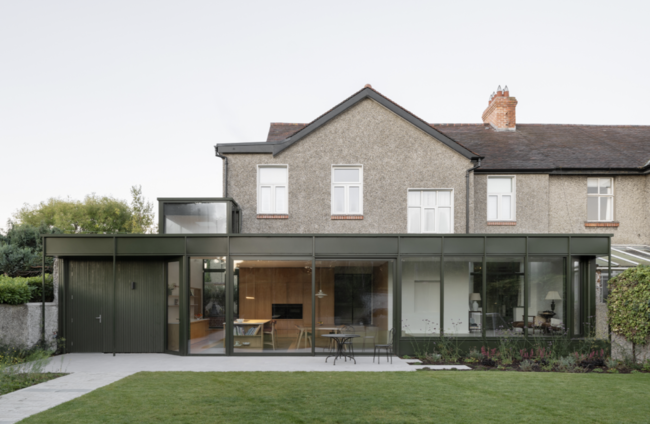
WHEN SCULLION ARCHITECTS were tasked with upgrading a Thomas Stringer-designed 1930s Semi-D in the Dublin suburb of Terenure the solution was to create a multifunctional gallery-style extension creating expansive views to the garden to enhance family life. Founder Declan Scullion speaks to Ruth O’Connor about the project.
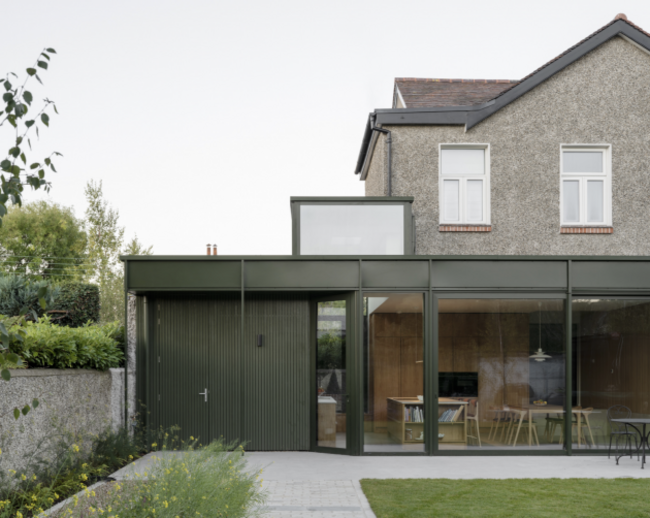
When the architects were approached to work on this home, the homeowners had already done a soft upgrade some five to ten years previously, however the kitchen/ dining/ family area to the back of the house had not been touched. This fine Semi-D is a prime example of the Thomas Stringer houses built in Dublin in the 1930s – solid, well built family homes with wonderful proportions but also with rooms that are not necessarily built for family life as it’s lived now.
“These are fine houses,” says architect Declan Scullion. “However, in houses like this, there was an over-provision of reception rooms to the detriment of cooking and dining spaces – specifically informal dining spaces. So when it comes to informal family dining, people who live in these homes nowadays find themselves squashed in a corner of the kitchen rather than in the overtly formal dining room.”
“We all now are inclined to spend more time close to cooking and to the garden and that wasn’t being served by the existing layout. The changes that people want to make to these types of houses reflect a changing society. The blend of roles has changed – there isn’t one person slaving away at the cooking in a windowless room while the other person sits waiting to be served in the dining room,” says Declan. “Nowadays people tend to be together a lot more, and if those rooms are siloed off, the social bonds of the household weaken. If you can make rooms that support overlapping functions successfully then people will spend more time together and spend more time in the garden.”
I ask Declan why people now seem to use their gardens in a very different way to people in the past. “I think a lot of it has to do with improvements in building technology. The way out to a garden used to be through a wooden door – or in this case a crittal door – the connection between you and your garden was generally quite oblique,” he says. “Then technology came on with double and triple glazing and we solved a lot of those thermal problems. I believe that when you can see a garden, you’re more inclined to use a garden and nowadays the transition from kitchen to garden can be really quite seamless.”
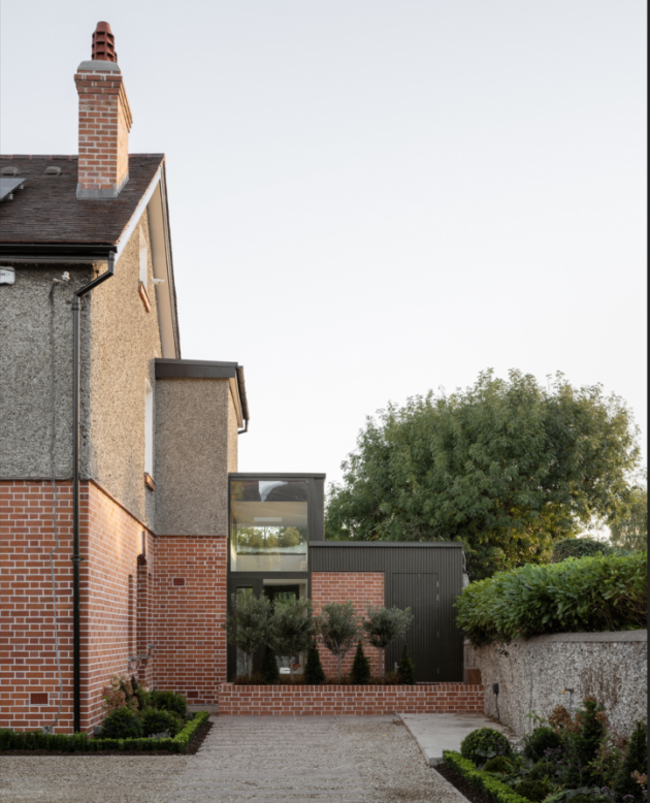
In this particular project, the goal was to maintain the beauty and character of the existing rooms while creating an extension that was in harmony with them. It was important for this project to avoid the “shock of the new” and to create something complementary to the exciting building.
Much of this was achieved through colour matching the red brick and grey pebbledash during the build, but also through the use of a specific colour green inspired by a colour found on the existing crittall door in the kitchen.
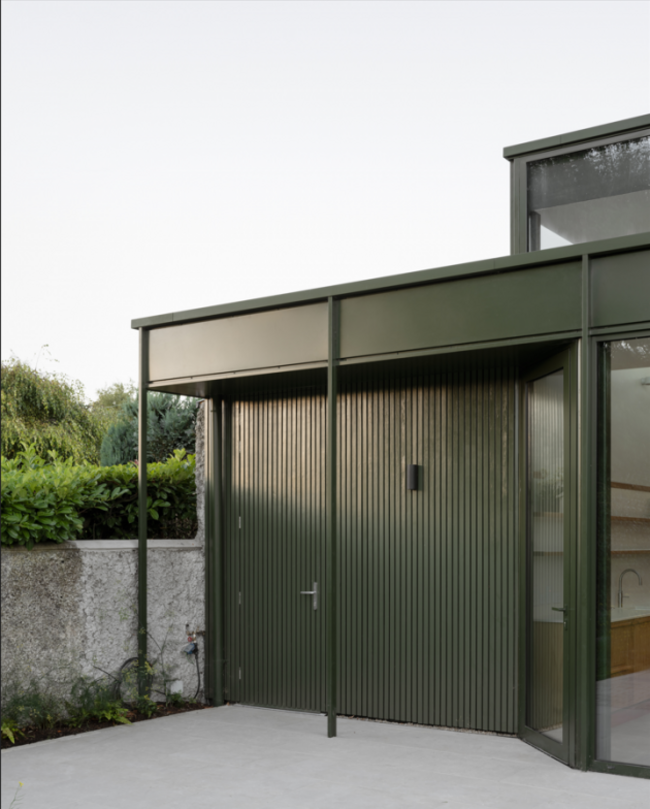
“We saw that particular green in the layers of paint on the original door and immediately colour-matched it – we realised that it sat so comfortably with the existing dash and brickwork. It’s a kind of Wimbledon green – it has a kind of Fred Perry 1930s feel – and felt appropriate to the colours that were there already,” says Declan.
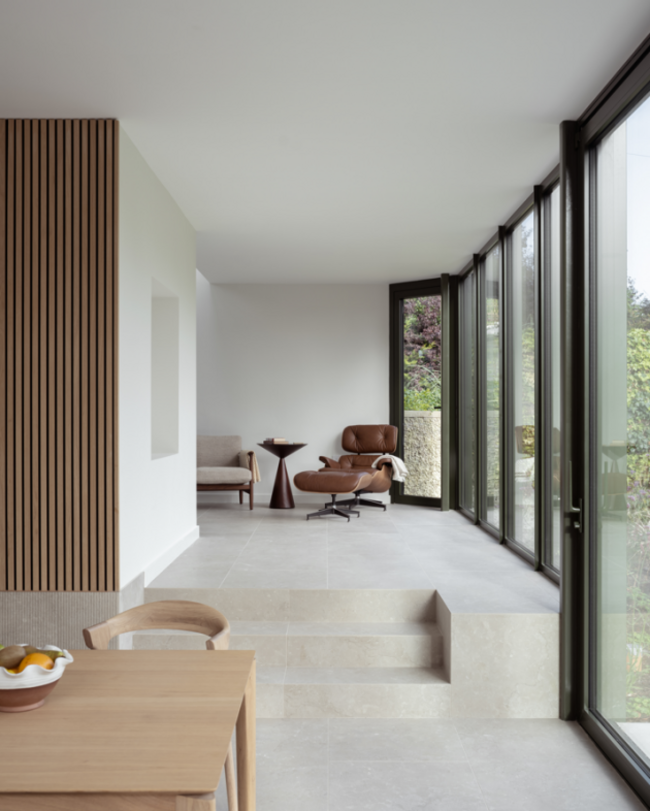
For these clients it was important to bring in warm, natural materials to the interior of the extension. “Both these clients work in healthcare environments and didn’t want to come home to highly-polished, sterile finishes. They wanted to come home to something that was rooted in tactile, natural materials as an antidote to the clinical environment that they work in.”
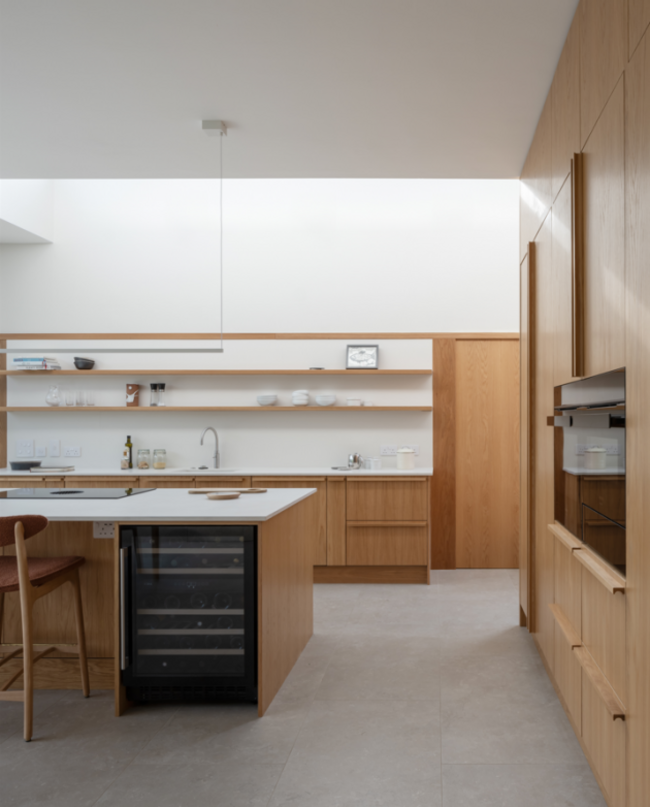
The oak joinery by Fearon Brothers is warm and tactile and contrasts beautifully with the painted finishes found in the main house. Acoustic panels help prevent a reverberation of sound around the room. “There were also practical considerations – the family wanted to use materials that are relatively easy to clean and maintain without resorting to highly machined or polished surfaces.”
Light was another major consideration in this project and while the back of the house faces north east, the clients wanted to have as much sunlight as possible in the extension throughout the day. The solution to this was to create a glass box or lantern which would allow the sun to shine through from the front of the house meaning the clients would get sunlight from morning to evening.
The addition of this south-facing window is balanced with privacy requirements through tall planting and set-in planter beds which means that a person standing in the kitchen is below the eyeline of people in the street. Dropping the entire extension to garden level at the back also helped to alleviate issues of privacy whilst creating enhanced ceiling heights and a more seamless connection to the garden.
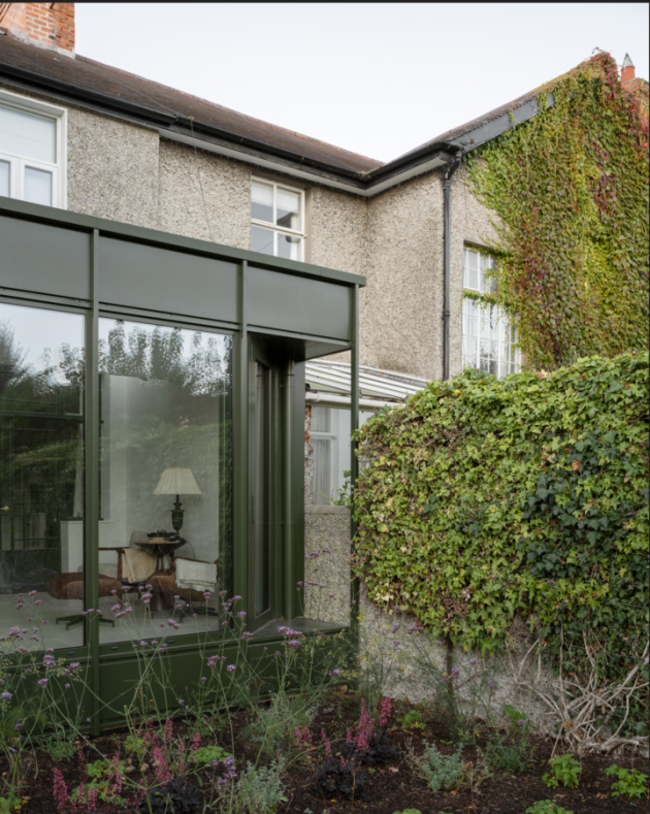
Declan Scullion and team were keen to capitalise on the wide garden at the back of the house and one of the early design moves in the project was to bookend the gallery extension with glass and to fold the glass 45 degrees at each corner in order to create what he calls a “panoptic effect” – widening the view to the east and west in order to make the garden feel wider.
“Ultimately, with this project, we wanted to create a long room running along the side of the existing rooms in the house while creating a new space with a series of functions such as the reading area which is still visually connected to other parts of the room including the kitchen and dining area,” says Declan.
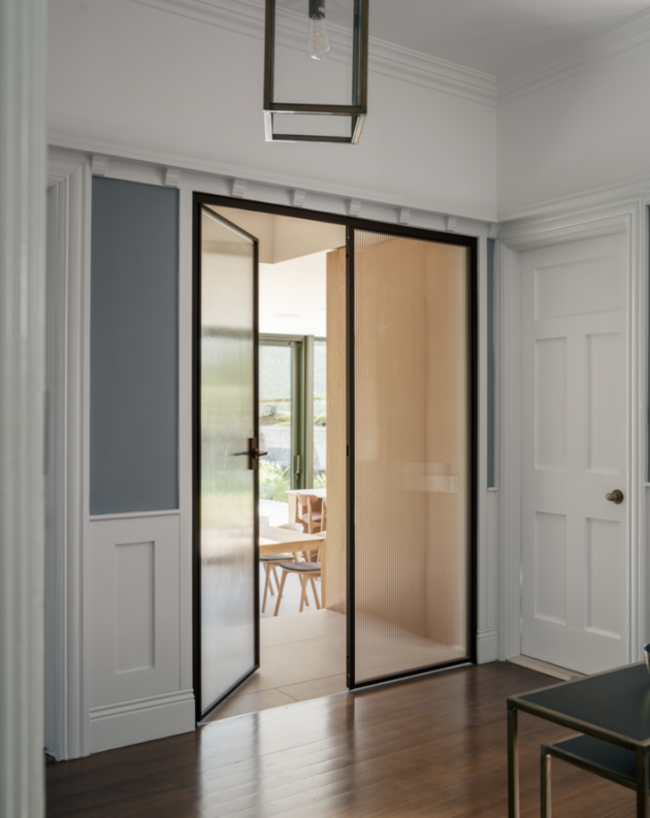
Having completed the project, Declan says that he is most struck by the connection that has been achieved with the garden: “There is a lovely sequence as you enter the house now. You first encounter this 1930s house with all its fine features, then you go through the hall and open the door and the house delivers even more. Now the garden is part of the offer of the house, so not only do you get to admire the beautiful original details but the garden has been brought to the fore with great success.”
Address Book:
Architect: Scullion Architects
Contractor: GC Construction
Engineer: MOCA Consulting Engineers
Windows: Aru Joinery
Joinery: Fearon Brothers
Photography: Johan Dehlin
To embed this post, copy the code below on your site



have your say