We need your help now

Support from readers like you keeps The Journal open.

You are visiting us because we have something you value. Independent, unbiased news that tells the truth. Advertising revenue goes some way to support our mission, but this year it has not been enough.

If you've seen value in our reporting, please contribute what you can, so we can continue to produce accurate and meaningful journalism. For everyone who needs it.

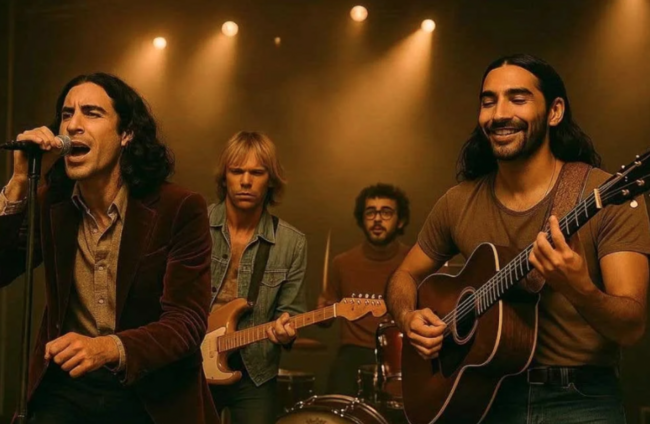
Velvet Sundown, an AI-generated band Velvet Sundown

In this new AI-generated world, everything is kind of plagiarism and nothing is

Writing with AI is more of a parasitic act than a plagiaristic one, writes our resident AI and media expert.

LAST WEEK SAW the world of journalism get itself in a tizzy over plagiarism and, you guessed it, artificial intelligence.

Eagle-eyed readers spotted that a New York Times book review of Jean Baptiste Andrea’s ‘Watching over Her’ was very similar to a review of the same book, previously published by the Guardian. We’re talking whole chunks that were virtually identical. Alex Preston, the freelancer who wrote the offending review, admitted he used AI and has been dumped by the paper.

Journalism is often treated as a moral endeavour in the US, not just a job. And the New York Times sets a high moral bar for itself. So this has caused a lot of hand-wringing. But Preston’s review isn’t the only AI plagiarism kerfuffle in the US last week. Nota, a company that automates tasks relating to creating and distributing content – like formatting and search engine optimisation – also found itself in hot water.

Nota ran a host of AI-powered news sites in news deserts; areas where there was a dearth of reporting. But there was a problem. Some of the stories on these sites were found to have lifted copyrighted content from other news outlets. Nota shut down 11 automated sites and fired one reporter.

It’s admirable that both news organisations took immediate action to protect their own reputations. But in a world where every business is doing its damndest to make the most of AI, and where publishing is dealing with smaller budgets and declining reach, it seems likely that this will be an increasingly frequent occurrence. So what’s a publisher to do?

Creatives 

There’s an inherent problem here for news reporting. AI erodes originality. If all AI writing emerges from the same training data, plagiarism makes no sense as a concept. Everything is kind of plagiarism and nothing is. Writing with AI is more of a parasitic act than a plagiaristic one. This is fine if you’re summarising a dull report for your boss, but it’s an issue if you’re writing commentary or criticism for a respected news outlet.

And this isn’t just true of writing. Take music. AI tools can generate songs in the style of any artist without reproducing a specific track. AI makes identity, or at least identifiable style, a reusable asset, detached from the person who created it. Just listen to the Velvet Sundown for a period of time and you begin to feel slightly empty inside. It’s like eating fast food. Empty calories. The same goes for visual art, moving images. Using AI in these fields mostly creates AI slop.

It seems that using AI to make anything creative, or where originality is prized, feels culturally parasitic. But is it plagiarism?

I suspect, looking at the disruption in creative industries or journalism, is looking at the effect rather than the cause. This isn’t really a story about plagiarism. It’s really about capitalism.

With that in mind, perhaps the most telling AI story of last week wasn’t some journalistic snafu; it was OpenAI shutting down its Sora app.

Sora was a tool from OpenAI that could turn written prompts into short, realistic videos. It got a lot of attention because it pushed video generation way past the usual glitchy, cartoonish AI stuff. It also got a lot of attention for its lack of guardrails.

Users created videos of copyrighted characters and, even worse, tasteless videos of dead public figures. How tasteless? How about John F Kennedy joking about the killing of right-wing influencer Charlie Kirk, or Stephen Hawking being beaten up by a UFC fighter and eaten by crocodiles?

Open AI fixed some of these issues and applied some common sense rules. It also penned a $1 billion content partnership with Disney. But all that is gone now. Why? Because video generation is damn expensive, and OpenAI has other priorities, like maintaining market share while its rival Anthropic is doing a better job of creating AI tools and marketing itself.

If AI companies, who have a track record of not respecting copyright, can drop a billion dollar deal with the likes of Disney, what does that mean for media and anyone in the creative industries?

It means they need to see AI – in its current form at least – as parasitic.

Parasites need to strike a balance between living off their hosts without killing them too quickly. Optimal virulence is the term biologists use for this. One theory is that parasites’ virulence decreases over time, and parasitic relationships evolve toward comfortable coexistence.

Maybe this will happen with AI.

But here’s the question for anyone doing creative or original work: If this is a parasitic relationship, shouldn’t you steer clear of AI until your intellectual property is recognised as the raw material for training models?

Shouldn’t you avoid like the plague until your output can be protected against plagiarism and hallucinations?

News media, with its natural cynicism and mission to speak truth to power, maybe needs to reflect more on the promise that AI can automate away all its worries and annoying tasks.

Maybe the rest of us need to as well.

Let’s return to the New York Times book review. Simon & Schuster is the publisher of ‘Watching over Her’. On its website, as you’d expect, there are glowing quotes from a handful of reviews. A quote from the New York Times review sits alongside one from the Guardian review. Simon and Schuster doesn’t seem to care much about the interrelationship and the questionable provenance of one of them. The originality doesn’t seem to matter much to the publisher, just quotes that drive sales. Capitalism trumps plagiarism every time. 

Steve Dempsey is a media expert and commentator. He is also director of advocacy and communications with the Irish Cancer Society.  

Readers like you are keeping these stories free for everyone...
A mix of advertising and supporting contributions helps keep paywalls away from valuable information like this article. Over 5,000 readers like you have already stepped up and support us with a monthly payment or a once-off donation.

Close
8 Comments
This is YOUR comments community. Stay civil, stay constructive, stay on topic. Please familiarise yourself with our comments policy here before taking part.
Leave a Comment
    Submit a report
    Please help us understand how this comment violates our community guidelines.
    Thank you for the feedback
    Your feedback has been sent to our team for review.

    Leave a commentcancel

     
    JournalTv
    News in 60 seconds