We need your help now

Support from readers like you keeps The Journal open.

You are visiting us because we have something you value. Independent, unbiased news that tells the truth. Advertising revenue goes some way to support our mission, but this year it has not been enough.

If you've seen value in our reporting, please contribute what you can, so we can continue to produce accurate and meaningful journalism. For everyone who needs it.

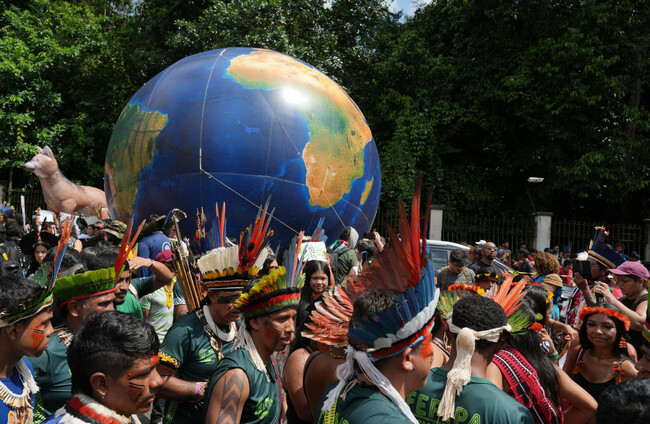
Indigenous activists participating in a climate demonstration in Belém this week. Alamy

Draft climate deal pitches ways to wean countries off fossil fuels

The marathon climate talks are supposed to end Friday after close to two weeks of negotiation.

COP30 HOST BRAZIL has unveiled a first draft deal after UN climate talks stretched late into the night, seeking a compromise with nations at odds as the summit clock ticks down.

The draft landed as President Luiz Inacio Lula da Silva announced he was returning to Belem, the rainforest city where the marathon negotiations are underway, in an effort to seal a deal.

The draft text offers a sweep of possible outcomes, reflecting the gulf between the nearly 200 nations at the summit in the Amazon, and the road still ahead to reach a final pact.

The nine-page text addresses the main flashpoints in Belem: trade measures, demands for greater finance for poorer nations, and the inadequacy of national carbon-cutting pledges.

“This is a mixed bag,” EU climate chief Wopke Hoekstra told news agency AFP today, flagging the bloc’s opposition to some proposals in the draft on climate finance and trade measures.

“We’re not going to open up the hard-fought compromise of last year in terms of financing” or be “lured into a phony conversation about trade measures”, he added in reference to China’s focus at COP30 on the EU’s flagship carbon pricing policy.

With the talks stuck, Brazil announced yesterday it wanted an agreement by midweek, sending exhausted negotiators back to the bargaining table and extending work hours late into the night.

The quick turnaround of a draft indicated Brazil was confident about landing an agreement soon, observers told AFP.

“It represents a steady progression from the previous iteration and is likely one of the earliest releases of such a clean text in recent COP history,” Li Shuo, a climate analyst at the Asia Society Policy Institute, told AFP.

Tough compromise

Among other things, the draft underscores a stark division between a coalition pushing for a “roadmap” on a fossil fuel phaseout and an opposing bloc led by oil-producing countries.

It proposes an optional “workshop” to discuss “low carbon solutions,” or a high-level ministerial roundtable on pathways to help countries “progressively overcome their dependency on fossil fuels.”

A third option proposes no text at all.

The draft also raises the possibility of assessing national climate pledges annually, instead of every five years, to assess more frequently shortfalls in global efforts to reduce greenhouse gas emissions.

It also suggested financial assistance from wealthy countries to developing ones for adaptation to climate change should be tripled by 2030 or 2035 – a key demand from poorer nations.

“Climate finance is not charity. It is a legal and moral obligation,” Vanuatu’s climate change minister, Ralph Regenvanu, told the summit today.

Proposals to address concerns over trade — as China leads a push against “unilateral” measures and the EU’s carbon price on imports in particular – were also canvassed.

On this sensitive issue, four proposals were outlined, including the creation of a summit under the UN secretary-general on climate trade disputes.

Presidential push

In a surprise move, a Brazilian presidential source told AFP that Lula would return to Belem tomorrow in what many interpreted as a tactic to push through a deal.

“It would be a way of putting pressure on delegates to move quickly to resolve issues,” David Waskow, international climate director at the World Resources Institute think tank, told AFP.

The marathon climate talks are supposed to end Friday after close to two weeks of negotiation, but previous summits have frequently run into overtime.

Brazil is eager to show that the world is still united in the fight against climate change, despite the United States skipping the summit and many other nations juggling competing priorities.

“We must show the world that multilateralism is alive,” Josephine Moote, permanent representative of the small-island state of Kiribati, told COP30 today.

Author
View 18 comments
Close
18 Comments
This is YOUR comments community. Stay civil, stay constructive, stay on topic. Please familiarise yourself with our comments policy here before taking part.
Leave a Comment
    Submit a report
    Please help us understand how this comment violates our community guidelines.
    Thank you for the feedback
    Your feedback has been sent to our team for review.

    Leave a commentcancel

     
    JournalTv
    News in 60 seconds