We need your help now

Support from readers like you keeps The Journal open.

You are visiting us because we have something you value. Independent, unbiased news that tells the truth. Advertising revenue goes some way to support our mission, but this year it has not been enough.

If you've seen value in our reporting, please contribute what you can, so we can continue to produce accurate and meaningful journalism. For everyone who needs it.

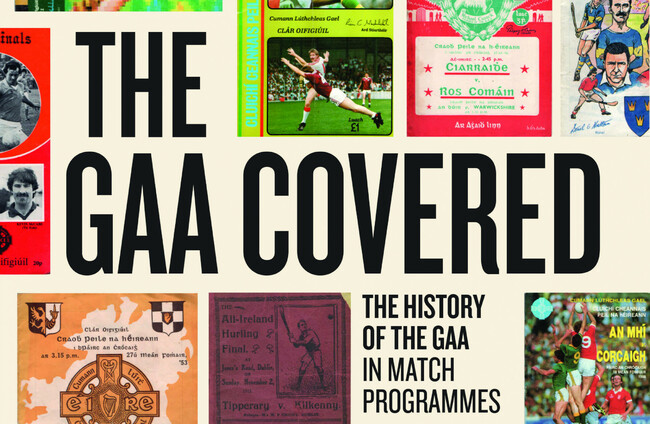
The match programme A treasure trove of Gaelic games history dating back to 1913

An extract from The GAA Covered details the origin story of the match programme across Gaelic games.

LIKE MANY PEOPLE, my first experience of the GAA was being brought to matches by my father. This took place in stages: first, to our local club, Palatine, then to Dr Cullen Park, the county grounds in Carlow, and, finally, to my first All-Ireland final in Croke Park in 1979.

There I witnessed one of the contests between the great Dublin and Kerry teams of the 1970s. In time-honoured tradition, my father’s ticket allowed me to be lifted over the turnstile.

Once inside, my father bought the official match programme and gave it to me to mind. Thus began a lifelong pastime of buying the programme of every match I went to and keeping it as a souvenir of the event.

The primary purpose of the match programme is to name the players on each team. It should also include the match officials, the date, time and venue of the match. Most of the early GAA programmes merely fulfil this basic requirement.

As programmes evolved, they also began to include photographs, match reports, season and all-time statistics, player profiles and advertisements. These features are what now make them invaluable local, social and sports history documents.

Team and action photographs have preserved players in the vigour of their athletic youth. Contemporaneous match reports provide us with an idea of how the games were played and perceived at the time.

Advertisements reflect how attitudes have changed regarding alcohol and tobacco consumption and, in some cases, gender roles. Player profiles and statistics have increased our awareness of the people who play our games and further our interest in the GAA.

Early match programmes

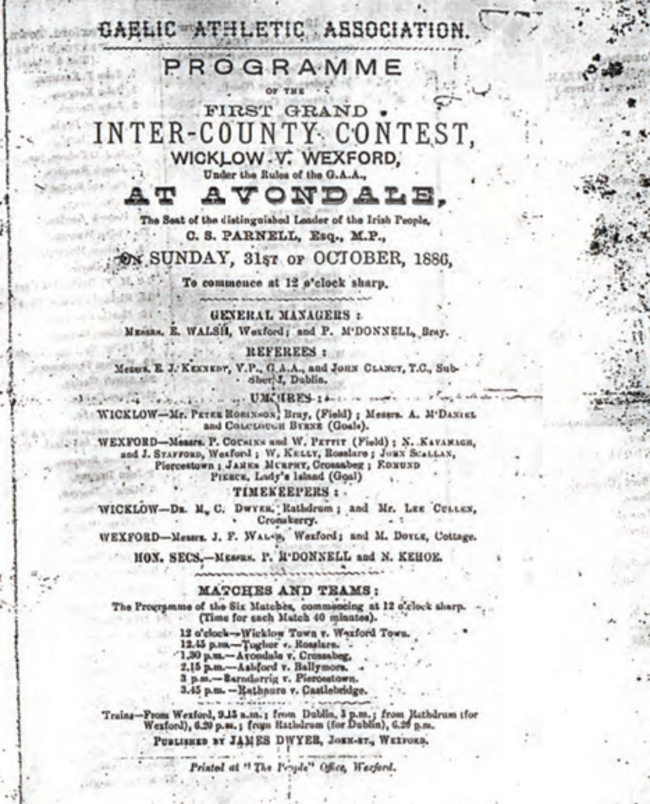
The earliest known GAA programme was produced on 31 August 1886 for the ‘First Grand Inter-County Contest’ between Wicklow and Wexford at Avondale, the home of Charles Stewart Parnell. The contest consisted of six matches featuring various clubs from the respective counties.

This programme listed the teams, players, match officials and also provided details of the trains on which spectators could travel to and from the venue.

The first programmes produced were never intended to be kept or indeed collected. They were ephemeral, for use on the day of the event to provide the spectators with information about the match.

The programmes for the 1913 and 1914 All-Ireland finals were small and designed to fit into a coat pocket. In fact, some programmes advised spectators to dispose of the programme carefully after the match. This caused programmes to become scarce, and many are no longer in existence. Trying to source the material for this book therefore became an exercise in finding those programmes that have endured.

The earliest surviving All-Ireland final programmes are those from the 1913 finals.
Programmes from All-Ireland finals in 1914 and 1915 also survive, but from then until the mid-1920s, few remain. This may be attributed to the political situation in the country during those years when censorship and the breaking of printing presses made the production of programmes extremely difficult.

PastedImage-15788

The All-Ireland final programmes of the 1920s and 1930s were simple documents, usually an A4 page folded over and printed in black and white on delicate paper. They remained in this format up to 1942.

In 1943, a coloured cover was added, and the programme took the form of a booklet. By 1945, black-and-white action and team photographs had been added. The covers of the 1940s programmes are identifiable by their orange-coloured covers, which show an image of Michael Cusack accompanied by the national flag and GAA crest.

After a brief return to a plainer cover in 1951 and 1952, from 1953 the covers took on a more colourful appearance. They comprised a map of Ireland with the GAA crest in the centre and the crests of the four provinces placed in the corners of the cover.

Further improvements in quality were made to the All-Ireland final programmes of the 1960s. This was largely due to the influence of Breandán Mac Lua from Co. Clare, who had been appointed to a full-time clerical position in Croke Park in 1964.

The 1965 All-Ireland final programmes were larger in size and colour was added to black and white action photos on the cover. In 1976, the All-Ireland hurling final programme had a colour photograph on the front cover and on an inside page, but black and white photographs and advertisements remained in place until the end of the 1980s.

By the end of that decade, the All-Ireland final programmes were predominantly colour productions printed on glossy A5 size paper and had grown in volume to 80 pages.

In 1995, the programme for the All-Ireland football final increased in size to an A4
full-colour, glossy publication. This format remained in place up to 2007 when the
programmes returned to a smaller, more manageable size.

Cost

In 1920, the cost of an All-Ireland final programme was a penny (1d).

By 1930 it had risen to two pence. The ‘Emergency’ years (1939–46) saw rationing introduced to the country. Petrol and paper shortages meant that attendances and programme production decreased over the period.

An outbreak of foot-and-mouth disease in 1941 affected both the ability of teams to enter the provincial and All-Ireland championships and of spectators to travel to matches.

The price of the programme produced for the 1947 All-Ireland football final, played in New York’s Polo Grounds, was 50 cents. By 1950, the cost of an All-Ireland final programme was three pence. The introduction of colour and an improvement in quality of the match programme in the 1960s saw the cost rise from six pence in 1960 to one shilling (6.25 cent approx.) in 1966.

Traditionally, VIP spectators seated in the Ard Chomhairle section of the Hogan Stand have received complimentary copies of the match programme. In the 1950s and 1960s, the covers of such programmes were made from embossed card rather than paper and did not have the cost of the programme printed on the cover.

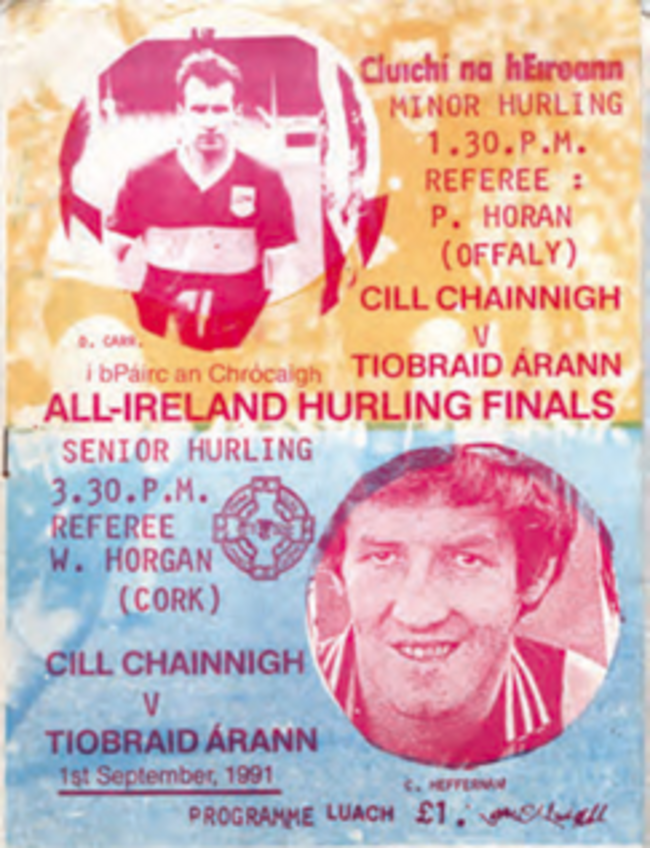
In 1984, when the GAA celebrated its centenary year, large commemorative programmes with a glossy card cover were produced, costing IR£1. Publication of the All-Ireland final programmes was taken over by the Dublin-based printing company DBA in 1988.

Production quality improved, as did the content and volume of the programmes. By the turn of the century, the All-Ireland programme was £3 and with the changeover to the euro in 2002, the cover price became €4. In 2019 the All-Ireland hurling final programme contained 128 pages and the cover artwork paid homage to the cover of the 1913 final played at Jones’s Road and featured a painting by George Fagan.

The cost of that programme was €7. By 2024 this had further increased by one euro to €8.

Unofficial 

One of the difficulties in compiling this book is the existence of unofficial programmes, sometimes known as ‘pirate programmes’. In the 1920s and 1930s, local printers often
produced unofficial programmes to give people information about their teams and to provide reading and discussion material on the long train journeys to matches.

From 1930, the signature of the then Ard Stiúrthóir, Pádraig Ó Caoimh, was added to the
cover of the All-Ireland final programme and, along with the words ‘Clár Oifigiúil’, this identified the programme as the official GAA version.

PastedImage-34116

In most cases, the official match programmes were sold at turnstiles or inside the grounds but, in later years, spurious programmes were sold slightly further away from the stadium.

These were usually of inferior quality to the genuine article and, with increased awareness around intellectual property rights, all but disappeared by the mid-1990s.

When the official programme only became available inside the grounds, people soon stopped buying the pirate copies.

Collectors

While some archives, such as those in the Croke Park Museum, the Cardinal Ó Fiaich Memorial Library and Muckross House Library contain GAA programmes in their catalogue, it is primarily the dedication of private collectors that has ensured that these documents are safely preserved for future generations.

The concept of the souvenir programme only gained traction in the 1950s for All-Ireland final programmes and in the 1970s for provincial final programmes. Prior to that, the programme was a disposable commodity regarded as useless once the match was over.

That so many of those items have survived is a credit to the people who recognised the value in keeping them. A committed network of programme collectors exists throughout the country.

Programmes are exchanged by swapping and buying and selling at various fairs which take place annually in Thurles, Co. Tipperary and Graiguenamanagh, Co. Kilkenny. Lately there has been increased interest in collecting GAA programmes and memorabilia.

As a result, many items are now attracting significant sums of money when they come up for sale at auction houses around the country or on internet sites such as eBay.

Irish language and orthography

As a cultural organisation, the GAA was widely recognised as the sporting element of the Gaelic revival and the promotion of the Irish language was an inherent part of its mission.

The most visible demonstration of the GAA’s commitment to the native tongue was its match programmes, where an Ghaeilge was used on the covers and to name players and officials.

Until the late 1950s, the orthography of the Irish language and style of print was different from what is used today. The old style of print, an cló Gaelach or seanchló, was first used on All-Ireland final programmes in 1930.

Within this style, the particular font used appears to be the Newman font, first introduced in 1858. Also used was the old Gaelic alphabet – an aibítir – which comprised 18 letters.

A dot, or séimhiú, above a consonant meant that the sound was ‘softened’. The séimhiú is no longer in use today, and the letter ‘h’ is used instead.

The cló Gaelach went out of fashion in 1958 when the language was standardised, and
the English alphabet came into use. The font was no longer used on All-Ireland final
programmes from 1966 but remained in use on Leinster final programmes up to 1970.

The manner in which county names were spelled also changed after standardisation
and the new versions became the norm. 

The seanchló endured, however, mostly being used for ornamental design purposes.

In 2016, for the 100th anniversary commemorations of the 1916 Easter Rising, the old
font, if not the spelling, was used on the covers of the All-Ireland final programmes. It
has remained in use on the covers of All-Ireland final programmes since.

Modern problems

Modern intercounty programmes have very high production standards, but they have become homogenous. Where previously, local printers published the provincial final match programmes, most are now printed by the same company.

In contrast, local county final programmes are more attractive to collectors due to their variety of style and content.

Just as design and production values were reaching new heights, the integrity of the GAA match programme suffered from the advent of the ‘dummy team’ in the 1990s.

In an attempt to frustrate opponents, the team printed in the programme often bore little resemblance to the team that took the field. A further setback occurred during the Covid-19 pandemic. Spectators were unable to attend matches and therefore physical programmes were not necessary.

Many county boards and provincial councils, as well as DBA, made match programmes available to download via websites and social media. As well as adapting to a modern environment where much content is accessed digitally, boards and councils recognised that there is a considerable cost saving to be had by not printing large numbers of programmes for each match.

Similar cost-cutting has in recent years sometimes seen a single programme represent several games. Some county boards continue to make their programmes available online.

However, for many spectators – and some managers – the programme is a working document where scores, wides and substitutions are recorded during a match.

Mick O’Dwyer and, more recently, Kieran McGeeney regularly patrolled the sidelines with their programme for reference. For these people, nothing beats having the match
programme in their hands and it remains an essential accessory to the match day
experience.

  • This extract has been lightly edited for length.
  • The GAA: Covered by John Kelly is nominated for Best Irish-Published Book, a category sponsored by The Journal in the An Post Irish Book Awards 2025. The winners will be announced on Thursday, 27 November. 
View 3 comments
Close
3 Comments
This is YOUR comments community. Stay civil, stay constructive, stay on topic. Please familiarise yourself with our comments policy here before taking part.
Leave a Comment
    Submit a report
    Please help us understand how this comment violates our community guidelines.
    Thank you for the feedback
    Your feedback has been sent to our team for review.

    Leave a commentcancel

     
    JournalTv
    News in 60 seconds