We need your help now

Support from readers like you keeps The Journal open.

You are visiting us because we have something you value. Independent, unbiased news that tells the truth. Advertising revenue goes some way to support our mission, but this year it has not been enough.

If you've seen value in our reporting, please contribute what you can, so we can continue to produce accurate and meaningful journalism. For everyone who needs it.

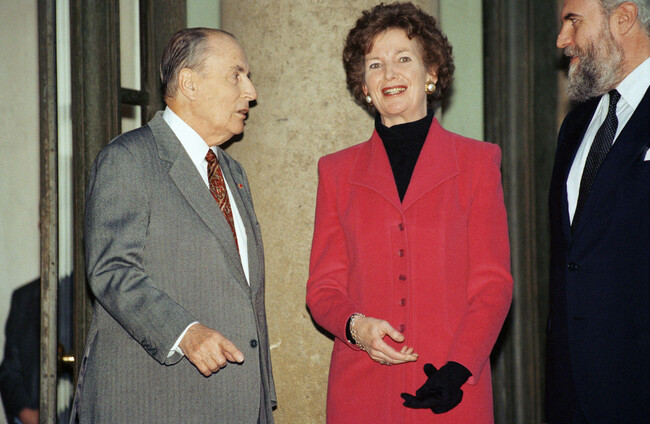
French President Francois Mitterrand and President Mary Robinson in January 1994. Alamy Stock Photo

'Sensitivities' around Ireland's neutrality and the question of attending VE Day 50 in Paris

In the end President Robinson attended the event in 1995, but it was no foregone conclusion.

THERE WAS DEBATE among Irish officials in 1995 over the appropriateness of President Mary Robinson attending events to celebrate 50 years since VE Day, given the “sensitivities” around Ireland’s neutral status both during World War II and since. 

Victory in Europe Day is commemorated on 8 May each year, with the 50th anniversary in 1995 being marked with significant events in Paris, Moscow and elsewhere. 

In the end, President Robinson was one of 55 heads of state who attended the anniversary in Paris, an event which included a large military parade in which each state in attendance saw their flag carried by a soldier. 

Among the others who attended were US vice president Al Gore, British Prime Minister John Major and German Chancellor Helmut Kohl. 

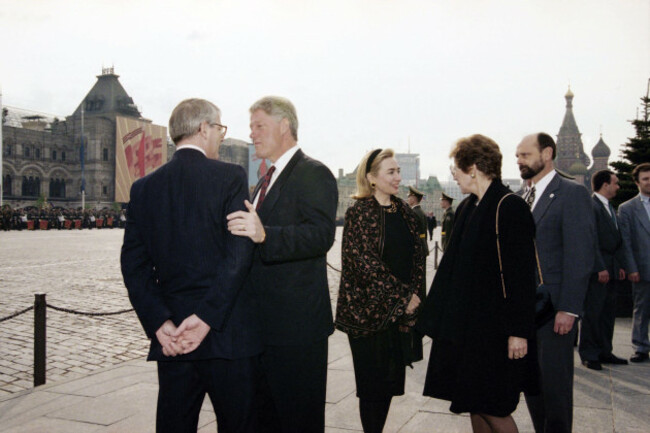
Taoiseach John Bruton attended an event in Moscow the following day, which also counted Major and President Bill Clinton among attendees. 

Behind-the-scenes preparations for President Robinson’s trip to Paris and Ireland’s wider participation in the event are contained in confidential documents from the Department of Foreign Affairs that have now been released to the National Archives under the 30-year rule. 

One draft briefing note from April 1995 signed by the DFA’s then chief of protocol John O. Burke outlined the department’s thoughts on whether the Defence Forces could participate in the military parade. 

Burke said that the department would have “no objection” to them doing so, but that this decision was only arrived after Irish diplomats in Paris made contact with “other neutral States, namely Sweden, Switzerland and Austria.”

“All of whom have confirmed that they will be sending a military officer to participate in the parade,” the advice states. 

Having considered the matter, this Department has no objection in principle to an Irish officer participating in such a fashion.

AP Archive / YouTube

Neutrality

The involvement of other neutral countries from WW2 was key to Ireland attending at all. 

Noel Dorr, then secretary general of the Department of Foreign Affairs, noted in one briefing note that “other neutrals and even countries such as Germany and Italy who fought on the other side” were doing so. 

Dorr, 30-year veteran of the DFA who retired only months after preparing this briefing, wrote that: “We were militarily neutral in World War II but we were certainly not unaffected by the War.”

He went on to say that there would be “no basis” to suggest that Ireland’s attendance would suggest the country would be joining an alliance, such as NATO, in the future. 

“Apart from major effects on the economy and on our population (rationing etc.), we had civilians killed in the North Strand bombing and seamen lost at sea to hostile attack. In addition, of course, there is the fact that many thousands of Irish people actually fought with the Allied forces in the War by their own choice and many were killed,” Dorr wrote. 

He added: “If the commemoration is so widespread, there should certainly be no basis for suggesting that our participation would be some kind of signal about future involvement in an alliance or that it would show anything other than our commitment, along with the rest of Europe, to work to ensure that no such war will ever recur.”

british-prime-minister-john-major-left-listens-to-u-s-president-bill-clinton-while-their-wives-hillary-rodham-clinton-and-norma-major-right-chat-at-moscows-red-square-just-before-the-parade-tue (L to R) John Major, Bill Clinton, Hillary Clinton and Norma Major in Moscow on 9 May, 1995. Alamy Stock Photo Alamy Stock Photo

The decision for President Robinson was not a foregone conclusion, with another official pointing out that Irish governments had in the past declined similar invitations.

“The issue of attendance at such commemoration ceremonies, remembrance days, etc, has always been a sensitive one. Ireland’s neutrality in World War II, and sensitivities in the Anglo-Irish context have led governments in the past to decline such invitations,” the DFA’s Richard Townsend wrote at the time. 

“In the light of developments in Europe and in Anglo-Irish relations there appears to be a good case to reconsider Ireland’s approach to such invitations. With regard to European developments, the commemoration of the 50th anniversary of the end of WWII is generally being marked as an occasion to emphasise reconciliation in Europe, rather than the victory of one side over the other.”

Readers like you are keeping these stories free for everyone...
A mix of advertising and supporting contributions helps keep paywalls away from valuable information like this article. Over 5,000 readers like you have already stepped up and support us with a monthly payment or a once-off donation.

Close
26 Comments
This is YOUR comments community. Stay civil, stay constructive, stay on topic. Please familiarise yourself with our comments policy here before taking part.
Leave a Comment
    Submit a report
    Please help us understand how this comment violates our community guidelines.
    Thank you for the feedback
    Your feedback has been sent to our team for review.

    Leave a commentcancel

     
    JournalTv
    News in 60 seconds