Sign in. It’s quick, free and it’s up to you.
An account is an optional way to support the work we do. Find out more.
Sign in. It’s quick, free and it’s up to you.
An account is an optional way to support the work we do. Find out more.
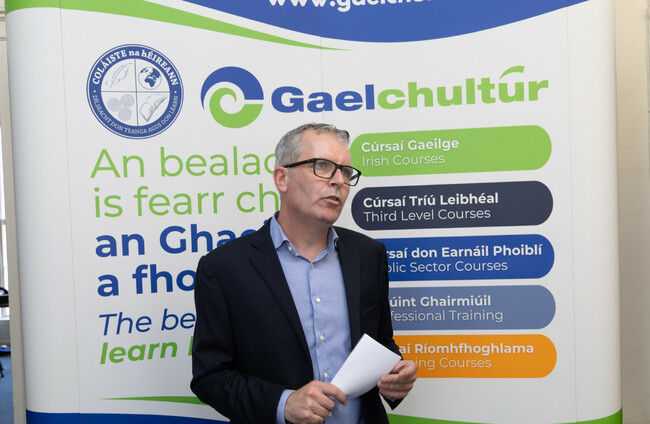
OVER 20 YEARS ago, Darren Ó Rodaigh set up Gaelchultúr to teach people Irish.
Since then the CEO of the company has seen major changes in how Ireland views the language, with the past few years marking a massive increase in interest. Interest in Gaelchultúr’s online classes spiked during Covid, then settled a bit. But lately, there’s been another positive change.
“From the start of this year we’ve seen an increase in interest, and particularly since the summer, we’ve seen an even bigger increase since then. Sometimes it’s hard put your finger on the why, but it does seem that the Irish language is having a moment.”
When Gaelchultúr was set up in 2004, there wasn’t the same demand for Irish language classes as there is today. But nonetheless, popular culture could have as much of an impact then as it has on it now.
“We were set up just after the first Official Languages Act in 2003. The language did have moments around then, like when Des Bishop had a program on TV called In the Name of the Fada, and we saw a huge increase in the numbers then,” recalls Ó Rodaigh.
Bishop’s 2008 series saw him learn the language and go on a quest to perform the first-ever comedy show as Gaeilge. These days, the likes of Belfast rap band Kneecap have been having an impact on how younger generations in particular see the language.
But there are also practical reasons for the recent interest, says Ó Rodaigh.
“You didn’t hear it regularly 20 years ago, on the radio or TV. The new Official Languages Act 2021 mandates that 20% of state advertising has to be through the medium of Irish,” he explains. “It means that people who may have not bothered to look at TG4 or anything like that are actually hearing Irish now that they wouldn’t have heard before, and that’s maybe rekindling something in them.”
Younger Irish speakers/Gaeilgeoirí níos óige
He’s also noticed that the age profile for classes is lower than it’s typically been, indicating younger people are embracing Irish in a fresh way.
“You can see the Irish language on a lot more people’s [social media] feeds. And there’s people doing really interesting stuff – there’s yoga classes through Irish, there’s Irish language retreats in the Wicklow Mountains,” he adds.
He also says that growing multiculturalism in Ireland is encouraging both people moving to Ireland to engage with the language, and those born here too. “When you’re walking down the street in Dublin now, you’re hearing different languages being spoken. So that might be something that is encouraging people then to learn their own language… If we don’t use it, we’ll lose it.”
In Gaelchultúr’s early days, it was based in Temple Bar. Ó Rodaigh long felt that online learning was the way to go – but it only really took off during Covid.
At one point the school had 15 venues nationwide. Now the majority of its classes are done on Zoom, and attract people from all over the world.
“We still do courses in person, but I’d say before Covid, 98% of our courses were on site, and after Covid, 98% of courses are online,” says Ó Rodaigh.
President Connolly/Uachtarán Uí Chonghaile
When President Catherine Connolly was running for the Áras, a big part of her campaign was her commitment to the Irish language. As President, she will make Irish the working language of the Áras.
“I think her interest in the Irish language, her ability to be able to speak Irish, that did resonate with people during the presidential election,” says Ó Rodaigh. “People think it’s important for our President to be able to speak Irish.”
“I think she’s going to have a very, very positive influence… I’m very hopeful.”
Increasingly, politicians are seeking out Gaelchultúr’s services, like former Taoiseach Leo Varadkar.
“He did the Certificate in Professional Irish. He didn’t ask for any special treatment or anything like that. He was in classes with everyone else – he did his Irish oral on the day Enda Kenny resigned his leadership,” says Ó Rodaigh. “And he passed as well!”
Gaelchultúr has been the main provider of Irish language training in the public sector since 2010. It set up the Certificate in Professional Irish in 2011, around the same time it became a third level college.
This was handy timing, as 20% of new recruits in the public sector will need to have competency in Irish from 2030 onwards. (There’s more information on the government’s plans for the language here.)
“Irish is an urban language now. In Dublin, you wouldn’t have heard a lot of Irish spoken maybe 30 or 40 years ago, but increasingly I’m hearing a lot more Irish being spoken,” says Ó Rodaigh. While he acknowledges he moves in circles where this would be highly likely, he’s also noticed more strangers in public speaking Irish in the city and beyond.
Plus, the people signing up for the classes are from lots of different backgrounds. “Two Basque women were in here looking to buy one of our books, and I just queried, ‘Why are you learning Irish?’ And they said, ‘well, we moved to your country. The onus is on us to speak your language’.”
“The opening night here for complete beginners level, it’s like the United Nations,” he adds. “It is incredible, just the mix of different nationalities.”
National tragedy/Tragóid náisiúnta
Ó Rodaigh says he’s always felt that the Irish language should be placed at the centre of Irish culture, and that the fact only around 2% of people speak the language daily is “a national tragedy”.
“I think there is that national trauma. I think it’s just taken us a long while to get to grips with it, to be honest. I think it can only be a positive thing that we are moving to a more bilingual society,” he says.
He theorises that, like in the case of the Clancy Brothers and Riverdance, Irish people often look to approval abroad before we embrace elements of our own culture. It could be a case of ‘post-colonial inferiority complex’, he suggests.
“You saw those having their day in the sun, and the acceptance and even the popularity now around traditional Irish sports and culture. And I think now it seems this is the Irish language’s time. It’s my theory, but I think there’s some substance there.”
But to keep this going, there needs to be greater investment and more opportunities to speak the language, he says.
“Gaeltacht areas are in decline, and I fear for the next 50-100 years if something isn’t done to help that. Because if we lose the Gaeltacht areas, it’d be very, very difficult to get them back.”
Teaching Irish/Ag múineadh Gaeilge
Gaelchultúr has devised structured classes for Irish that are based on the Common European Framework of Reference for Languages (CEFR). This means that students can map their progression. All classes are developed in house.
“Unfortunately, what you have [in schools] is that the teacher’s ability at primary and secondary level – not always, but in a lot of cases – is very, very poor,” says Ó Rodaigh, adding that the teaching style and curriculum in schools hasn’t changed hugely over the years.
“In Gaelchultúr classes, there’s loads of pair work and group work, so you get to speak the language all the time. So it’s not just listening to someone and writing down verbs.”
How is it that our method works? I’m not saying we’re geniuses or anything. We have an approach that works, and we have very talented teachers.
As a man who has built his career around the Irish language, what is it that makes Ó Rodaigh feel so connected to Gaeilge?
“I find a pride in it. I don’t think I’m superior to anyone else, but it just feels natural to me, and it always has felt natural just to be able to speak my own language,” he says.
To embed this post, copy the code below on your site



have your say