We need your help now

Support from readers like you keeps The Journal open.

You are visiting us because we have something you value. Independent, unbiased news that tells the truth. Advertising revenue goes some way to support our mission, but this year it has not been enough.

If you've seen value in our reporting, please contribute what you can, so we can continue to produce accurate and meaningful journalism. For everyone who needs it.

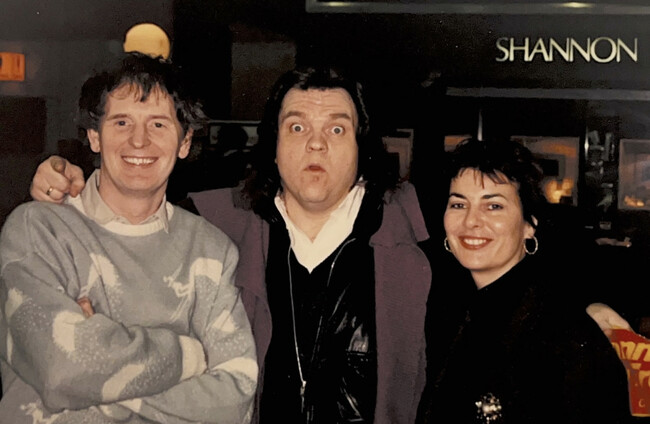
Promoter Tommy Swarbrigg, Meat Loaf, and Geraldine Swarbigg at Shannon Airport in 1990

Inside Meat Loaf's whirlwind pre-comeback tour of Irish ballrooms and nightclubs

Garry Keane, the director of a new documentary about the tour, takes us backstage and back in time.

ON FRIDAY, 26 JANUARY, 1990, Meat Loaf, alongside what many would consider the finest line-up of his ever-evolving backing band, The Neverland Express, performed You Took the Words Right Out of My Mouth on The Late Late Show.

What followed was classic television. Gay Byrne introduced the “Big man with the Big sound”.

Meat Loaf bristled comically at being called by his birth name, Marvin, and within minutes had the audience on its feet, chanting “Meat Loaf!” by the end of a riotously funny interview.

It was the opening act of something extraordinary.

Over the next 26 days, Meat Loaf played 19 sell-out shows in a whirlwind, 32-county tour that criss-crossed Ireland: Drogheda to Cork, Wexford to Moate, Carrickmacross to Castlebar, Bundoran to Belfast and back again to Dublin.

This wasn’t a greatest hits dash between capital cities. This was deep touring of towns and villages rarely visited by international artists, places more accustomed to being skipped over than headlined.

Ireland in 1990 was still emerging from a bruising decade. Economic recession, high unemployment, political instability, the ongoing Troubles in Northern Ireland and waves of emigration had taken their toll.

Into this landscape rolled one of the biggest rock performers of his era, arriving with trucks, crew, theatrical bombast and a voice capable of lifting the roof clean off the building.

Thirty-five years later, that improbable tour is revisited in Meat Loaf – From Hell and to Connaught, our 50-minute documentary airing on RTÉ One tomorrow evening.

I’ll go into a bit more detail on how our team put together the programme later in this article. It’s worth setting the scene a little first – because it’s hard to overstate how unusual this tour was. Ireland wasn’t yet the glossy, globalised country we know today. Venues were smaller, infrastructure was thinner and risks were higher.

Touring Ireland extensively was not an obvious move for an artist of Meat Loaf’s stature – or former stature – and yet along he came, playing places that international stars simply didn’t play.

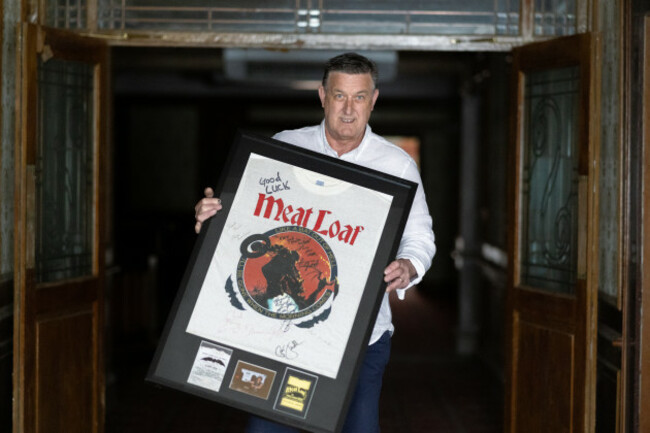
01_KEVIN_SWARBRIGG_From Hell_and_to_Connaught Kevin Swarbrigg holding a tour poster. RTÉ RTÉ

Before the comeback

That decision mattered and it happened because of promoter Tommy Swarbrigg.
Along with his brother Jimmy, Tommy represented Ireland at the Eurovision Song Contest in 1975 and 1977 as part of The Swarbriggs, before becoming one of the most successful showbands in the country, clocking up more than 15 Top 20 Irish chart hits.

By the time Tommy moved into promotion in the 1980s, he understood the showband circuit intimately. He knew the rooms and the audiences and he trusted them.

Still, bringing Meat Loaf to Ireland was a gamble. The colossal success of Bat Out of Hell in 1977 had faded. By 1990, Meat Loaf’s star had dimmed significantly. Aside from the occasional European festival slot, he was back on the US club circuit, playing to hundreds rather than tens of thousands.

To understand that moment in time fully, our documentary team travelled to the US to speak with members of Meat Loaf’s 1990 touring band: drummer Chuck Burgi, keyboard player Mark Alexander, guitarist Pat Thrall, bassist Steve Buslow and backing vocalist sisters, Amy and Elaine Goff, whose harmonies were vital to the emotional power of the shows and whose stage outfits caused no small stir in conservative, Catholic Ireland.

We also spoke to stage manager Eric Anderson and sound engineer Jim Steinford, tasked with translating Meat Loaf’s theatrical wall of sound into venues that had never hosted anything like it.

What emerged from our visit was the portrait of an artist at a crossroads.

By 1990, Meat Loaf was fighting for relevance. He and his band were gigging relentlessly, willing to play anywhere they were invited. So when Tommy Swarbrigg asked about touring Ireland, the answer was an immediate ‘YES’.

Vivid memories 

What surprised me most was the band’s recall. As Elaine Goff put it, “I couldn’t tell you about most tours back then … they’ve all blurred together, but I vividly remember the Irish one.”

Her sister Amy added, “There were moments when I was scared … for many reasons.”

They remembered a particularly volatile night in Carrickmacross, a broken nose for one of the road crew, a near-stage collapse in Kerry, a power outage in a Tipperary village and their shock at armed soldiers and barbed wire outside their Belfast hotel.

And they all remembered the relentless rain.

But again and again, they returned to the same point: the gigs were phenomenal. The band was playing better than ever and the audiences were extraordinary. They listened differently, they sang back louder and in tune.

“Like a choir,” Pat Thrall remembered.

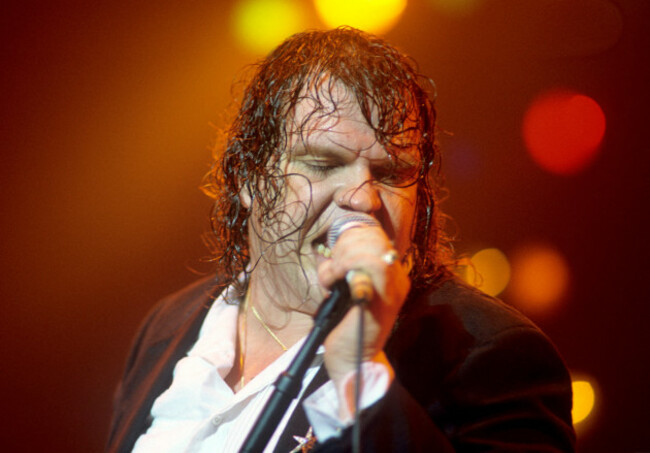
meat-loaf-on-06-04-1988-in-munchen-munich-usage-worldwide Meat Loaf on stage in Germany in 1988. Alamy Stock Photo Alamy Stock Photo

Ireland may not have been quite ready for Meat Loaf but it rose to the occasion. Those 19 nights validated those venues: sweaty, packed, imperfect rooms where Meat Loaf sang as if his life depended on it and for the people who were there, the concerts became touchstones.

There’s an unspoken melancholy too. This is a post–Meat Loaf world. He’s gone now and so are many of the certainties of that era.

Touring and music consumption has changed and the idea that an artist could vanish for years and then return with something as culturally seismic as Bat Out of Hell II feels almost impossible today.

That’s why this story matters.

It reminds us that cultural moments are fragile. They depend on individuals taking risks: promoters, musicians and crew without any guarantee it will work. It also reminds us that Ireland’s relationship with global culture has always been negotiated, balancing ambition and limitation, scale and intimacy.

It’s tempting to romanticise 1990, but the truth is more interesting than nostalgia.

Things were hard and things went wrong. People learned as they went and yet something extraordinary happened.

A man desperate for revival stood on rickety Irish stages and sang his heart out and Irish audiences met him halfway. And for a few cold, wet weeks in early 1990, the distance between Ireland and the wider world felt a little shorter.

That’s what Meat Loaf – From Hell and to Connaught is really about. Not just a tour and not just a rock star but a moment when music, place and connection aligned.

Those moments are rare and when they happen, they’re worth remembering.

Meat Loaf: From Hell and to Connacht airs on RTÉ One at 6:30pm this evening and will also be available on the RTÉ Player. 

Readers like you are keeping these stories free for everyone...
A mix of advertising and supporting contributions helps keep paywalls away from valuable information like this article. Over 5,000 readers like you have already stepped up and support us with a monthly payment or a once-off donation.

Close
JournalTv
News in 60 seconds