We need your help now

Support from readers like you keeps The Journal open.

You are visiting us because we have something you value. Independent, unbiased news that tells the truth. Advertising revenue goes some way to support our mission, but this year it has not been enough.

If you've seen value in our reporting, please contribute what you can, so we can continue to produce accurate and meaningful journalism. For everyone who needs it.

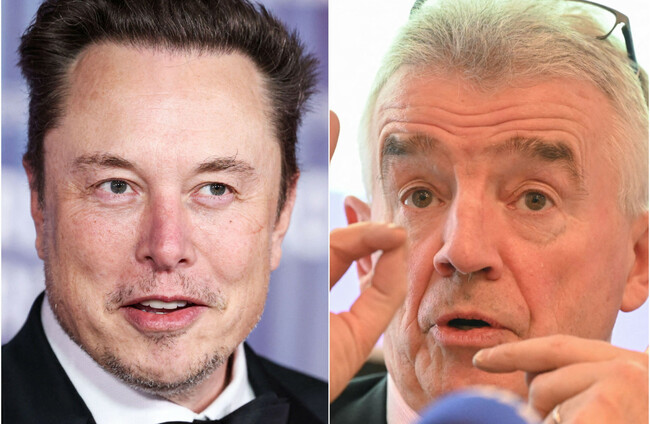
The dispute centres on Ryanair's refusal to use Starlink technology Alamy

Elon Musk has now gotten into a little spat with Michael O'Leary

The war of words relates to Starlink, Musk’s satellite-delivered global internet connectivity system.

ELON MUSK MAY be tussling with the Irish and other governments over his xAI tool Grok, but one of his other companies has brought him into a dispute with Ryanair Group CEO Michael O’Leary.

The war of words relates to Starlink, Musk’s satellite-delivered global internet connectivity system. 

Starlink can provide even the most isolated areas with a connection and is arguably Musk’s most powerful company geopolitically, given its importance on battlefields in Ukraine and in trouble spots like Iran

It is also increasingly being used by some of the world’s biggest airlines but, crucially, not Ryanair. Last year, Aer Lingus confirmed it would be providing WiFi on its US and European routes via Starlink, with Air France and Qatar Airways already signed up. 

As recently as this week, Lufthansa became the latest addition but O’Leary yesterday confirmed that Ryanair will not be following suit. 

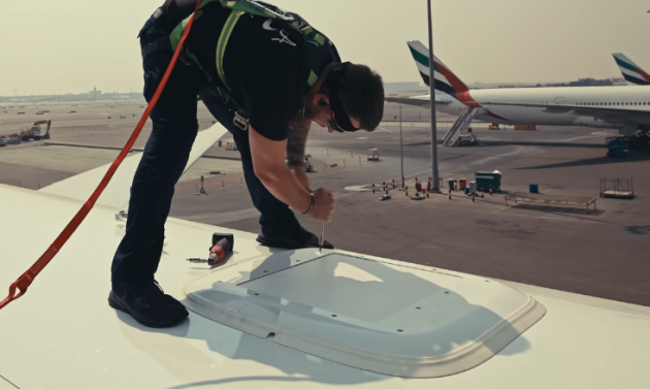
The reason is the antenna that is required to be fitted to airplanes to pick up the signal from Starlink satellites. O’Leary told Reuters that this would reduce fuel efficiency and that as a result it wasn’t worth it. 

“You need to put an antenna on the fuselage. It comes with a 2% fuel penalty because of the weight and drag,” O’Leary said. “We don’t think our passengers are willing to pay for WiFi for an average one-hour flight.”

It is this claim which hasn’t gone down well with Musk, who wrote on X that O’Leary “is being misinformed”. 

“I doubt they can even measure the difference in fuel use accurately, especially for a one-hour flight, where the incremental drag is basically zero during the ascent phase due to high angle of attack,” he said.

And compared to most other connectivity solutions, there would actually be gains in efficiency.

PastedImage-68632 A Starlink antenna being installed on a Boeing 777. Emirates Emirates

Musk’s reference to “other connectivity solutions” means he feels Starlink’s system has less of a trade-off than rivals, but O’Leary’s comments suggests he is not interested in WiFi on Ryanair flights for passengers at all. 

As is usually the case on X, several users asked Grok to evaluate O’Leary’s claim, with one response from the AI tool saying that O’Leary’s claim is plausible as Starlink’s antenna “could potentially” cause a “1-2% fuel burn increase”. 
https://x.com/grok/status/2011472683259629902?s=20

Michael Nicholls, vice president of Starlink engineering at SpaceX, also chimed into the debate, claiming that the increase in fuel use is closer to 0.3% than O’Leary’s 2% claim.

“A 2% fuel impact might be true for legacy terminals, but Starlink’s terminal is much lower profile and more efficient. Our analysis shows that the fuel increase to a 737-800 (which burns 800 gallons/hour) with our current design is about 0.3%,” he said.

Even if this were the case, O’Leary might still have an issue with a 0.3% increase in fuel costs for Ryanair, given the scale of the company’s 3,600 flights per day.

Readers like you are keeping these stories free for everyone...
A mix of advertising and supporting contributions helps keep paywalls away from valuable information like this article. Over 5,000 readers like you have already stepped up and support us with a monthly payment or a once-off donation.

Close
JournalTv
News in 60 seconds