We need your help now

Support from readers like you keeps The Journal open.

You are visiting us because we have something you value. Independent, unbiased news that tells the truth. Advertising revenue goes some way to support our mission, but this year it has not been enough.

If you've seen value in our reporting, please contribute what you can, so we can continue to produce accurate and meaningful journalism. For everyone who needs it.

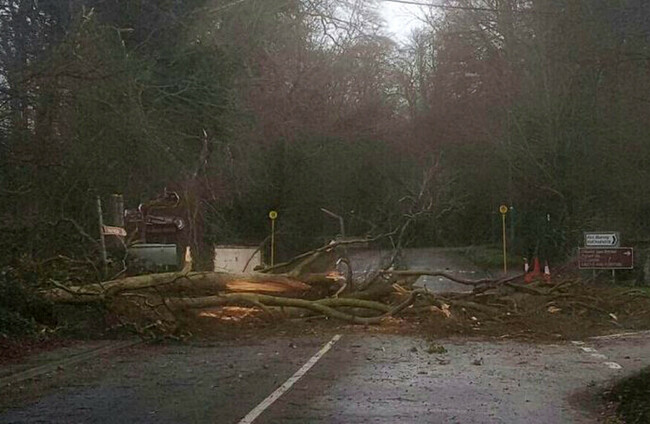
Trees down in Dublin because of Storm Dorris in 2017. Dublin Fire Brigade

Workers facing 'impossible choice' between their safety and their livelihood during storms

Unite the union says that employers shouldn’t be allowed to dock workers pay or annual leave during red alert storms.

THE TRADE UNION Unite is calling on the government to enact ‘extreme weather’ legislation to protect frontline workers as climate change will lead to more adverse weather events in the future.

The main issue, the union says, is around companies giving differing advice to people on whether they can stay at home during red weather alerts, which has led to many travelling in bad conditions.

Speaking to The Journal, Unite’s Irish Secretary Susan Fitzgerald said that the science tells us that we are going to see “more frequent and more severe weather events” of the kind we saw this week when Storm Chandra caused widespread flooding in Dublin, Wicklow and Wexford.

The call for new protections comes as a report by the union has highlighted how workers are being put at risk during storms in Ireland.

Fitzgerald said that new laws are needed to protect workers’ health, safety, and incomes during and after these weather events, and to ensure that they are not forced to make “impossible choices between their safety and their livelihoods”.

The report found that during Storm Eowyn in January last year, the union heard from workers who had to travel into work, others who were told to take a day’s unpaid leave, and some who were told a day was being taken from their annual leave.

This was despite Met Eireann having issuing a Status Red wind warning for the whole country for Friday, 24 January.

The union said that there is a lack of specific legislation outlining employer’s responsibilities in this scenario.

Of 576 survey respondents, just 40% told Unite that their employer had a severe weather policy, while 22% reported that their workplace did not close during the red weather alert time period.

Of those who had to travel to work, over half said that they did not feel safe doing so.

Calls for new protections

In Northern Ireland, following the death of Unite union member Matthew Campbell who was killed while working during Storm Ali in 2018, Unite engaged with Stormont officials with a view to developing new workers’ protections, and that work is ongoing.

They are now calling for the same to happen in the Republic.

The Environmental Protection Agency has warned that climate change will intensify adverse weather events, and will cause them to happen more frequently.

Unite wants to see the introduction of a statutory obligation on employers to conduct extreme weather risk assessments for all employees, including for essential workers travelling to and from work during extreme weather events.

They also want a legal obligation on employers to implement “graduated alert-based responses” that will see “non-essential outdoor work ceasing during amber alerts and all non-essential work ceasing during red alerts”.

The union also says there should be an “explicit prohibition” of any attempts to shift the cost of these events onto workers by deducting pay, requiring workers to use their annual leave, accrued flexitime or TOIL.

They say that sanctions should be placed on employers who breach these rules.

The union also said that its survey heard from workers who were left without power, or with flooded homes in the aftermath of Storm Eowyn, or who were without childcare as their provider was temporarily unavailable.

They want to see the introduction of four days “climate leave” for badly impacted workers, and for employers to be able to declare “force majeure” and access government funding in the event that these circumstances carry on for longer.

Unite also noted that temperatures are going to rise in the long-term.

The union is calling for a maximum temperature limit for work of 30 degrees “at which work should stop” if the temperature in the working environment cannot be brought down.

It further wants to see legislation put in place that recognises illnesses caused by extreme workplace temperatures.

Readers like you are keeping these stories free for everyone...
A mix of advertising and supporting contributions helps keep paywalls away from valuable information like this article. Over 5,000 readers like you have already stepped up and support us with a monthly payment or a once-off donation.

Close
40 Comments
This is YOUR comments community. Stay civil, stay constructive, stay on topic. Please familiarise yourself with our comments policy here before taking part.
Leave a Comment
    Submit a report
    Please help us understand how this comment violates our community guidelines.
    Thank you for the feedback
    Your feedback has been sent to our team for review.

    Leave a commentcancel

     
    JournalTv
    News in 60 seconds