Sign in. It’s quick, free and it’s up to you.
An account is an optional way to support the work we do. Find out more.
Sign in. It’s quick, free and it’s up to you.
An account is an optional way to support the work we do. Find out more.
(Seo alt ónár bhfoireann Gaeltachta. Is féidir an bunleagan as Gaeilge a léamh anseo)
THE GOVERNMENT WILL have little chance of meeting its Irish-language recruitment targets in the public service by 2030, unless more third-level courses through Irish are made available in education institutions across the country.
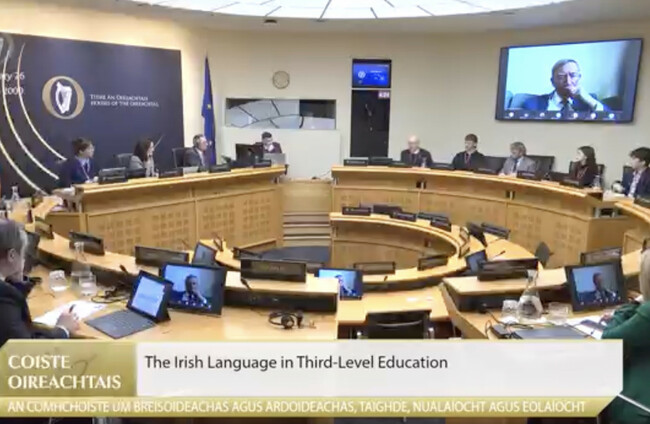
That was the resounding view of those giving testimony at a hearing of the oireachtas committee on Further and Higher Education, Research, Innovation and Science yesterday.
The government’s current plan would see that 20% of new recruits to the public service will be able to converse with the public and provide services through Irish by 2030.
However, it was noted yesterday that this will not be achieved unless the proportion of third-level courses taught through Irish increases from less than 1% to 5%.
Providing more third-level courses or modules through Irish would develop the ability and confidence of those interested in working in the public service to use Irish, while also ensuring that a sufficient number of people will be available in the future to meet the government’s target.
All the testimonials throughout the hearing were given through Irish.
Professor Ciarán Ó hÓgartaigh from the University of Galway told the committee that Ireland is “at a critical point in support for the Irish language in our society” and that there is “a need for a new strategy” within third-level institutions.
“There are a number of initiatives across the sector that are commendable in their innovation and potential. There are many staff members who have both the ability and the interest to teach through Irish,” he said.
“However, as university funding is now largely based on student numbers, there is an institutional challenge associated with modules that have small enrolments.”
“More targeted funding must be provided for Irish-medium modules and support given to them as part of the university workload and that of its staff. This also requires support for textbooks, technology and other teaching resources through Irish.”
Pádraig Mac Brádaigh, Irish-language officer with Aontas na Mac Léinn in Éirinn (AMLÉ), said that there is currently no data available on the number of people who have Irish and who are working in public and third-level institutions.
This means research would need to be carried to determine how many workers are necessary to make up the 20% needed by 2030.
Mac Brádaigh said that courses delivered through English should also have Gaeltacht placement, which would be the most innovative change in the education system.
“Every student in a third level institution in Ireland should have access to an Irish language module based on the Common European Framework of Reference, whether this is part of the course or outside of it,” he said.
“The same option is also available to staff members of institutions. As part of courses, new students and staff members could also take a language awareness module such as a data protection course or an environmental survey through Irish.
“This module or test could assess the person’s language ability as well as explain to them the language rights and obligations of public bodies,” he said.
He referred to his own experience when on Erasmus in Wales, saying that, “Welsh was offered every time I went to University appointments. They would ask, ‘do you want to do this meeting in Welsh or in English?’
Seán Ó Coinn, Chief Executive of Foras na Gaeilge, also mentioned the Welsh language model in his opening statement, saying that there is a national institution for learning Welsh that is responsible for supporting people of all ages to learn the language.
“The 2025 Education and Skills legislation (which aims to have 1 million Welsh speakers in Wales by 2050) includes a specific state-led approach to learning Welsh outside the formal school system,” he said.
“It is also responsible for the development of innovation in Welsh-language learning and every local authority is required to have a plan that takes adult learning and community learning into account.”
Foras na Gaeilge is recommending a 10-year strategy with a four-year action plan and the establishment of a dedicated institution responsible for funding the Irish language across the State.
“We are badly in need of something like this in Ireland,” he said.
Apprenticeships and trades should also be included in any Irish language strategy going forward, said John Prendergast, advocacy manager with Conradh na Gaeilge.
“Mechanics, plumbers and carpenters should also be trained in Irish. A particular emphasis must be placed on expanding courses that would be relevant and required for the new public services department in Ireland, such as interpreting, translation and language planning too,” he said.
When asked why the participants had not yet raised these concerns with the Department of Rural and Community Development and the Gaeltacht, Ó Coinn noted that Foras na Gaeilge and the other organisations present had not yet been successful in securing a meeting with minister Dara Calleary.
The committee on Further and Higher Education, Research, Innovation and Science committee said that they hope a meeting will take place with the Department of the Gaeltacht in the near future.
The Journal’s Gaeltacht initiative is supported by the Local Democracy Reporting Scheme

To embed this post, copy the code below on your site












have your say