We need your help now

Support from readers like you keeps The Journal open.

You are visiting us because we have something you value. Independent, unbiased news that tells the truth. Advertising revenue goes some way to support our mission, but this year it has not been enough.

If you've seen value in our reporting, please contribute what you can, so we can continue to produce accurate and meaningful journalism. For everyone who needs it.

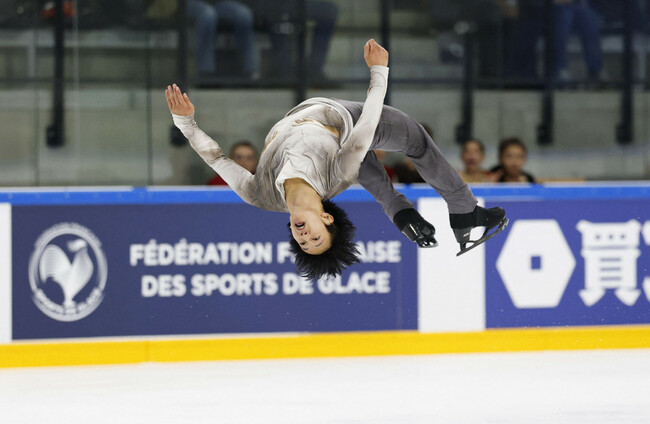
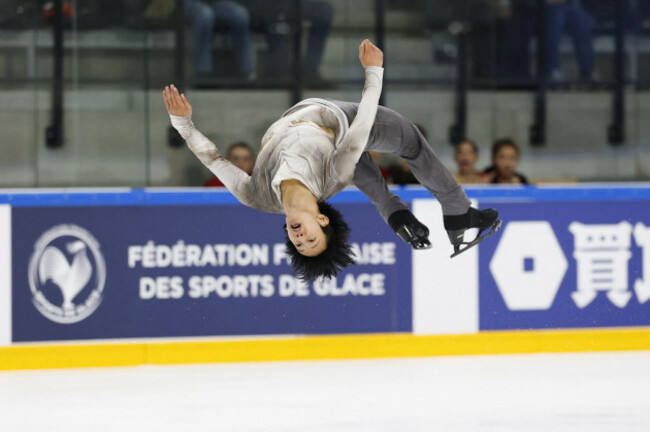
Adam Siao Him Fa of France in competition in October 2025 BJ Warnick/Newscom

Are you seeing lots of videos online of backflipping ice skaters? Here's why

In figure skating, the backflip has always been controversial.

ONE OF THE most decorated and famous tennis players in the world puts his hands on his head, opens his mouth in astonishment and gets to his feet for Team USA figure skater Ilia Malinin. 

A spectator at the 2026 Milan Cortina Olympic Games, Novak Djokovic probably* isn’t someone who has spent too much time worrying about the technicalities or legalities of a backflip in ice skating. 

But watching the 21-year-old American land on one foot after launching himself backwards in the air, the Serbian definitely knew something special had just happened.
https://x.com/tntsports/status/2020659744042565999

With the tumble Malinin became the first person since 1998 to perform the move on Olympic ice, starting a wave of internet discourse comprising joy, annoyance, anger, history, race and gender politics and misinformation. 

‘Who did it first?’ and ‘who should get the credit?’ were questions debated at length. 

First off, the facts: the backflip was outlawed by the sport’s governing body in 1977 – a ban that was only lifted after the 2023/2024 season. 

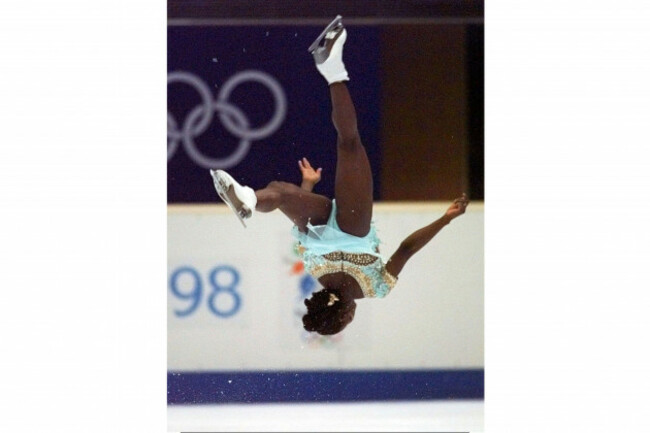
The lore of the backflip in figure skating encompasses a plot line in Will Ferrell’s 2007 Blade of Glory and an almost-consistent virality status for French skater Surya Bonaly’s Nagano 1998 performance. 
https://x.com/OGmariposafria/status/2020674308855476380

But to give the full story to Novak, we’d really have to go back decades to the beginnings of a debate that may never be fully adjudicated: Is figure skating more art or sport? And, related, are you more likely to be a champion if you are seen as athletic and innovative or artistic and perfectionist?

The first?

When skater Lloyd Valdemar ‘Skippy’ Baxter died in 2012, Olympic champion Scott Hamilton led the tributes on (then) Twitter: “My heart hurts today. I just learned that Skippy Baxter, the first human to ever backflip on ice, has passed at the age of 93. 1 of a kind!”

That was a white lie wrapped up in a larger truth. Skippy wasn’t the first to backflip on ice – the human urge to tumble would probably make that fact impossible to verify – but he was unquestionably a pioneer of the move. 

Crucially though, the thousands of times he performed the trick were in ice shows – not competitions – from the 1940s onwards. 

k9henrydog / YouTube

(Skip to 30 seconds to see the backflip – note he lands on two feet) 

“It is the slam dunk of figure skating,” Troy Goldstein, an American technical specialist for the International Skating Union (ISU) told the Washington Post’s Robert Samuels recently.

A slam dunk is not more valuable than a layup, but crowds love it.”

And that gets to the heart of how it became controversial within the confines of the ISU. Figure skating is a sport battling a duality of athleticism and artistry for as long as it has existed. The backflip remains at the heart of that struggle. 

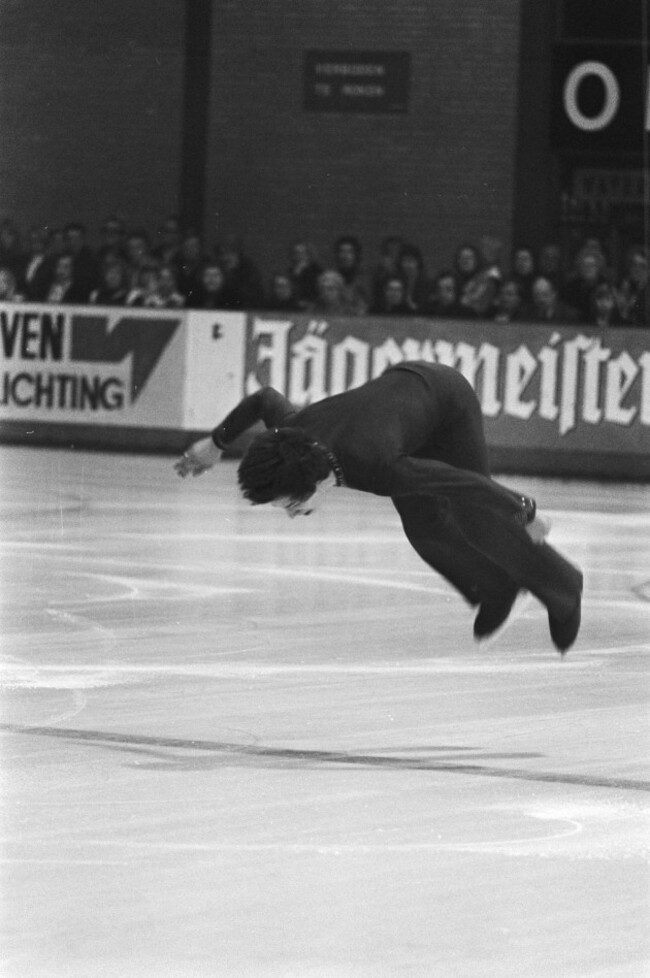
When Terry Kubicka performed it in competition for the first time at the Innsbruck Olympics in 1976, many within the conservative and traditional governing body thought it too like gymnastics, too showy and perhaps too dangerous. (Generally and understandably, ice rinks were also reluctant to allow skaters, particularly children, to try it.)

demonstration-of-international-top-art-fighting-in-edenhal-american-terry-kubicka-in-action-koprol-date-march-16-1976-location-amsterdam-noord-holland-keywords-art-fighting-sport-personal-nam Terry Kubicka in action in 1976 BNA Photographic BNA Photographic

Kubicka said he’d keep doing it for as long as he could, so the ISU acted. In banning the backflip and other acrobatics in 1977, the ISU told the world it was comfortable in its conservatism, traditionalism and exceptionalism. It did not want to be show-business or gymnastics. 

In the athleticism versus artistry debate, the balletic and traditional were winning out. 

The change meant that anyone who performed a backflip wouldn’t just not receive points for it, they’d get a two-point deduction. The threat of disqualification was never far from coaches’ minds either so for the next 20 years the backflip was left to the razzle-dazzle of the professional ice-show.

Bonaly’s moment

The best modern skaters deal with the duality of the endeavour by embracing and excelling at both the technical aspects and the artistic components, but the scoring of the latter has always had an element of the subjective. 

The headings used for component scoring include skating skills, transitions (between technical moves), performance, composition (of the programme) and interpretation of the music.

Over the years, countless female athletes have fallen foul of these criteria because of nebulous traits such as ‘grace’ and ‘elegance’, the stereotype of the ice princess.

(Men, historically, were constrained by a different but similarly rigid set of expectations.)

American Tonya Harding and French woman Surya Bonaly are two of the most famous examples of skaters who were deemed powerful, fast and skilled jumpers but didn’t align to the judges’ ideals for a world champion. 

Former US coach Frank Carroll told an ESPN documentary that a common negative refrain he would hear about Bonaly was that she wasn’t a skater, but a ‘gymnast on ice’. 

Although she won nine French national titles and five European championships, the top spot at worlds eluded her. She had three consolation silver medals. But they hurt. 

Bonaly and many who knew and loved skating believed she was consistently undermarked at world level. The excuse from the judging panel was often that her artistic components lacked grace, an adjective many felt was part of the systemic racism the Black athlete endured. 

By the time the 1998 Olympics were hosted by Nagano, she was near the end of her career – and injured. She was recovering from surgery and didn’t know how much her groin could take, particularly when it came to the difficult jumps she executed. 

She went into her long programme, the second round during a competition, in sixth place. A podium place was not possible. So as she entered the fourth minute with little gas left in the tank, realising she wasn’t going to nail a triple jump, she wanted to leave the audience with something to remember her by. 

As a young girl she learned the backflip because she was inspired, not by Skippy or Hamilton or Kubicka, but by a German skater called Norbert Schramm who she had seen on professional tours.  

If she could land it on one foot, her parents and coaches thought it could help with her jumps. She was landing them at 12 years old. 

In Nagano, perhaps flashing through her memory bank of exhibition programmes and an early controversial warm-up when she did one to the horrors of the other competitors, the media and judges, she said she always had the backflip ‘in her back pocket’. 

She launched herself up and back. Her landing was elegant and she had a great running edge. 

The crowd erupted. It was her slam dunk. She didn’t win, placing 10th, but the audience lapped it up and the world took it as a final stand against the skating fraternity who they deemed had held her back. 

file-frances-surya-bonaly-performs-a-back-flip-during-her-free-skate-program-feb-20-1998-in-nagano-japan-ap-photoeric-draper-file Bonaly mid-flip in Nagano Alamy Alamy

It is one of the most enduring images of the sport. Every year it is also held up as an example of Black defiance in the face of visible and invisible barriers in all walks of life. 

Despite the publicity of the moment, ice skating never dealt with Rule 601. To be fair, a global cheating scandal in the next Olympics in Salt Lake City kept it reform-busy. 

Why again? Why now?

The cycle picks up again 25 years on when in steps someone who has almost been completely written out of the current online narrative: Adam Siao Him Fa.
https://x.com/blooperiod/status/2020774856611250320

He is the link between Bonaly and Malinin. And, objectively, he has a larger role to play in the return of the backflip than the American. 

An outstanding skater, he debuted his two-footed version in competition in 2023. In a world where men do multiple quads, earning them north of nine points each, two points seemed a small penalty. 

In his own words: “When I heard that backflip was just a two-point deduction, I thought, ‘Then, I’ll do it.’ Figure skating is a rare sport that combines athleticism and artistry. I want to try more various possibilities.”

He won the European Championships in January 2024 anyway. 

Speaking directly to the crowd after winning, he gave Bonaly her flowers: “I’ve actually done this backflip for you people. It’s a little French touch.” 

adam-siao-him-fa-of-france-performs-a-backflip-during-the-mens-free-program-at-the-grand-prix-de-france-figure-skating-competition-in-angers-france-on-oct-19-2025-kyodokyodo-photo-via-credit Adam Siao Him Fa of France in competition in October 2025 BJ Warnick / Newscom BJ Warnick / Newscom / Newscom

At season’s end, Fa had a world bronze medal. And he’d turned the heads of some IFU officials in a positive direction. 

Just like that, Rule 601 was changed and skaters could start incorporating all sorts of manoeuvres into choreographic elements of their programmes. This week we’ll see cartwheels and handstands, as well as backflips. 

Bonaly, although not the inventor, nor the first practitioner, or even the first Olympian to do it, is irrevocably linked with the move. Particularly, the one-footed landing version. 

It is also why, although not the most difficult trick in any skater’s arsenal, it was seen as a way to push the ISU – still lacking in diversity – out of its comfort zone.

When Malinin performs it again this week, he most likely won’t make the connection to any of his predecessors. 

A generational skater who comes from a family of Olympic figure skaters, he isn’t unaware of the history. But he’s also not too bothered.

This is a young man who named himself the Quad God as a teenager to manifest his future. He wears his own merchandise emblazoned with that phrase at competition training. 

His Olympic long programme features spoken word which he voices himself. He says he broke physics by mastering the quadruple axel. He does the backflip because he likes doing backflips. 

His aim is to make figure skating relevant again. To be a superstar by pushing the boundaries. 

He might be bringing our attention to the history but he’s all about the future. 

(Disclaimer: I may be wrong here, Novak may be a Kubicka/Hamilton/Bonaly/Siao Him Fa stan) 

Readers like you are keeping these stories free for everyone...
A mix of advertising and supporting contributions helps keep paywalls away from valuable information like this article. Over 5,000 readers like you have already stepped up and support us with a monthly payment or a once-off donation.

Close
5 Comments
This is YOUR comments community. Stay civil, stay constructive, stay on topic. Please familiarise yourself with our comments policy here before taking part.
Leave a Comment
    Submit a report
    Please help us understand how this comment violates our community guidelines.
    Thank you for the feedback
    Your feedback has been sent to our team for review.

    Leave a commentcancel

     
    JournalTv
    News in 60 seconds