We need your help now

Support from readers like you keeps The Journal open.

You are visiting us because we have something you value. Independent, unbiased news that tells the truth. Advertising revenue goes some way to support our mission, but this year it has not been enough.

If you've seen value in our reporting, please contribute what you can, so we can continue to produce accurate and meaningful journalism. For everyone who needs it.

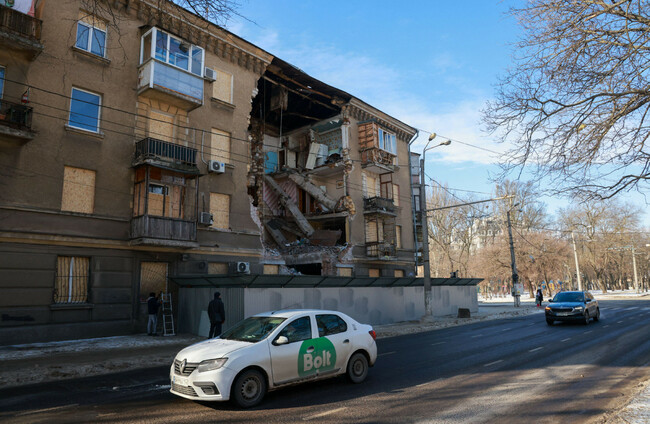
Odessa, Ukraine. 03rd Feb, 2026. Buildings hit by Russian drone strikes on 27 January. Alamy Stock Photo

Barry Cowen on EU Ukraine loan Supporting Ukraine doesn't mean short-changing Ireland

The Irish MEP says the EU support loan is not money taken from Irish services — and pretending it is, only weakens a very serious debate.

LAST UPDATE | 1 hr ago

IN RECENT WEEKS, severe storms have reminded many of us how disruptive the loss of power and basic services can be. Flooded roads, electricity outages, daily life thrown off course.

In Ukraine today, that experience is neither temporary nor accidental. Russian forces continue to target energy infrastructure as part of a sustained campaign, with the explicit aim of making civilian life unbearable. Millions of people are being pushed towards cold, darkness and displacement in an effort to break the country’s capacity to function.

That is only part of the shocking reality facing the people of Ukraine behind the vote before the European Parliament later today on a €90 billion support loan for the country for 2026 and 2027.

Yet in Ireland, debate around the measure has once again been clouded by a familiar and deeply misleading claim: that supporting Ukraine somehow comes at the expense of housing, healthcare or public services at home. It is a claim designed to alarm rather than inform. It makes for an easy soundbite, but it creates a false choice and does nothing to address the real challenges we face.

Tough decisions

The Government, frankly, has enough hard decisions to make without Sinn Féin, the hard left, Independent Ireland, Áontu and other elements of the opposition manufacturing artificial ones.

Housing delivery is improving — more than 36,000 new homes were completed last year, the highest figure in over a decade — but supply still falls short of need. Infrastructure constraints continue to slow progress across housing, energy and regional development. The next Common Agricultural Policy negotiation will be the toughest in a generation. Add global instability and trade disruption, and the pressures on an open economy like ours are clear.

Against that backdrop, it is particularly frustrating to hear claims that this vote represents “money taken from” Irish priorities, or that Ireland is signing a blank cheque that will eventually land on the taxpayer’s desk. We have heard repeated assertions that Ireland is “guaranteeing” the loan to Ukraine, that the bill will come home to Irish households, and that there is little clarity or control over how the money will be used. These claims are usually wrapped in references to genuine cost-of-living pressures, as if invoking one somehow proves the other.

They do not withstand even the most basic of scrutiny. First and foremost, they misrepresent both the scale and the purpose of EU assistance, which is directed towards sustaining essential civilian services and remains modest for Ireland when assessed against national income. This measure does not involve Ireland transferring €90 billion to Ukraine from our own public purse, nor does it divert funding from the HSE, housing or education. The support takes the form of a limited-recourse EU loan, raised on capital markets and backed by existing EU budget headroom — the same architecture used for other EU financial assistance instruments in recent years. Put plainly, Ireland is not writing a cheque, and there is no line item in this vote that subtracts from domestic public spending.

Due diligence

Nor is this an exercise without controls or conditions. Disbursements are tied to a financing strategy drawn up by Ukraine, assessed by the European Commission and approved by the Council, with clear requirements, including on governance and the rule of law. Repayment is structured around Russian war reparations, with Russian assets remaining immobilised in the meantime and available for use in line with international law.

There is also far more transparency than critics suggest. The €90 billion package is clearly divided between macro-financial and budget support on the one hand, and defence-related industrial and procurement support on the other, with detailed rules governing eligibility and oversight. Disagreeing with aspects of that balance is legitimate. Pretending there is no clarity about what the package does or funds is not.

Ireland’s own experience of how the EU thrives tells a clear story. The dividends of our European engagement are visible everywhere: in the roads we drive on, the schools our children learn in, the export markets that sustain Irish jobs and the CAP payments that underpin rural communities. Through Europe, Ireland moved from the margins to the mainstream — from economic vulnerability to competitiveness, from a net recipient to net contributor, from dependency to influence — not by accident, but through partnership and ambition.

That progress has endured because Europe works best when it acts together. We saw it during Brexit, when EU unity protected Irish interests. We saw it through Covid, when collective action supported recovery. And we see it again when Europe chooses cooperation over fragmentation in the face of global instability. European unity has never been abstract or ideological for Ireland; it has been practical, measurable and decisive — which is precisely why it matters most when tested by misinformation closer to home.

Wake up to the reality

It has been said before, but bears repeating: Ireland, of all countries, should recognise what is happening in Ukraine. A larger power denying a smaller nation’s right to exist. A language and culture dismissed or suppressed. An invasion justified as a “security necessity”.

These arguments are not new. They were once used against us. Nor is Ukraine an abstraction. Tens of thousands of Ukrainians now live in Ireland. They work in our hospitals and businesses, study in our schools and universities, and contribute daily to our communities. They are not distant beneficiaries of a decision taken in Brussels; they are our neighbours, colleagues and friends.

At the end of the day, serious politics does not invent easy trade-offs between compassion abroad and competence at home. It confronts reality honestly and then gets on with delivering.

Ireland can invest in housing, health and infrastructure while also standing firmly with a country fighting for its survival. That is the standard against which this week’s vote, and similar ones in the future, should be judged — and it is how they will be treated by my Fianna Fáil colleagues and I: with facts rather than fear, and with the confidence to say clearly that Ireland can meet its priorities at home without being dragged into made-up choices.

Barry Cowen is a Fianna Fáil MEP for the Midlands–North-West constituency. 

Readers like you are keeping these stories free for everyone...
A mix of advertising and supporting contributions helps keep paywalls away from valuable information like this article. Over 5,000 readers like you have already stepped up and support us with a monthly payment or a once-off donation.

Close
JournalTv
News in 60 seconds