We need your help now

Support from readers like you keeps The Journal open.

You are visiting us because we have something you value. Independent, unbiased news that tells the truth. Advertising revenue goes some way to support our mission, but this year it has not been enough.

If you've seen value in our reporting, please contribute what you can, so we can continue to produce accurate and meaningful journalism. For everyone who needs it.

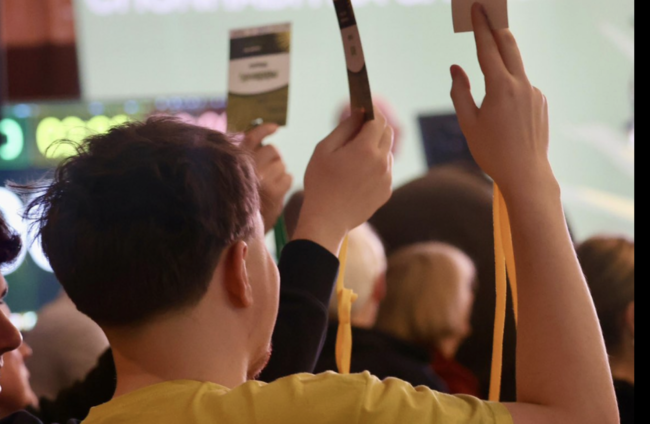
A large majority of delegates at this weekend's Conradh na Gaeilge/Gaelic League ard-fheis have voted in favour of committing the organisation to working for Irish unity Conradh na Gaeilge

Good Friday generation of Irish speakers votes overwhelmingly for Irish unity at Belfast event

The age gap was to the fore as young people voted by a large majority to work for Irish unity at this weekend’s Gaelic League Ard-fheis.

(Seo alt ónár bhfoireann Gaeltachta. Is féidir an bunleagan as Gaeilge a léamh anseo)

WHILE THE AIM of the Conradh na Gaeilge Ard-Fheis in Belfast at the weekend was to end the partition of Ireland, the most striking aspect of the conference was the gap between the high number of young people compared to the middle-aged and pensioners.

It has been a long time since this reporter was at a Conradh na Gaeilge Ard-Fheis, but when I was last there, the attendance was far greater of those with free travel passes than of those with student cards. That equation has now been turned upside down.

These young people are the Good Friday Agreement generation who now lead the largest and oldest Irish language organisation in the country, an organisation that provided many leaders for the 1916 Rising and that has clearly not lost that revolutionary spirit. Or, perhaps it is more accurate to say, that spirit has been recaptured by a new generation.

These young people were supporting this motion

Under Article 3(i), insert this new objective: (j) Work towards United Ireland for the betterment of Irish and the Gaeltacht

And while there was opposition, they were voices from another era of the League, older people offering wise counsel about the impact that a vote for this resolution might have on the attitude of funders towards the League and the charitable status of the organisation.

Cormac Ó Dúlacháin, a senior counsel and member of the Bar’s Irish Language Society, raised these concerns but had a more serious warning about the way in which this purpose, if adopted by the required majority, two-thirds of those present, could have a negative impact on people who would like to be members of the organisation but would not be in favour of Irish unification.

“One of the things about amending the purpose is the article that follows that in the constitution which makes it a duty for the member of the [Gaelic] League to adhere to the aims and characteristics of the organisation in order to be a member,” said Ó Dúlacháin.

If this resolution is adopted, we are telling anyone who has a different view of Irish unity that they have no place in the [Gaelic] League.

He cited research that suggested that up to 30% of the population in the south and 60% in the north were not in favour of unification and recalled with pride the decision in 2008 when the League decided to focus solely on the Irish language.

In the twenty-five years since the turn of the millennium, he said that the League’s income had increased from €250,000 per year to over €2.5m annually.

“Over two million of that comes from public sources because the League is a registered charity.

“There are legal rules relating to how far a charity can have political objectives – that is a question to be examined.

“There is a serious question in the future for Foras na Gaeilge, a cross-border institution, whether the Foras can support a movement that is in favour of or against achieving major political reform, €800,000 which is coming from Foras na Gaeilge.”

There were other voices against the resolution but the voices in favour were younger, stronger and more numerous.

According to Conchúr Ó Muadaigh of Belfast district branch of the League, the fact that this resolution was being proposed at the ard-fheis showed ambition and courage.

“We are not a small, marginal community, we are a living movement that is growing, changing and creating a future for ourselves, we are a community full of enthusiasm and imagination.”

According to Grian Ní Dhaimhin from Strabane in Tyrone, former President of the Students’ Union at Queen’s University, the Irish language would not have existed in her community without people who had supported the Irish language and a united Ireland at the same time because the two things were intertwined.

“I am here looking at what I want for the future of the Irish language and the Conradh and every morning I get up and I am working for the Irish language, everything we do for the Irish language is anti-colonial and decolonial work.”

There were many other women who spoke in favour of the resolution, young women, mothers and teachers. There was one woman who spoke against the resolution and said that there had never been any good results when the Conradh had involved itself with politics as it was intended to do at this ard-fheis.

There were a handful of men who spoke in favour of the resolution, Padaí Ó Tiarnaigh, who works with the Conradh and is involved in many of the legal cases in which the Irish language is currently central and Liam Ó Flannagáin from Carn Tochair in Derry where there is a vibrant Gaeltacht community – but without that status.

According to Ó Tiarnaigh, the Irish language community was “on its knees demanding language rights from Britain and that it was time to get up and imagine a new country founded on equality, language rights and human rights”. 

In his contribution, O’Flanagan was asking people who were against the resolution to walk in the shoes of the northerners who were oppressed by ‘English tyranny’.

Gaeltacht activist Donncha Ó hÉallaithe stood up to speak and admitted that he was not sure how he would vote. He believed that there were serious implications for the League and the Irish language if the resolution was passed – or lost. He asked that the resolution be sent back to the League’s business committee, the most senior committee in the organisation, for reconsideration before it was brought before the upper house again.

This was something that the proposer of the resolution, Conchúr Ó Muadaigh, was not prepared to concede but, understanding that there was some concern in the room about the questions about the ‘practical matters’ raised by Cormac Ó Dúlacáin earlier, he pointed out that the business committee had sought legal advice and that according to that advice, there should be no risk to the League’s income if the resolution was passed.

“We are using this space today, this is the democratic forum, this is the forum where we discuss and this is the forum that will make the decision.”

Conradh President, Ciarán Mac Giolla Bhéin, had the last word in the debate, saying that he was in favour of the resolution because the conversation about the unification of the country was currently ongoing and that the League should be involved in the discussion as he did not want questions about the future of the Irish language and the Gaeltacht to be discussed and the Irish language movement to be excluded on the sidelines.

The resolution was passed by a huge majority, with only a handful of votes against. There was no dramatic walkout as in 1915 when the motto and objective ‘Ireland not only Gaelic but also free, not only free but Gaelic also’ was adopted.

At that Ard Fheis in Dundalk, Eoin Mac Néill and Dubhglás de Íde walked out and there was a split in the organisation. The following year, leaders of the Conradh were among those involved in the Easter Rising and Páraic Mac Pearse, Seosamh Plunkett and Éamon Ceannt were among those executed.

The Journal’s Gaeltacht initiative is supported by the Local Democracy Reporting Scheme

Readers like you are keeping these stories free for everyone...
A mix of advertising and supporting contributions helps keep paywalls away from valuable information like this article. Over 5,000 readers like you have already stepped up and support us with a monthly payment or a once-off donation.

Close
10 Comments
This is YOUR comments community. Stay civil, stay constructive, stay on topic. Please familiarise yourself with our comments policy here before taking part.
Leave a Comment
    Submit a report
    Please help us understand how this comment violates our community guidelines.
    Thank you for the feedback
    Your feedback has been sent to our team for review.

    Leave a commentcancel

     
    JournalTv
    News in 60 seconds