We need your help now

Support from readers like you keeps The Journal open.

You are visiting us because we have something you value. Independent, unbiased news that tells the truth. Advertising revenue goes some way to support our mission, but this year it has not been enough.

If you've seen value in our reporting, please contribute what you can, so we can continue to produce accurate and meaningful journalism. For everyone who needs it.

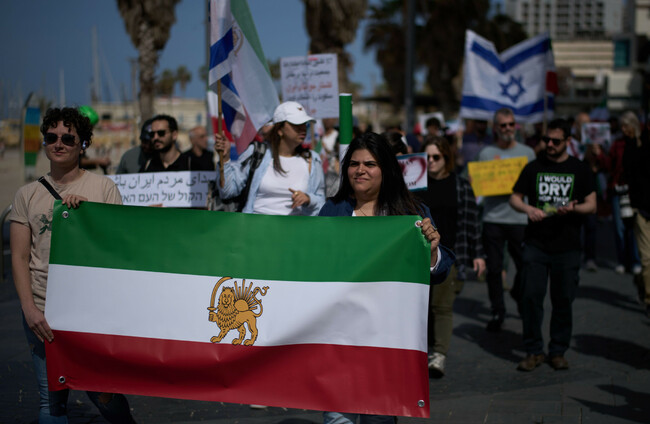
Demonstration in support of anti-government activists in Iran that took place in Tel Aviv, Israel earlier this month Alamy

US allows non-emergency staff to leave Israel as Trump threatens Iran strikes

US President Donald Trump has repeatedly threatened to strike Iran while his army builds up its forces in the region.

LAST UPDATE | 1 hr ago

THE UNITED STATES has authorised the departure of non-emergency embassy staff from Israel, as it threatens strikes on Iran and presses its biggest military build-up in the Middle East in decades.

The move came a day after a round of Oman-mediated talks between Iran and the US seen as a last-ditch bid to avert war, though initial optimism was tempered by Tehran warning Washington must drop “excessive demands” to reach a deal.

The talks follow repeated threats from President Donald Trump to strike Iran while the US military builds up its forces in the region.

As the world’s largest aircraft carrier, the USS Gerald R. Ford, was due to arrive off the coast of key US-ally Israel, the US embassy in the country announced it was allowing non-emergency government personnel and family members to leave “due to safety risks”.

“Persons may wish to consider leaving Israel while commercial flights are available,” the embassy said on its website.

The New York Times reported that US Ambassador to Israel Mike Huckabee sent an email to embassy staff on Friday morning saying that those wishing to leave “should do so TODAY”.

“Focus on getting a seat to anyplace from which you can then continue travel to DC, but the first priority will be getting expeditiously out of country,” he was quoted as writing.

Growing concerns over conflict also resulted in UK embassy staff in Iran being temporarily withdrawn from the country due to the current “security situation”.

The British embassy in Tehran – which was temporarily closed last month – will continue to “operate remotely”, the British Foreign Office said today.

China meanwhile today joined other countries in warning its citizens to leave Iran “as soon as possible”.

Trump on 19 February gave Iran 15 days to reach a deal. While Iran has insisted the discussions focus solely on nuclear issues, the United States wants Tehran’s missile programme and its support for militant groups curtailed.

The Wall Street Journal reported yesterday that Trump’s negotiating team would demand that Iran dismantle its three main nuclear sites and hand over all its remaining enriched uranium to the United States.

Without specifying what demands he was referring to, Iran’s Foreign Minister Abbas Araghchi said today that “success in this path requires seriousness and realism from the other side and avoidance of any miscalculation and excessive demands”.

Talks to continue

Following the talks in Geneva on Thursday, Araghchi told state TV that the negotiations “made very good progress and entered into the elements of an agreement very seriously, both in the nuclear field and in the sanctions field”.

He said the next round would take place in “perhaps less than a week”, with technical talks at the UN’s nuclear agency to begin in Vienna on Monday .

Omani Foreign Minister Badr Albusaidi also announced technical discussions were to be held next week in Vienna.

“We have finished the day after significant progress,” he said in a post on X.

UN nuclear chief Rafael Grossi joined the negotiations, a source close to the talks told AFP.

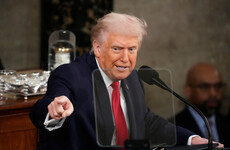
Trump said in his State of the Union address this week that Iran had “already developed missiles that can threaten Europe and our bases overseas, and they’re working to build missiles that will soon reach the United States of America”.

He also accused Iran of “pursuing sinister nuclear ambitions”, though Tehran has always insisted its programme is for civilian purposes.

The accusations were delivered in the same forum in which then-president George W. Bush laid out the case for the invasion of Iraq in 2003.

The Iranian foreign ministry called these claims “big lies”.

‘Extremely alarmed’

Washington already had more than a dozen warships in the Middle East, including another aircraft carrier, before deploying the Gerald R. Ford.

A previous attempt at negotiations collapsed when Israel launched strikes on Iran last June, beginning a 12-day war that the US briefly joined to bomb Iranian nuclear sites.

The UN rights chief Volker Turk said he was “extremely alarmed” at the risk of a regional escalation around Iran, adding: “I hope the voice of reason prevails.”

Turk also highlighted Iran’s domestic pressures, after Tehran launched a mass crackdown on nationwide protests last month, killing thousands of people according to rights groups.

“The situation in Iran remains volatile,” Turk told the Human Rights Council in Geneva, noting that protests have since resumed around Iranian universities, “making it clear that the underlying grievances remain”.

Close
JournalTv
News in 60 seconds