We need your help now

Support from readers like you keeps The Journal open.

You are visiting us because we have something you value. Independent, unbiased news that tells the truth. Advertising revenue goes some way to support our mission, but this year it has not been enough.

If you've seen value in our reporting, please contribute what you can, so we can continue to produce accurate and meaningful journalism. For everyone who needs it.

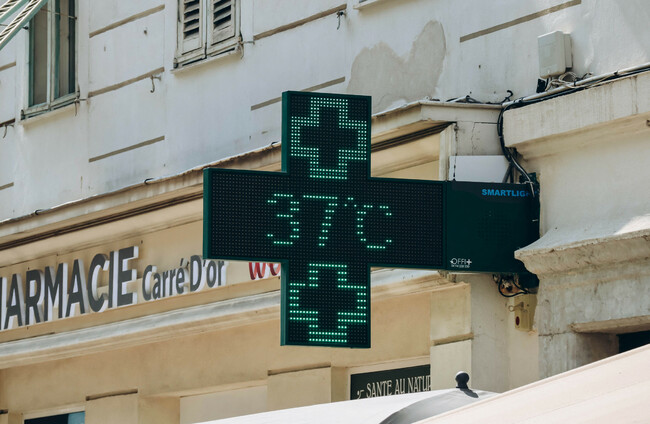
An outdoor thermometer in Nice during a heatwave Alamy

El Niño phenomenon fuels likelihood of extreme weather over summer

The natural climate phenomenon typically takes place every two to seven years and lasts around nine to 12 months.

EL NIÑO WILL quickly develop into a strong event between July and September, fuelling the likelihood of extreme weather, the United Nations’ weather and climate agency has warned.

The World Meteorological Organization (WMO) said El Niño had already set in, and would quickly gain strength, as it warned countries to brace for impact.

El Niño is a natural climate phenomenon that warms surface temperatures in the central and eastern equatorial Pacific Ocean, bringing worldwide changes in winds, pressure and rainfall patterns.

It typically takes place every two to seven years and lasts around nine to 12 months.

Conditions oscillate between El Niño and its opposite La Niña, with neutral conditions in between.

The WMO classifies El Niño events as weak, moderate, strong or very strong. It is set to reach the third-highest level out of four between now and September.

Warm spell coming

Met Éireann revealed that last month was the hottest June on record in Dublin

Temperatures in Ireland this weekend are set to reach the low to mid-20s.

Met Éireann says Saturday will be mostly cloudy and mostly, but there may be some patchy light rain and drizzle in Connacht and Ulster.

Meanwhile, the south and southeast will get some bright or sunny spells.

Temperatures will reach highs of between 15 and 18 degrees in the north and west, and 19 and 23 degrees in the south and east.

It’ll stay cloudy through to Sunday, again with some drizzle in the north and west.

Highest temperatures will range from 16 degrees in the northwest to 23 or 24 degrees in the southeast, with moderate southwesterly winds.

Heatwave risks

The Geneva-based agency said that forecasts produced by leading global climate centres, using different models, indicate a consistent and significant warming of ocean temperatures across the central and eastern equatorial Pacific.

“Seasonal-average sea-surface temperature anomalies expected to exceed 2C in key monitoring regions,” it said.

The models show “remarkable agreement, providing high confidence in the outlook”, the WMO said.

The last El Niño contributed to making 2023 the second-hottest year on record and 2024 the all-time high at around 1.55 degrees above the 1850-1900 pre-industrial average.

While El Niño usually peaks between November and February, the resulting spike in temperatures typically comes later down the line.

With reporting by AFP

Readers like you are keeping these stories free for everyone...
A mix of advertising and supporting contributions helps keep paywalls away from valuable information like this article. Over 5,000 readers like you have already stepped up and support us with a monthly payment or a once-off donation.

Close
39 Comments
This is YOUR comments community. Stay civil, stay constructive, stay on topic. Please familiarise yourself with our comments policy here before taking part.
Leave a Comment
    Submit a report
    Please help us understand how this comment violates our community guidelines.
    Thank you for the feedback
    Your feedback has been sent to our team for review.

    Leave a commentcancel

     
    JournalTv
    News in 60 seconds