We need your help now

Support from readers like you keeps The Journal open.

You are visiting us because we have something you value. Independent, unbiased news that tells the truth. Advertising revenue goes some way to support our mission, but this year it has not been enough.

If you've seen value in our reporting, please contribute what you can, so we can continue to produce accurate and meaningful journalism. For everyone who needs it.

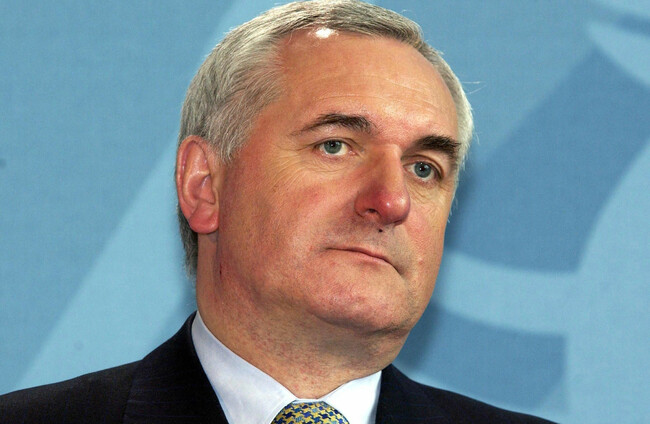
Taoiseach Bertie Ahern in 2003. Alamy Stock Photo

When Bertie Ahern brought loyalists to Dublin and they raised 'ethnic cleansing' by republicans

The Loyalist Commission had representatives from the UVF, UDA and Red Hand Commando.

TAOISEACH BERTIE AHERN welcomed a group representing loyalist paramilitaries to Dublin 22 years ago and told them that his father had been a republican and “a good rebel”.

The meeting with the Loyalist Commission in Dublin was held in June 2003 and Ahern had said publicly afterwards that the meeting was important to build trust and confidence by engaging in dialogue.

The Loyalist Commission was an umbrella group formed post-ceasefire in 2001 that had representatives from loyalist paramilitaries the UVF, UDA and Red Hand Commando.

It was formed in the aftermath of the violent confrontation between UDA figure Johnny Adair and the UVF on the Shankill Road between 2000 and 2002.

As well as paramilitary representatives, the Loyalist Commission also had community and political representatives.

Confidential minutes of the meeting between Ahern and the loyalists has now been made public for the first time.

Government documents are released annually under the 30-year rule and sent to the National Archives but more recent files relating to Anglo-Irish relations up to 2005 have also now been released.

The report of the meeting shows the then taoiseach and the loyalist group attempting to find common ground with one another.

Ahern, welcoming them to the capital, noted that his father had been “a good rebel” in his day, and explained that his deep engagement with Northern Ireland stemmed from a desire to secure peace and stability.

He stressed that he was “absolutely sincere” in working with loyalists and other communities: “We could not change the past, but we respected different beliefs and traditions,” he said, according to the record.

Ahern told the men that he “understood inner city problems” and reportedly said that “his constituency probably saw more murder in recent times than in Northern Ireland”.

Ken Wilkinson, a former member of the Ulster Volunteer Force who died in 2021, told Ahern that “service in the British Army was part of the Irish tradition”, stating that one of the first casualties of the Iraq War who died two months previous was Irish.

Ahern commented to Wilkinson that the individual was “from my constituency”.

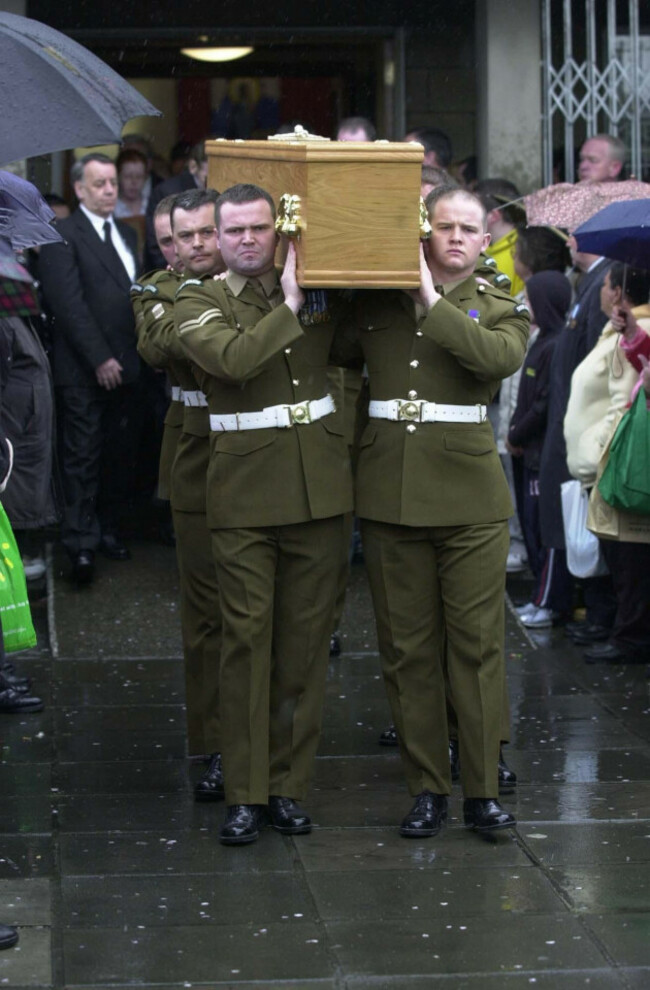
Although this would not be Ahern’s constituency, this is likely a reference to Ian Malone, from Ballyfermot in Dublin, who was part of the British Army’s Irish Guards and who was killed in Basra on 6 April 2003.

lance-corpral-ian-malone-funeral Malone's funeral in 2003 was the first British military funeral in the Republic of Ireland. Alamy Stock Photo Alamy Stock Photo

Also present at the Dublin meeting was the Church of Ireland Archbishop of Armagh, Lord Robin Eames, alongside the commission’s chair, Orange Order grand secretary Mervyn Gibson.

Eames said a meeting such as this in Dublin would have been “inconceivable” ten years previous.

Bill McCaughey from North Antrim claimed that republicans were intent on ethnic cleansing and that rural interfaces were being created to achieve this as part of what he called a “Provo strategy”.

McCaughey said this strategy “went back to 1641” and that republicans “spoke the language of peace, but continued a campaign of low-level intimidation”.

Jim Wilson, then an Ulster Unionist Party MLA for East Belfast, complained that Sinn Féin “operated a powerful propaganda machine” capable of shaping the public narrative about the north.

He said dozens of Loyalist families had been forced to leave their homes in Cluan Place, the interface area beside the Short Strand, in 2002 because of intimidation, yet “this was never reported”.

He argued that communities like Cluan Place had seen no improvement since the 1998 Belfast Agreement and that the hostilities evident in 2002 were “worse than anything he had seen since 1969”.

Responding to the taoiseach, Jackie McDonald — a prominent loyalist figure then and still today — said that “the sincerity” of Ahern’s approach did not resonate within his community.

“They felt threatened, isolated and second-class. They believed that there was an iron triangle of the British and Irish governments and Sinn Fein working against them,” he said.

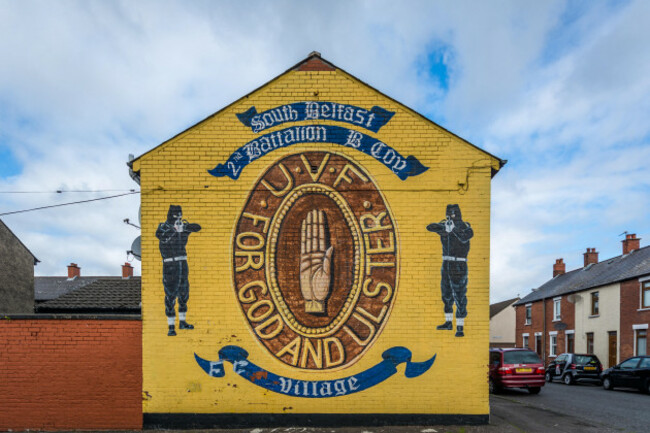
uvf-mural-in-south-belfast A UVF mural in south Belfast. Alamy Stock Photo Alamy Stock Photo

Constitutional claim

Ahern pointed out to the loyalists that he had asked people in the Republic to replace Articles 2 and 3 of the Constitution but that the promised North-South structures had not materialised in return.

The original Articles 2 and 3 of the Constitution of Ireland had claimed the “national territory” as being the whole island of Ireland before this was changed by referendum.

On this point, according to the report of the discussion: “The loyalist community did not seem to appreciate that we had given away Articles 2 and 3 which were held dear by Irish people.”

Jim Wilson dismissed said Articles 2 and 3 “should not have been there in the first place” and contending that from a loyalist standpoint the Belfast Agreement “was all green, white and gold”.

The delegation also questioned why those responsible for killing RUC and British Army personnel had been released under the terms of the Good Friday Agreement, while the Provisional IRA members involved in the 1996 killing of Detective Garda Jerry McCabe in Adare, Co Limerick, were still imprisoned.

Ahern responded that the Castlerea prisoners had been “disowned” by the Provisional IRA and “were treated for what they were – bandits operating in Limerick who shot two detectives”.

Readers like you are keeping these stories free for everyone...
A mix of advertising and supporting contributions helps keep paywalls away from valuable information like this article. Over 5,000 readers like you have already stepped up and support us with a monthly payment or a once-off donation.

Close
24 Comments
This is YOUR comments community. Stay civil, stay constructive, stay on topic. Please familiarise yourself with our comments policy here before taking part.
Leave a Comment
    Submit a report
    Please help us understand how this comment violates our community guidelines.
    Thank you for the feedback
    Your feedback has been sent to our team for review.

    Leave a commentcancel

     
    JournalTv
    News in 60 seconds