We need your help now

Support from readers like you keeps The Journal open.

You are visiting us because we have something you value. Independent, unbiased news that tells the truth. Advertising revenue goes some way to support our mission, but this year it has not been enough.

If you've seen value in our reporting, please contribute what you can, so we can continue to produce accurate and meaningful journalism. For everyone who needs it.

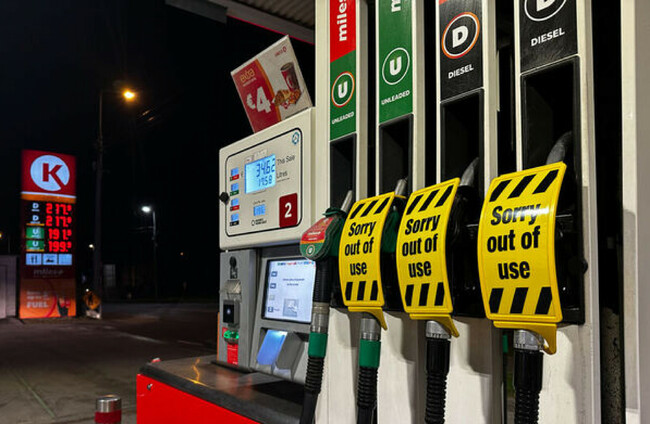
Empty fuel pumps at a forecourt in Co Cork this morning. RollingNews.ie

Can the government cut carbon tax, and what would happen if it did?

Carbon tax is back on the agenda. Here’s what any changes would mean in the short and long term.

ONE OF THE central demands of the current fuel price protests has been a suspension of carbon tax on fuels given the current global energy crisis.

John Dallon, one of the organisers, told The Journal yesterday that protesters want the carbon tax “removed completely” as part of price caps on both ‘green’ diesel (for off-road machinery) and ‘white’ diesel (for road vehicles).

The protests have amplified calls from opposition parties Sinn Féin, Aontú and Independent Ireland for the suspension of annual carbon tax increases.

As government talks get underway this afternoon, the construction industry has called for a pause on any carbon tax increases on fuel. The Irish Farmers’ Association, which will be part of this afternoon’s negotiations, wants a reduction in carbon tax on green diesel. Hauliers have called for carbon tax to be suspended.

Carbon tax is levied on fuels: coal, peat, home heating oil, natural gas supplies to consumers and, of course, petrol and diesel.

So can the government cut carbon tax? Should it? And what would happen if it did? 

Can the government cut carbon tax?

Yes, is the short answer.

It’s a bit complicated, because it would require the amendment of primary legislation, namely the 2020 Finance Act, but the government could halt the next carbon tax increase – due next month – if it wanted to. Scrapping the tax altogether seems a lot less likely.

“The government has a big fat majority. They can do what they want,” says Green Party leader Roderic O’Gorman.

He argues that with €1.1bn in ringfenced revenue earmarked this year for social protection measures, home retrofitting and farming supports, carbon tax is “the last part of the tax system that should be meddled with” if Ireland wants to protect itself against more fossil fuel crises in the future.

What do farmers and farm contractors want?

The government will be under pressure at this afternoon’s talks to grant targeted concessions for farmers, farm contractors and hauliers. Carbon tax will be high on the agenda for the sectors’ representatives.

Tadhg Buckley, director of policy at the Irish Farmers’ Association, points out that carbon tax is supposed to help driver behavioural change to help the environment – but for farmers, there is no alternative to diesel. 

“Electric tractors don’t exist,” Buckley says.

“If you’re doing agricultural work, there’s no alternative fuel, you just literally have to use diesel. Down the road, we might have other options, but that’s  probably a decade away.

“That’s our issue with carbon tax: we can’t avoid it.”

Buckley says the IFA wants to see a reduction in carbon tax on green diesel not only for its members but also for farm contracters. Many of those protesting in Dublin city centre this week are farm contracters. 

How much money are we talking about? 

Right now, carbon tax is charged at €71 per tonne of CO2 emitted by petrol and diesel, and €63.50 per tonne for other fuels.

Farmers get some tax relief, although as with all tax reliefs, there is a delay in receiving this. 

Under legislation agreed in 2020, carbon tax is ratcheted up a notch every year. This upward trajectory is heading towards a promised €100 per tonne of CO2 for all fuels in 2030.

These increases are staggered, with hikes on auto petrol and diesel coming in at the time of the budget in October, and the increases for other fuels including home heating oil and green diesel kicking in in May each year.

So the increase due in May, which you’re likely to have heard opposition politicians giving out about this week, doesn’t apply to petrol and diesel at forecourts.

Carbon tax currently comes in at about 16c per litre for petrol and 18c for diesel. The last increase in October 2025 added about 2.5c per litre, industry lobby Fuels for Ireland said at the time.

VAT is charged on top of carbon tax, so any change to carbon tax also brings a proportionate VAT change. It’s worth noting that your fuel bill comprises quite a bit less carbon tax than excise.

Farm contractors and others have argued that last month’s excise cuts took a lot less off the price of ‘green’ diesel than ‘white’ or auto diesel.

What would happen if the government cut carbon tax? 

There’s a few factors to consider here.

It’s worth noting that Ireland enjoys an exemption from an EU requirement to price carbon emissions from road transport and buildings because we have a relatively high carbon tax.

If the carbon tax were scrapped, as called for by fuel protesters, Ireland would lose this derogation. The money then raised under the EU scheme would go into an EU pot rather than being ringfenced here at home.

“It’s far better that we’ve control over this money here, and that we get to invest it in areas where we know is delivering, and particularly delivering for the most vulnerable,” O’Gorman argues.

The next factor to consider is the revenue. Carbon tax is unusual in the Irish tax system in being ringfenced for specific purposes.

Greenways, energy efficiency measures, peatlands rehabilitation, and social protection payments are all funded with cabon tax. So are grants for electric cars and home upgrades for people in energy poverty. About half of retrofitting grants to date have helped lower income households.

Revenue is also heavily invested in fuel allowance, to offset the effect of carbon tax on poorer households, on whom it would otherwise have a disproportionate impact.

The tax is obviously not just about raising money, however. Putting a price on pollution is also supposed to act as an environmental policy lever. If it’s working, it should help to level the playing field between fossil fuels and cleaner alternatives.

Does carbon tax cut emissions?

Muireann Lynch, who has done extensive research in this area with the ESRI, says it is regarded as an established fact by almost all mainstream economists that carbon tax reduces emissions.

Both Irish and international research shows this to be the case – not just studies based on modelling, but also studies looking back after the fact.

Paul Deane, senior lecturer in clean energy futures at University College Cork, believes that with fuel prices as high as they currently are, there’s already a significant incentive for people to use their car as little as they can in the immediate term. That could be considered by government if they’re looking at policy changes.

But he agrees with O’Gorman that cutting carbon tax would mean taking away money “that goes into the exchequer to help families move away from fossil fuels”. It would reduce the state’s ability to help people who need help most with the climate transition, including poorer households and farmers, Deane says.

He believes this factor has not had enough airtime in the national debate on this subject this week.

What would be the longer term impact?

The fuel crisis is an immediate one, and many people who depend on their car to get around are struggling with the price of filling their tank. But the government will also be looking at the question of the long-term impact if the carbon tax signal is interfered with.

Carbon tax changes how we think about the future, Deane says.

A 2c or 3c increase in carbon tax as happens each year won’t stop anyone driving, but knowing the direction of travel does change how people think about cleaner alternatives such as electric cars or heat pumps when they make their next big investment.

“There’s a long-term signal there that the price of petrol, diesel, and the pollution coming from it, is going to be taxed higher and higher every year,” Deane says

Lynch agrees that changing carbon tax policy now would hamper Ireland’s progress towards its climate goals.

In the short-run, it would increase usage of high-carbon goods. In the long-term, it would make people less likely to invest in, for example, an electric car.

“If the government makes it clear that carbon tax policy is something they’re willing to mess around with, this would make someone less likely to opt for the lower emissions car over the higher emissions car,” Lynch says.

Readers like you are keeping these stories free for everyone...
Our Explainer articles bring context and explanations in plain language to help make sense of complex issues. We're asking readers like you to support us so we can continue to provide helpful context to everyone, regardless of their ability to pay.

Close
80 Comments
This is YOUR comments community. Stay civil, stay constructive, stay on topic. Please familiarise yourself with our comments policy here before taking part.
Leave a Comment
    Submit a report
    Please help us understand how this comment violates our community guidelines.
    Thank you for the feedback
    Your feedback has been sent to our team for review.

    Leave a commentcancel

     
    JournalTv
    News in 60 seconds