We need your help now

Support from readers like you keeps The Journal open.

You are visiting us because we have something you value. Independent, unbiased news that tells the truth. Advertising revenue goes some way to support our mission, but this year it has not been enough.

If you've seen value in our reporting, please contribute what you can, so we can continue to produce accurate and meaningful journalism. For everyone who needs it.


According to the Central Bank, there was a 7.4% year-on-year decrease in job postings in the third quarter of this year. Alamy Stock Photo

Job postings are falling as unemployment ticks up - but not because the economy is weakening

The Central Bank issued the stark warnings in their latest quarterly bulletin, but added that the economy is still on the up.

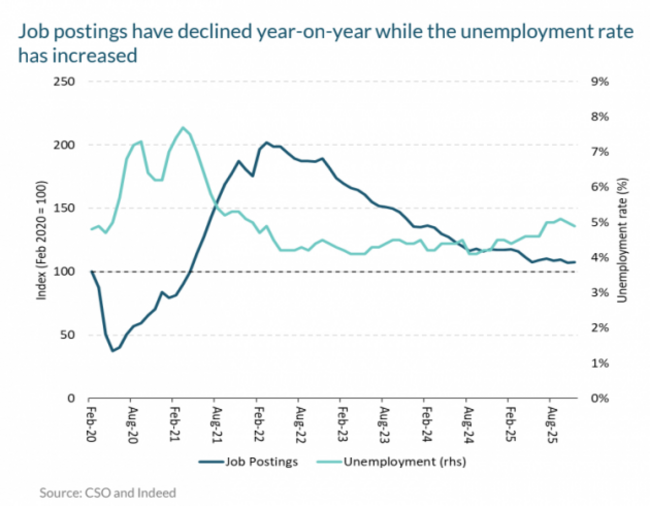
JOB POSTINGS HAVE fallen year-on-year and the unemployment rate has edged higher, but the Central Bank says this cooling in Ireland’s labour market should not be mistaken for an economic downturn.

Instead, the easing reflects an economy that has been operating close to its limits for several years, with firms increasingly constrained by labour shortages, housing supply and infrastructure capacity rather than a collapse in demand.

It also reflects global trends of job vacancies dropping across a number of western economies, with hiring levels cooling but “not falling off a cliff” in the US, according to one economist.

Data cited by the Central Bank in its final Quarterly Bulletin of 2025 show that job vacancies are now at their lowest level in four years, but still remain higher than pre-Covid pandemic levels.

While the labour market remains tight by historical standards, demand for workers is no longer accelerating at the pace seen earlier in the post-pandemic period.

A decrease in job postings in Ireland is generally seen as a normalisation after an exceptional boom (such as the post-pandemic period), not necessarily a bad sign for the economy.

That cooling is expected to continue gradually, the Central Bank has said.

The drop off in advertised vacancies has also led to a rise of “job hugging”, the trend of workers reducing their job searches and staying put in their current roles, according to LinkedIn.

Employment growth is forecast to ease to below 2%, the Central Bank has said, while the unemployment rate is projected to average around 5% over the coming years (still low, but higher than recent lows).

The Central Bank is predicting that roughly 143,000 people will be unemployed by the end of the year – an increase of 20,000 people compared to 2024.

Screenshot (162) Central Bank Central Bank

Crucially for households, however, the Central Bank expects workers’ purchasing power to continue improving.

Real compensation per employee (a measure that accounts for inflation) is projected to rise steadily over the forecast horizon, supporting further gains in disposable income.

Nominal compensation per employee rose by 6.1% year-on-year in the third quarter of 2025, its fastest pace in several quarters.

This was driven by strong wage growth in sectors such as professional services, finance and the public sector, as well as “composition effects”, with lower youth and part-time employment pushing up average earnings for remaining workers.

After inflation, real compensation still rose by 4.1% in the third quarter of the year.

The Central Bank also found that more timely data from Indeed points in the same direction.

Growth in advertised wages has averaged 4.4% so far this year, running ahead of the Euro area average.

For 2025 as a whole, compensation per employee is projected to rise by 4.6% in nominal terms and 2% in real terms.

Wage growth is expected to moderate in the coming years, easing towards 3.5% by 2028 as labour demand weakens and unemployment rises slightly.

However, with inflation forecast to average around 2%, real wages are still expected to grow.

Upcoming increases to the minimum wage in January 2026 and remaining public sector pay rises will also support incomes in the near term.

The Central Bank said this pattern (slower hiring alongside continued real wage growth) is consistent with an economy facing capacity constraints rather than cyclical weakness.

Housing shortages and infrastructure bottlenecks are limiting how quickly firms can expand, even as multinational investment continues to underpin overall growth.

The Central Bank predicts that 155,500 homes will be built by the end of 2028 (since the beginning of 2025) – a significantly lower figure than the government’s target of 300,000 homes (50,000 homes a year) by 2030.

Modified domestic demand (an economic indicator that measures the underlying health of the actual domestic economy by summing household spending, government spending, and modified investment) is forecast to grow by just under 4% in 2025 before easing to an average of 2.9% between 2026 and 2028.

While this represents a slowdown from the post-pandemic surge, the Central Bank said sustaining living standards will depend less on boosting demand and more on addressing long-standing supply constraints, particularly in housing, that are now shaping the labour market’s next phase.

Screenshot (164) Central Bank Central Bank

The Central Bank also noted that the surge in goods exports this year has been driven overwhelmingly by a single pharmaceutical product category – ingredients used in diabetes and obesity medicines – rather than broad-based growth across manufacturing.

Readers like you are keeping these stories free for everyone...
A mix of advertising and supporting contributions helps keep paywalls away from valuable information like this article. Over 5,000 readers like you have already stepped up and support us with a monthly payment or a once-off donation.

Close
42 Comments
This is YOUR comments community. Stay civil, stay constructive, stay on topic. Please familiarise yourself with our comments policy here before taking part.
Leave a Comment
    Submit a report
    Please help us understand how this comment violates our community guidelines.
    Thank you for the feedback
    Your feedback has been sent to our team for review.

    Leave a commentcancel

     
    JournalTv
    News in 60 seconds