Sign in. It’s quick, free and it’s up to you.
An account is an optional way to support the work we do. Find out more.
Sign in. It’s quick, free and it’s up to you.
An account is an optional way to support the work we do. Find out more.
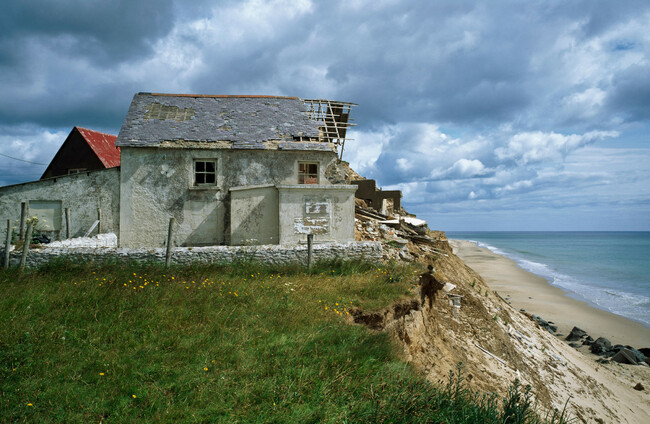
NEARLY 4,500 IRISH homes are at risk from coastal erosion by 2050, and the professors behind a landmark new report say even that figure barely scratches the surface.
The report, published today by the Climate Change Advisory Council, provides the first comprehensive roadmap for a national Coastal Change Adaptation Framework.
A 2022 survey by the Climate Action Regional Office found 2,279 properties and 570 kilometres of roads currently at risk from coastal erosion, with that property figure projected to nearly double to 4,446 by 2050.
But Dr Eugene Farrell, Associate Professor at University of Galway and lead author of the report, told The Journal those numbers are almost certainly a significant undercount.
“Those numbers come from just eight of the 19 counties with coastlines,” Farrell said.
“So that number could quadruple, or more. They didn’t even factor in sea level rise or the increasing intensity of storms in the Northeast Atlantic. When you put those things together, the number of houses at risk will absolutely be much more than what was reported in 2022.”
Local authorities know where the worst affected areas for coastal erosion are, and that around 20% of its coastline is actively eroding.
What the State as a whole lacks, the report argues, is any binding plan for what to do about it.
“We’re the only island nation I know of without even a statutory coastal management plan,” Farrell said.
“We have a strategy for coastal change, but we’re really lagging behind places like England, Scotland and our European neighbours.”
In England and Wales, Shoreline Management Plans map out government strategy for every stretch of coastline across three time horizons (0 to 20 years, up to 50 years, and up to 100 years) giving communities and homeowners lead time to consider their options. Ireland has no equivalent.
The report argues that hard sea defences, while politically popular, are not a universal answer. They’re expensive, environmentally damaging and increasingly unsustainable in the face of accelerating sea level rise.
Coastal engineering can disrupt sediment transport, cause beach narrowing, and generate new erosion problems elsewhere.
Yet the alternative, which is telling people their home will not be protected, is deeply contentious.
“We can’t afford economically to protect 20% of our coastline using hard engineering,” Farrell said.
“But we can’t just let rural coastlines get washed away either. That should not be the option. There has to be a plan B, and there has to be compensation.”
That plan B is what the report calls “planned relocation”: a deliberate, state-supported process of moving people, homes, and critical infrastructure away from at-risk areas before crisis hits.
The report recommends retiring the term “managed retreat,” which it says carries connotations of abandonment, in favour of language that frames the process as strategic and proactive.
“Coastal erosion is treated like a local nuisance – it’s your problem, it’s the homeowner’s problem,” Farrell said.
“Compare that to flooding, where we have national plans and structures to manage it and compensate people. There have been multiple relocation projects done for river flooding in Galway and on the Shannon in the last 20 years.”
The most recent, the 2017 Voluntary Homeowners Relocation Scheme, moved 24 households and provided replacement homes with a similar number of bedrooms, covered legal costs, and paid relocation expenses. Nothing equivalent exists for coastal erosion.
“People depend on ad hoc, reactive interventions from the OPW and local authorities,” Farrell said.
“Long-term, that’s really not the best approach, because over the next 50 to 100 years, you’re looking at thousands of houses on the line. We need a transparent, fair process. Moving house is a human rights issue. You’re entitled to a home, and there are real mental health consequences of what people are going through.”
Among the report’s recommendations is one drawn from Farrell’s own experience working in the property sector in California – mandatory natural hazard disclosure in property transactions.
Under such a scheme, prospective buyers would be formally notified if a home falls within a projected erosion or flood risk zone before they complete a purchase.
“In Ireland, we don’t have that. People aren’t always aware of erosion maps or flood maps. We have that information — why not provide it as part of property transactions? At least then people are buying the risk knowingly.”
He acknowledged the proposal doesn’t solve the problem for those already locked into at-risk properties, many of whom find their homes worth a fraction of their mortgage value.
The report also flags that future coastal infrastructure (ports, transmission networks, and onshore connections for offshore wind farms) must be designed with long-term coastal change projections built in from the start.
Addressing the fundamental governance gap, the report identifies that unlike flooding, which is governed by EU directive, coastal erosion has no equivalent legal framework at European level.
That absence, Farrell argues, is part of why progress has stalled.
“There’s no clear mandate,” Farrell said.
“We don’t have to do anything, which is why it ends up ad hoc. Cost-benefit analysis ends up favouring more urban coastlines, and they get protection first. But we cannot just let rural coastlines get washed away.”
The report also identifies multiple government departments with a remit touching the coastline and relocation (climate, environment, finance, transport, housing, energy), all of which would need to be involved in any coherent national response.
“We need a shift in mindset,” Farrell said.
“Erosion isn’t a local nuisance problem. It’s a whole of Ireland problem. That’s the bottom line.”

To embed this post, copy the code below on your site








have your say