We need your help now

Support from readers like you keeps The Journal open.

You are visiting us because we have something you value. Independent, unbiased news that tells the truth. Advertising revenue goes some way to support our mission, but this year it has not been enough.

If you've seen value in our reporting, please contribute what you can, so we can continue to produce accurate and meaningful journalism. For everyone who needs it.

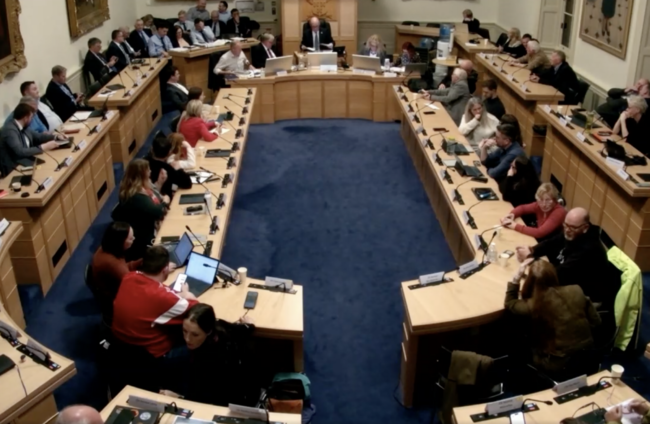
Dublin City Council held a heated meeting on the issue. Dublin City Council

Dublin City councillors vote to pass rent hikes for tenants by razor-thin margin

31 councillors voted to pass the increase and 30 voted against it.

DUBLIN CITY COUNCIL has narrowly voted to pass a budget which would cause rent increases for council and HAP tenants following a heated meeting on the issue where 31 councillors voted to pass the increase and 30 voted against it.

The setting of rents is a decision for Dublin City Council management rather than Councillors. But the decision, which was included in the annual budget, must be passed by councillors in a vote. 

The Council also voted on an amendment to the budget brought by People Before Profit Councillor Conor Reddy which would have resulted in a 15% increase on commercial rates rather than residential rate increases.

The amendment, which included a local business support scheme which would result in 97.5% of businesses paying no effective rate increase, failed with 28 votes in favour, 31 against and one abstention.

The controversial issue, which is the first planned change to how tenants rent is calculated in 30 years, has been the subject of protests in recent weeks with the latest protest held today outside Dublin’s City Hall.

Councillors were first made aware of the plans by DCC officials in October, and they were told that the hike in rents are necessary due to the projected cost of carrying out needed maintenance on social housing properties in the city. 

Some tenants could face a rent increase of up to 50% under the proposal, with the amount of additional rent people will be expected to pay being calculated on the basis of their income, and what category they fall into (i.e. single parent households will have a different rate). 

This kind of rent review has not been carried out by the council since 1996.

Council officials told local councillors that there is currently a €55.6 million funding gap between the cost of running its social housing programme and the combined income from rents and government grants. 

Sinn Féin, Social Democrats, People Before Profits and many Independent candidates were against the increase, while the government parties, Green Party and Labour were among those in favour of it.

During the meeting, those in favour argued the rent increase would provide maintenance for those who need it, while those against argued it would hurt people already struggling with the cost of living crisis and said government should provide funding for maintenance works.

Green Party Councillor Janet Horner accused those voting against increasing the rent of being ‘cheap and manipulative’.

She said: “You are voting against action. You are selling lies. You are selling lies and snake oil instead of actually allowing for action to take place. It is insulting and it is outrageous on behalf of the constituents we represent”.

Social Democrats Councillor Lesley Byrne received a warning from Lord Mayor Ray McAdam after she went over her one minute prescribed speaking time arguing that the increase would result in families being left unable to pay for necessities such as period products.

Sinn Féin Councillor Janice Boylan said: “I don’t support rent increases in a cost of living crisis. It’s as simple as that, and the neck of anyone in this chamber to suggest we are sitting on the fence or grandstanding. We are directly listening to our constituents and they don’t want the rent increase.”

Speaking after the vote, Conor Reddy said: “Tonight, Labour and the Greens voted with Fianna Fáil and Fine Gael to raise rents on the poorest people in this city. They had a fair, workable alternative in front of them and they refused to take it. The consequences will be poverty, homelessness and misery for many households.”

“We showed exactly how you could protect tenants, support small businesses, strengthen enforcement and improve maintenance without forcing another cent out of low-income households. Our scheme has been proven to work in Dún Laoghaire–Rathdown and Limerick. There was nothing abstract or unworkable about it.”

New plans

Under the new plans, households would have the first €50 of the primary earner’s income left unassessed, and would face an 18% charge on the rest of their weekly income, and there would be a €40 additional maximum charge if there is a subsidiary earner. 

The plans do try to mitigate burdening families, as they propose increasing the €1 per child weekly deduction for households with children or young adults aged 18-22 in full-time education to €2.  

The plans project that the changes would bring in an additional €35.5 million annually for the council. 

With reporting from Eimer McAuley

Readers like you are keeping these stories free for everyone...
A mix of advertising and supporting contributions helps keep paywalls away from valuable information like this article. Over 5,000 readers like you have already stepped up and support us with a monthly payment or a once-off donation.

View 155 comments
Close
155 Comments
This is YOUR comments community. Stay civil, stay constructive, stay on topic. Please familiarise yourself with our comments policy here before taking part.
Leave a Comment
    Submit a report
    Please help us understand how this comment violates our community guidelines.
    Thank you for the feedback
    Your feedback has been sent to our team for review.

    Leave a commentcancel

     
    JournalTv
    News in 60 seconds