We need your help now

Support from readers like you keeps The Journal open.

You are visiting us because we have something you value. Independent, unbiased news that tells the truth. Advertising revenue goes some way to support our mission, but this year it has not been enough.

If you've seen value in our reporting, please contribute what you can, so we can continue to produce accurate and meaningful journalism. For everyone who needs it.

Alamy Stock Photo

New Defence Bill: Suspensions of military personnel and raft of provisions for foreign missions

The General Scheme of the new Defence (Amendment) Bill 2025 was published last week by the Government.

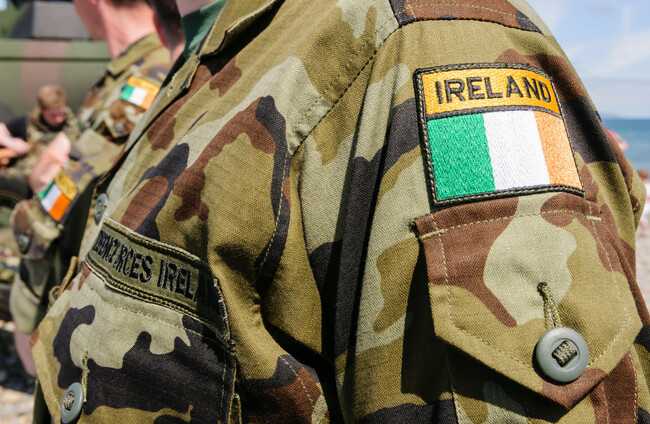
THE BILL FOR new defence legislation allowing for the suspensions of military personnel under investigation by gardaí and the scrapping of the Triple Lock has been published. 

The General Scheme of the new Defence (Amendment) Bill 2025 was published last week by the Government. 

The 41 page document outlines the changes to the statute governing how Defence Forces personnel are deployed on foreign missions, interact with international organisations and how discipline is dealt with across the military. 

The proposed legislation will begin its legislative scrutiny this Thursday and it is expected to be passed through the Oireachtas by the end of the year. 

Suspensions

One of the key measures to be introduced is around how military members can be suspended from service by the Chief of Staff if they are under investigation.

This solves an issue around enlisted members and officers who are in trouble with civilian authorities – including in cases where they are charged, but not yet convicted of a serious criminal offence.

It also obliges personnel to tell their commanding officer if they are under investigation in connection with a criminal offence. They must also keep that officer informed of the progress of the investigation.

The law provides for the Minister for Defence to make regulations around suspensions.

The lack of a legal basis for suspensions was identified in the Ward Report. A temporary fix was identified in which soldiers would be placed on leave. This new power, similar to that of the garda commissioner, would be used by the leader of the military. 

Peter Ward, a senior counsel, was commissioned by the Government in the wake of the Cathal Crotty case. Crotty was a soldier who was convicted of a serious assault on Limerick woman Natasha O’Brien.

There was another case identified by The Journal in which a naval service member was not dismissed after an assault conviction.

The Ward report identified that there was a problem of military personnel not telling their commanding officer that they were before the courts or under criminal investigation. 

The Ward report had identified that there was a problem of data sharing between State entities such as gardaí and the courts service. 

Triple Lock axed

The new Bill would also codify how Irish troops are deployed – removing the so-called Triple Lock measure which only allows deployment of troops if the UN Security Council makes a resolution and that this must be matched by Government approval and a vote of the Dáil.

It would end that and introduce a new system where the Government decides if the mission fits the UN Charter and in general international law. It would then be sent to the Dáil for a vote. 

A number of provisions look at the Defence Forces involvement with foreign operations, training missions and liaisons with military orientated foreign groups such as the United Nations, European Union and the Organisation for Security and Co-operation in Europe (OSCE).

The Bill defines an “international force” as a body established, led or controlled, the UN, OSCE, EU or other regional groups.

While NATO isn’t specifically identified in the Bill there is a subsection which states “any other regional arrangement or body”. 

One of the key provisions is that it will increase automatic despatches of troops from 12 personnel to 50. The Journal understands one example of this is the deployment of a team of Army Ranger Wing (ARW) operators and their support staff on hostage rescues or close protection duties. 

In the past the ARW has provided security at embassies and there is a provision in Head Seven which makes this possible – it is understood that Military Police are also being considered in the military for this role. The Bill also said that Irish troops can take part in counter narcotics operations and participation in training or in sporting events.

The Bill states that any international force the Defence Forces is participating in would be for the “purposes of peace-keeping, conflict prevention, and strengthening international security” – it would have to be consistent with the principles of the UN Charter.

The force, the Bill states, will “contribute to the maintenance of international peace and security”.

Readers like you are keeping these stories free for everyone...
A mix of advertising and supporting contributions helps keep paywalls away from valuable information like this article. Over 5,000 readers like you have already stepped up and support us with a monthly payment or a once-off donation.

Close
20 Comments
This is YOUR comments community. Stay civil, stay constructive, stay on topic. Please familiarise yourself with our comments policy here before taking part.
Leave a Comment
    Submit a report
    Please help us understand how this comment violates our community guidelines.
    Thank you for the feedback
    Your feedback has been sent to our team for review.

    Leave a commentcancel

     
    JournalTv
    News in 60 seconds