Sign in. It’s quick, free and it’s up to you.
An account is an optional way to support the work we do. Find out more.
Sign in. It’s quick, free and it’s up to you.
An account is an optional way to support the work we do. Find out more.
THE GAPING HOLES in pension schemes for Ireland’s biggest companies and quangos has widened – more than doubling in just 8 months.
Only one out of 29 major firms and semi-governmental bodies, state broadcaster RTÉ, had enough assets in reserve to be able to fund all its liabilities, according to the latest pensions accounting briefing.
The report today from LCP Ireland said that despite global stock markets gaining over 12% between December 2013 and August this year, falling bond yields meant pension deficits had swelled from €4 billion to more €8.5 billion.
LCP also noted Irish pension funds were taking bigger gambles with their investments than their overseas counterparts.
In the UK, only a third of pension assets from the biggest 100 companies were in stocks, but in Ireland the average figure was half and one company, budget carrier Ryanair, had 77% of its funds in equity last year.
Deficits up to €841m in companies’ pension schemes
As of last year, the biggest pension fund shortfall belonged to the Bank of Ireland, which had a €841 million deficit, although food producer Greencore had the largest hole relative to its size.
Here are the figures for the top 5:
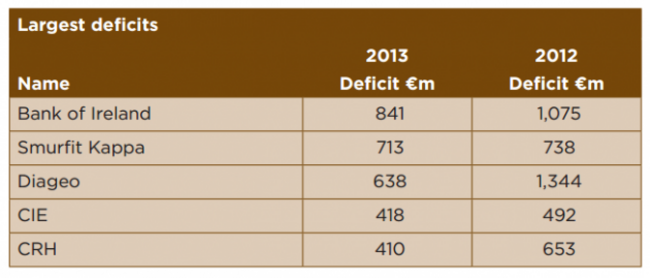
LCP said the government’s pensions levy scheme, which this year slugged all private funds with a 0.75% charge, had “resulted in further increases in funding deficits”.
Some €2.3 billion had been pulled out of Irish pension schemes through the levy, while about €1 billion was put back into the 29 surveyed funds.
No breaks
LCP partner Conor Daly said Irish defined benefit pension schemes “cannot catch a break” at the moment thanks to the combination of weak bond yields and “difficult” benefit reductions and funding plans being brought in over the past 2 years.
“We would urge companies and trustees to focus on the fundamentals and establish the expected contribution requirement and inherent risk in their defined benefit pension schemes,” he said.
While the balance sheet cannot be ignored, we would have a concern that a classic case of the ‘tail’ wagging the ‘dog’ will emerge with the accounting numbers becoming a key driver in strategic decision making.”
What are these defined benefit schemes?
Defined benefit, or pension schemes, promise an amount will be paid to a company’s employees when they retire based on their final salary and years of service.
This can either be paid out as a lump sum or an ongoing pension and is usually capped at two-thirds of a worker’s salary.
In recent years, private firms have quickly been winding up their defined benefits schemes as people started living much longer in retirement and the liabilities for companies making the payouts swelled.
Less than 200,000 people now belong to the schemes as companies try to shift workers onto defined contribution schemes instead.
These involve payments from staff and their employers going into external funds, where the total value a pensioner will be paid out when they retire goes up and down based on the performance of the investment.
The main advantage of the defined contribution setup is that if a worker’s former employer goes belly up, their pension will still be safe because the money invested remains outside the company.
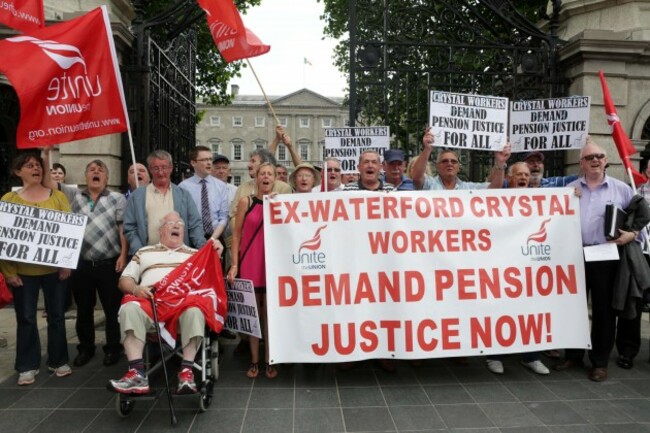
The problems with defined pension schemes were most clearly highlighted when Waterford Crystal collapsed in 2009 and its one-time workers were told their retirement benefits were so underfunded they could get as little as 18% of what they had expected.

To embed this post, copy the code below on your site












have your say