Take part in our latest brand partnership survey

We need your help now

Support from readers like you keeps The Journal open.

You are visiting us because we have something you value. Independent, unbiased news that tells the truth. Advertising revenue goes some way to support our mission, but this year it has not been enough.

If you've seen value in our reporting, please contribute what you can, so we can continue to produce accurate and meaningful journalism. For everyone who needs it.


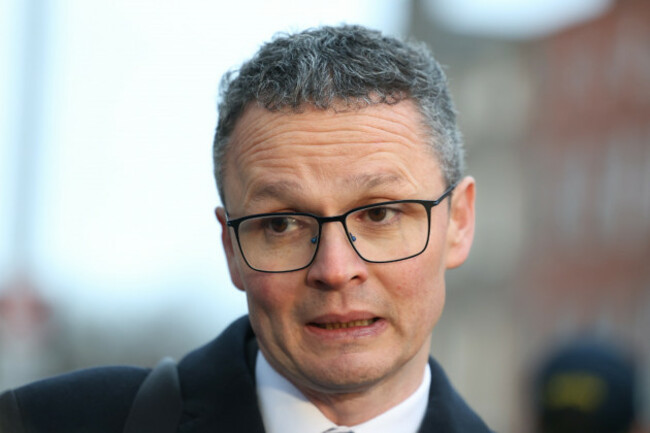
Communications Minister Patrick O'Donovan announced that the government will commence a pilot programme of the wallet early next year. Alamy Stock Photo

'Digital wallet' pilot to be rolled out next year to verify age of social media users

Communications Minister Patrick O’Donovan said the lack of consensus from the EU on online safety laws for children is “our collective shame”.

A “ROBUST” AGE verification tool is being developed as part of the creation of a digital wallet to verify the identity of social media users in an effort to keep children safe online. 

Communications Minister Patrick O’Donovan today announced that the government will commence a pilot programme of the wallet early next year.

The wallet will be available as an app and allow government to send alerts, information and public notices. 

Speaking at Government Buildings today, O’Donovan said the pilot will involve around 2,000 people aged both over 18 and under 18 “to prove that, when they try and navigate their way onto different platforms, their age is properly verified”. 

He said the government is also planning a nationwide survey of children through Coimisiún na Meán about their own online experiences.

The development of the digital wallet is being led by the Office of the Government Chief Information Officer (OGCIO), while O’Donovan’s department is working with the office on providing an age verification tool as part of the wallet.

Legislation will follow to support the rollout. O’Donovan said it is “complicated legislation”, but that his department will work with others, including Social Protection, Education and Children, during the pilot programme to bring forward a Bill next year. 

He said under the legislation, the government would be able to restrict exactly the level of information that could be transferred from the digital wallet to social media platforms.

That will be “worked out” by the OGCIO “having regard to a person’s individual data”, he added. 

Lack of EU consensus ‘collective shame’

Ireland is moving ahead with its own plans as the EU has not reached a consensus on the issue.

“You wouldn’t allow a child in to a bar to sit up at the counter and drink gin and tonic,” O’Donovan said.

We’re allowing children access, in an uncontrolled manner, to some of the most heinous material online.

He said parents have a duty of care “but parents can’t do everything on their own”. 

“As a parent and as a teacher, but more importantly, in this role as minister with responsibility for it, it disappoints me that we’re in a situation where we have to act on our own over the last number of years, that we haven’t got to consensus in Europe with regard to how we move forward on this.”

O’Donovan said that as chair of the European Council of Communications Ministers next year, he wants to use the opportunity “to push this to the fore”, adding that the theme of the department will be ‘protecting the child online’.”

He also said he was “annoyed” that the EU had not yet acted on this issue, and said “the failure” of its institutions to act as one voice “is to our collective shame, to be quite honest about it”.

Cabinet Wednesday-10_90738576 Patrick O'Donovan criticised the EU for not acting with one voice on online safety for children. Leah Farrell Leah Farrell

But he said: “There’s still an opportunity to right that wrong, and I hope that during our presidency, or during the Cypriot Presidency, that stock will be taken of what Ireland is doing.

“Maybe the European Commission might get out ahead of us and actually do the things that parents all over the European Union are asking should be done, which is to protect our kids online and stop large companies from making immoral sums of money on the backs of exploiting children.”

‘Public health issue of our generation’

O’Donovan said this was not an Irish issue but a European issue. “We are failing children all over Europe by not having a singular voice with regard to this,” he said. 

“From a public health point of view, I think this is the public health policy issue of our generation, and no more than the smoking ban was back in the late ’90s or early ’00s, this is akin to that.”

Asked about concerns that children could get around age-related restrictions, he said: “We have to try. And if at first we don’t succeed, we’re going to try it again.”

He added: “We’re not talking about removing children from technology and sending them on a one-way ticket back into the Stone Age. What we are doing is talking about protecting their innocence.”

He was also asked about whether Ireland would follow Australia’s lead at some point and implement a social media ban for children aged under 16.

“There’s no point in me coming out here and saying ‘we’re going to close the internet’ or do something cracked, because we’ll wind up inside court and it’s not going to get anywhere,” he said. 

“I have to be conscious of the limitations that are set out under the European treaties, European law and the Digital Services Act, and I have to have regard to legal advice that’s available to me.”

‘Massively corrosive for society’

Earlier today, Social Democrats leader Holly Cairns urged the government to restrict “toxic” social media algorithms over potential harms being done to children.

Speaking in the Dáil, Cairns quoted a High Court judge who likened children using the internet unhindered to them “playing with matches”.

She acknowledged that regulating sites online was a “hugely complex issue” that governments around the world were grappling with, referencing Australia’s social media ban for children.

She said she had issues with such a ban, including the fact that current age restrictions online are not enforced, saying delaying access to social media would have no impact on algorithms “that are feeding children toxic content”. 

She also quoted from studies that found social media platforms show young teenagers content about self-harm and suicide, and “bombarded” teenage boys with misogynistic content.

“Social media platforms now routinely show graphic, violent or racist videos to people who are not looking for that content,” Cairns said. 

This isn’t just having a hugely damaging impact on children, it is massively corrosive for society. It is spreading misinformation and hate through communities like wildfire.

She asked if the government would regulate algorithms that direct harmful and extremist content to people.

Responding, Taoiseach Micheál Martin said there needed to be “coordinated, robust and rights-respecting” responses to social media, and that the response should span education, parental supports and age-verification controls.

He said a culture of strong self-esteem and self-respect should be created through the education system so that children can “withstand, be resilient in the face of whatever comes at you in life”.

“We’re also developing a secure, privacy-focused approach to age verification and we’re working to include age verification functionality in Ireland’s digital wallet under the EU project,” he said.

“That’s about giving parents and young people a robust, government-backed mechanism to protect privacy, and a large-scale pilot is planned for early next year.”

Martin said they had also reduced phone distractions in classrooms and that 462 schools had drawn down €6 million-worth of funding with the aim of reducing phone use in classrooms through purchasing material such as phone pouches.

He acknowledged that the US believes the EU is over-regulating “the digital space”, but said “I don’t think we are.

“We will be examining all aspects of this, including the impacts and the use of algorithms to direct people to certain areas and that clearly is an issue.

“The European Commission has launched investigations into these powerful algorithm influences, and especially young users online, so the European Commission is already working on that aspect.”

Readers like you are keeping these stories free for everyone...
A mix of advertising and supporting contributions helps keep paywalls away from valuable information like this article. Over 5,000 readers like you have already stepped up and support us with a monthly payment or a once-off donation.

Close
15 Comments
This is YOUR comments community. Stay civil, stay constructive, stay on topic. Please familiarise yourself with our comments policy here before taking part.
Leave a Comment
    Submit a report
    Please help us understand how this comment violates our community guidelines.
    Thank you for the feedback
    Your feedback has been sent to our team for review.

    Leave a commentcancel

     
    JournalTv
    News in 60 seconds