Skip to content
Support Us

We need your help now

Support from readers like you keeps The Journal open.

You are visiting us because we have something you value. Independent, unbiased news that tells the truth. Advertising revenue goes some way to support our mission, but this year it has not been enough.

If you've seen value in our reporting, please contribute what you can, so we can continue to produce accurate and meaningful journalism. For everyone who needs it.

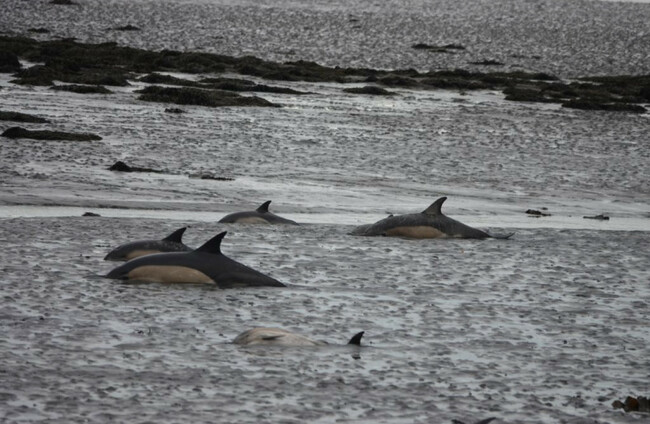
The dolphins in Co Clare.

Seven dolphins die after pod of 27 become stranded in Co Clare

The Irish Whale and Dolphin Group (IWDG) worked to assist the remaining dolphins.

SEVEN DOLPHINS DIED after 28 became stranded at low tide in Ballyvaughan, Co Clare last weekend, with volunteers working hard to rescue the remainder and float them back out to sea.

The Irish Whale and Dolphin Group (IWDG) said that the dolphins were discovered at low tide on Sunday, 21 December. The group said that the dolphins were in good body condition, which indicated that they were a healthy pod prior to the event.

“This was most likely a case of navigational error on a dropping tide, with this pelagic pod becoming disoriented in shallow, muddy terrain and unable to escape before the tide receded,” the group said in a statement.

Volunteers said that the area was very difficult to work with, due to soft mud, and the safest option was to wait for the incoming tide to naturally refloat dolphins.

The first four refloated at about 1.30pm, with the rest following just before 3pm. IWDG responders assisted numerous dolphins, including calves swimming in the wrong direction. 

“Sadly, seven dolphins died, mainly those that had stranded on their sides,” the group said.

The remaining dolphins refloated and were observed swimming into deeper water as the tide rose.

‘A sad sight’

Trea Heapes – an voluteer with the IWDG who was present on Sunday – said the stranded dolphins were “a sad sight” when volunteers came upon them.

“There were calves alive and their mothers a couple of metres away. Dolphins with their tails bashing into the mud,” she said.

“Biologically they are supposed to be in the water with support, being stranded wouldn’t be good for their internal organs.

For those on their sides we found their pectoral fins could be damaged also.

Some of the dolphins were upright and seemed calm, while others were on their sides and were more agitated. Heapes said dolphins can become “very stressed” when stranded and it is important to be highly cautious when dealing with them.

She said that any members of the public who come across stranded dolphins should call the IWDG hotline (given below) and not interact with them without proper training, as it is unsafe for both the person and the dolphin to do so.

Heapes said that volunteers worked hard to assist the dolphins in whatever way they could.

More strandings

On Monday, members of the local community found several dolphins again stranded. IWDG group volunteers worked with members of the National Parks and Wildlife Service to locate and attend to eight dolphins.

“These animals were positioned upright, monitored, and cared for, awaiting the incoming tide which took several hours,” the group said.

“All eight dolphins were refloated during the incoming tide and herded out of the bay. There was no sign of them when the last volunteer left the area, so fingers crossed all remained out of the area over night.”

The IWDG said that live strandings are “extremely difficult and often heartbreaking” but said that responders on scene worked “calmly and carefully” to help the dolphins, and thanked all who were involved in the operation.

The IWDG guidelines for dealing with stranded animals are as follows:

  • Do not drag the animal, especially by the tail — this can cause serious or life-ending injury.
  • Take a photo or short video for IWDG.
  • Record the location on Google Maps or note GPS coordinates.
  • Call the IWDG Emergency Stranding Hotline immediately with this information on 097 28118

Readers like you are keeping these stories free for everyone...
A mix of advertising and supporting contributions helps keep paywalls away from valuable information like this article. Over 5,000 readers like you have already stepped up and support us with a monthly payment or a once-off donation.

Close