We need your help now

Support from readers like you keeps The Journal open.

You are visiting us because we have something you value. Independent, unbiased news that tells the truth. Advertising revenue goes some way to support our mission, but this year it has not been enough.

If you've seen value in our reporting, please contribute what you can, so we can continue to produce accurate and meaningful journalism. For everyone who needs it.

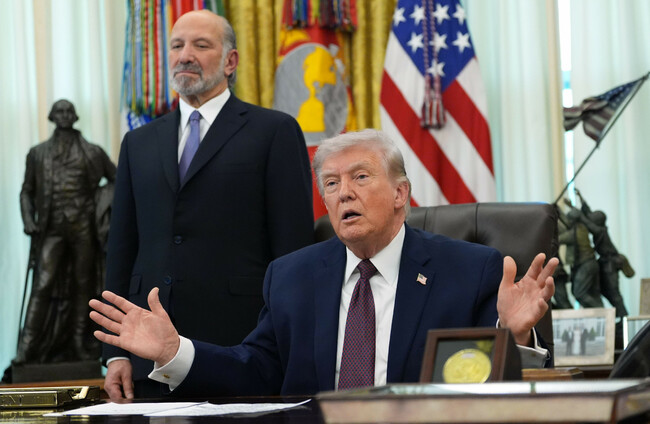
Donald Trump answers questions from the media in the Oval Office Alamy Stock Photo

Trump again claims US is talking to Iran, this time with the country's 'New Regime President'

The US is coming under increasing global pressure to resolve the current conflict in the Middle East.

LAST UPDATE | 1 Apr

PRESIDENT DONALD TRUMP has once again claimed that Iran has approached the United States seeking a ceasefire, which Tehran has again denied. 

Today, Trump said “Iran’s New Regime President” had asked for a ceasefire in the ongoing war, despite the current Iranian president, Masoud Pezeshkian, holding the office since 2024. 

The Iranian presidency does not come with extensive powers, although it is a high-profile role. Sitting at the top of the power structure in the Iranian government is the supreme leader, Ayatollah Mojtaba Khamenei, who replaced his father Ali Khamenei when he was killed on the first day of the war. 

Trump said he rejected the supposed request, adding that the US would only consider it when the Strait of Hormuz “is open, free and clear”. 

“Until then, we are blasting Iran into oblivion or, as they say, back to the Stone Ages!!!” he said in a post on his social media site. 

Trump has claimed multiple times throughout the war that the US and Iran were negotiating and end to the fighting, only for Iranian officials to deny the claims and accuse him of attempting to calm stock markets and bring down fuel prices. 

Today, Iranian state media quoted the country’s foreign ministry spokesperson as saying:

“Trump’s statements about Iran’s request for a ceasefire are false and baseless.”

National address tonight

Trump’s post on Truth Social comes ahead of him addressing the nation later today to provide an “important update” on the ongoing war, which the US and Israel launched against Iran on 28 February. 

The address is to take place at 9pm Eastern Time, which is 2am Thursday Irish time.

The US is coming under increasing global pressure to resolve the current conflict as oil prices soar all over the world, while the American nation sent thousands of US marines and sailors to the Middle East on an assault ship at the weekend, reportedly in preparation for “weeks of ground operations” in Iran.

Trump, whose statements on the war have swung from combative to conciliatory, said late last night that the fighting could be over in “two weeks, maybe three”.

Pentagon chief Pete Hegseth, speaking to reporters early yesterday after he visited the US troops in the Middle East, vowed that “the upcoming days will be decisive.”

“Iran knows that, and there’s almost nothing they can militarily do about it.”

Iran’s parliament speaker said the US is plotting a ground attack despite publicly engaging in diplomatic efforts aimed at ending the war. 

“The enemy publicly sends messages of negotiation and dialogue while secretly planning a ground attack,” Mohammad Bagher Ghalibaf said in a statement carried by Iranian state news agency IRNA on Sunday.

Tehran has insisted there are no ongoing negotiations with the United States, and that it has not responded to a reported 15-point proposal from Washington to end the war.

Threats to leave Nato

Meanwhile, Trump has grown outwardly frustrated at allies who will not get involved with the attacks on Iran.

In an interview with The Telegraph in the UK, Trump said he is considering whether to pull America out of Nato, calling the alliance a “paper tiger”. 

Yesterday, Trump suggested the UK and other countries that did not take part in strikes against Iran should secure the Strait of Hormuz themselves and “go get your own oil”.

Reacting to Trump’s comments overnight, Tánaiste Simon Harris said “we don’t have 21 days or thereabouts to see de-escalation”. 

“The war is currently ongoing for about 33 days. Look at the scale of damage that has been done to the world’s energy infrastructure in that period of time,” he said this morning. 

“We’re already living through the largest energy crisis in the history of the world, bigger than the last three combined, 1973, 1976 and 2022, so saying two to three weeks this will end, it might sound like a relatively short period of time, but the impact of what could happen economically, and of course, from a humanitarian point of view, during the course of another two to three weeks is extraordinarily concerning,” Harris said.

The Tánaiste said there needs to be de-escalation “much, much, more quickly. There is an urgency with this”. 

Strikes

Meanwhile, Iran’s Revolutionary Guards today vowed to keep Hormuz closed to the country’s “enemies”.

It also confirmed they hit an oil tanker in the Gulf they said belonged to Israel.

A British maritime security agency said the vessel was struck off Qatar, reporting damage but no casualties.

Iran’s military’s central command also said its latest missiles targeted Israeli cities including Tel Aviv and Eilat, as well as US military facilities in Bahrain and Kuwait, though there was no immediate confirmation of any hits.

The Israeli military meanwhile confirmed it struck Tehran, while emergency services in Israel said an Iranian missile attack this morning wounded 14 people, including an 11-year-old girl.

Israel also said its air defences responded to a missile fired from Yemen – the third attack by the Iran-backed Houthi rebels since they entered the war over the weekend.

In Lebanon, seven people were killed in strikes around south Beirut, the health ministry said Wednesday, with the Israeli military saying it had struck a senior Hezbollah commander.

Lebanon’s health ministry said today that Israeli attacks have killed more than 1,300 people in the country since war erupted between Israel and Hezbollah on 2 March.

Across the Gulf, strikes in Kuwait caused a large fire at its international airport, Bahrain’s interior ministry also reported a fire at a business facility, and Saudi Arabia said several drones were intercepted.

A Bangladeshi national was also killed today by falling shrapnel from an intercepted drone in the United Arab Emirates.

Meanwhile, a drone strike caused a massive fire at the storage facilities of an engine oil firm in Iraq’s autonomous Kurdistan.

Additional reporting by Christina Finn, David Mac Redmond, AFP and PA

Readers like you are keeping these stories free for everyone...
A mix of advertising and supporting contributions helps keep paywalls away from valuable information like this article. Over 5,000 readers like you have already stepped up and support us with a monthly payment or a once-off donation.

View 128 comments
Close
128 Comments
This is YOUR comments community. Stay civil, stay constructive, stay on topic. Please familiarise yourself with our comments policy here before taking part.
Leave a Comment
    Submit a report
    Please help us understand how this comment violates our community guidelines.
    Thank you for the feedback
    Your feedback has been sent to our team for review.

    Leave a commentcancel

     
    JournalTv
    News in 60 seconds