We need your help now

Support from readers like you keeps The Journal open.

You are visiting us because we have something you value. Independent, unbiased news that tells the truth. Advertising revenue goes some way to support our mission, but this year it has not been enough.

If you've seen value in our reporting, please contribute what you can, so we can continue to produce accurate and meaningful journalism. For everyone who needs it.

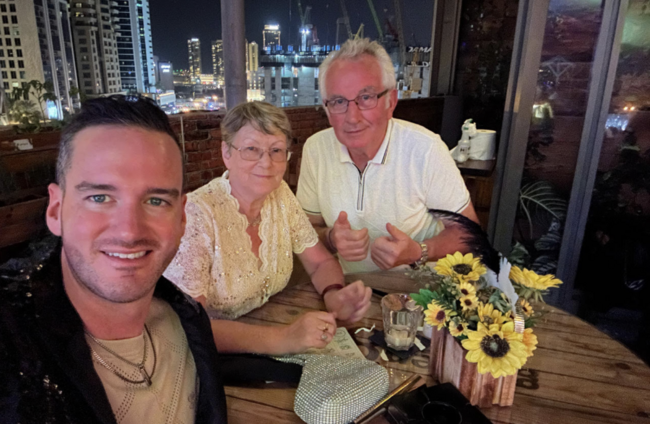
Limerick journalist John Hayes pictured with his parents, who recently visited Dubai.

'It’s a scary place right now': Limerick man in Dubai on the panic from Iranian missile attacks

‘Every 25 minutes my phone receives a warning that more missiles are incoming,’ the journalist said.

AS IRAN FIRED missiles at Dubai in retaliation for the US and Israeli attack on the Islamic republic, Limerick man John Hayes, was watching the warheads zip over his head.

According to Hayes, what followed, was a cacophony of booming explosions in the sky as the city’s air-defence missile system began taking out missile after missile, drone after drone.

“We thought we would be safe but then we started spotting projectiles above us, and they were being intercepted by the air defence system in place here,” said Hayes, a journalist with the MBC (Middle East Broadcasting Center) owned, Al Arabiya (English) television news channel.

“So, in the middle of the day we are watching missiles and drones being taken out in the sky, and then, it just seemed to escalate more and more,” said Hayes.

In the escalation, Hayes described how a “barrage of missiles” hit the city’s coastline, just as “Iftar” – the evening meal Muslims eat to break their fast at sunset during the holy month of Ramadan – was beginning.

“That sparked the initial phase of panic among the public where there was panic buying, people rushing to the stores, the petrol stations were full, and so then we felt something is going horribly wrong here”, said 38-year-old Hayes, a native of Hospital, Co Limerick.

“Every single time one of the strikes happened we thought that it might be done, but it just continued through the evening, every two hours, missile strike after missile strike.”

Just after midnight into Sunday morning Dubai time, warning notifications were flooding into mobile phones “to say wherever you are right now, seek shelter, stay away from windows, get inside and stay safe”.

“At that point everybody just disappeared into shelters, but everyone had to evacuate high-rise buildings, and we heard another barrage of missiles being intercepted above our heads,” said Hayes.

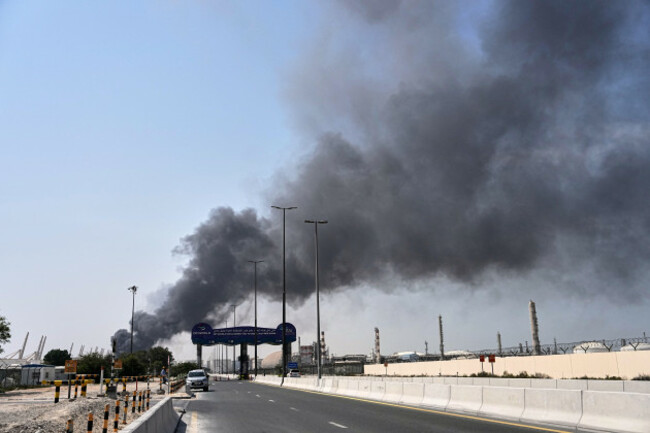
Dubai hotels, its airport and port were all hit in the Iranian air strike.

smoke-rises-after-an-iranian-drone-attack-in-the-port-area-of-dubai-united-arab-emirates-sunday-march-1-2026-ap-photofatima-shbair Smoke rises after an Iranian drone attack in the port area of Dubai, United Arab Emirates today,1 March. AP Photo / Fatima Shbair AP Photo / Fatima Shbair / Fatima Shbair

Hayes said: “Previously, all thought this was an Iran – US war that would never hit our shorelines — so, nobody envisaged this. And, now that our airspace is closed, and nobody can get in or get out, it does feel like everyone is on edge, there is a lot of panic, and to be honest with you, it’s a scary place right now.”

On Saturday, Hayes was stationed in the city as the first wave of Iranian ballistic missiles and so-called ‘suicide drones’ entered Dubai airspace.

“If a missile hits a [ground target] and impacts you hear a loud eruption that also reverberates through the ground; windows vibrate, everything with it reverberates if it makes an impact.

“The ones that are being hit [by the defence system] also reverberate but they don’t appear as intense. This was happening right above our heads,” said Hayes who lives further out towards the coastline.

“What is worse is that we can see those missiles since sunset, and seeing the missiles is terrifying, because we are actually witnessing in real time the missiles being taken out of the sky.”

“You’re watching the trajectory of the missile to see where it lands and hoping that it burns up before it reaches impact – it’s a terrifying thing to see.”

Despite the terror, Hayes remained confident the UAE could cancel out the Iranian military hardware being fired at it.

“The air defence system that is in place here is impressive, it’s second to none, you could compare it to Israel’s Iron Dome  [mobile air-defence system], and hopefully it holds up.”

“For us right now, there is a lot of panic and a lot of people are scared, but there is obviously not a lot one can do because you can’t go anywhere, the airspace is completely closed.”

Hayes, who is primarily based between Dubai and Riyadh, another city rocked by explosions, said that, while he is used to “talking about the news that’s happening in another country” it has been sobering to see “it on my doorstep”.

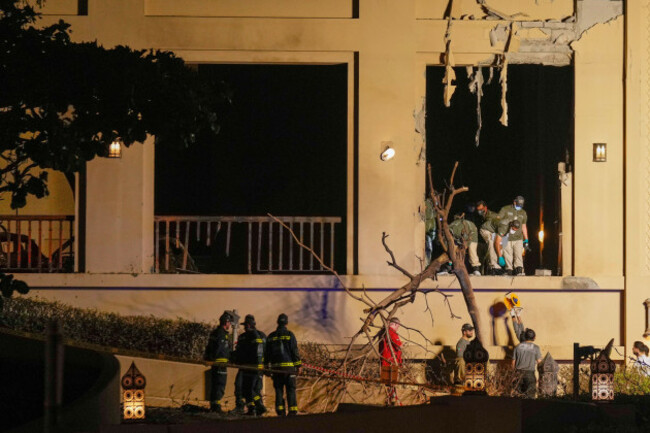
firemen-and-rescue-workers-inspect-the-site-of-an-explosion-at-the-fairmont-the-palm-hotel-in-dubai-united-arab-emirates-saturday-feb-28-2026-ap-photoaltaf-qadri Firemen and rescue workers inspect the site of an explosion at the Fairmont The Palm Hotel in Dubai, United Arab Emirates, on Saturday. AP Photo / Altaf Qadri AP Photo / Altaf Qadri / Altaf Qadri

Hayes said it was only last Tuesday he waved goodbye to his parents, Ger and Julia, who had visited on holiday.

The timing of his parents exiting the emirate city is not lost on Hayes: “Tensions were kind of high last week, and my parents had been here for four months, so I thought, ‘let’s get you on a flight back to Ireland, it seems like things might go south’, and when things go south in this region – very quickly everything closes down, so they are luckily back in Limerick.

“I have been in contact with them, they’ve been immensely worried but I have put their mind at ease.”

Hayes lives in a house but said friends of his have had to evacuate from apartment blocks “because they are glass and we have seen from the Fairmount Hotel explosion that windows were blown in”.

“There’s a lot of people who are spending the night in a carpark, or sitting in their car with their pets or with their family, because they can’t go into their apartment because it has been evacuated.”

“I certainly don’t think that any of the GCC [Gulf Cooperation Council] countries will stand by and watch this continue and I imagine the retaliation by tomorrow morning will be fierce and swift,” he said.

Hayes lives between the coastline, where Iran’s missiles have been entering from, and a military airbase, so sleep is not on his priority list.

“The fighter jets have been passing over us all night, its been hot and heavy for the last few hours, and because they are low flying, their [engines] are also vibrating the house,” said Hayes.

The Limerick man met up with friends after the first wave of attacks on Saturday night, and said people are now panicked when they hear any kind of sound.

“Everyone thinks it’s another explosion going off and everyone panics, so there is a real sense of heightened awareness about this now, nobody is sleeping, everyone is on edge.”

Watching Iran’s aerial firepower zoom through the skies near his home and workplace has been “crazy to see”, but Hayes remains confident in the air-defence systems protecting the UAE, “it could have been a lot worse if we didn’t have those [air defence] missiles in the sky”.

Despite it all, Hayes remains upbeat that normal life will soon resurface in Dubai, and his initial thought is “not to try and jump on a plane and get out of here”.

The UAE has been good for him, he has carved out a name for himself in global news media and found enduring friendships.

“I personably feel that, although we are all on edge, and I have a sense of unease, I have faith in the air -defence system, and because this has been home for 16 years, my thinking is to wait it out,” said Hayes.

“I’m sure that in the next couple of days, we are going to see the retaliation of Saudi Arabia, UAE, Bahrain, Qatar, which I think will be separate from the US retaliation.”

As the battle in the skies played out, Hayes was fighting a battle in his own thoughts about what to do and when to do it: “Okay, of course when you are hearing bombs going off – in your head you are going to panic, but I still feel the authorities will deal with it.

“We will prepare for the next 72 hours and we will see what happens, I’m hopeful that it wanes off, but every 25 minutes my phone receives a warning that more missiles are incoming.”

Hunkering down at his home with his two pet dogs, “Lana” and “Lola”, Hayes concludes: “It’s getting tense, it’s a bit stressful to be honest.”

Readers like you are keeping these stories free for everyone...
A mix of advertising and supporting contributions helps keep paywalls away from valuable information like this article. Over 5,000 readers like you have already stepped up and support us with a monthly payment or a once-off donation.

View 15 comments
Close
15 Comments
This is YOUR comments community. Stay civil, stay constructive, stay on topic. Please familiarise yourself with our comments policy here before taking part.
Leave a Comment
    Submit a report
    Please help us understand how this comment violates our community guidelines.
    Thank you for the feedback
    Your feedback has been sent to our team for review.

    Leave a commentcancel

     
    JournalTv
    News in 60 seconds