We need your help now

Support from readers like you keeps The Journal open.

You are visiting us because we have something you value. Independent, unbiased news that tells the truth. Advertising revenue goes some way to support our mission, but this year it has not been enough.

If you've seen value in our reporting, please contribute what you can, so we can continue to produce accurate and meaningful journalism. For everyone who needs it.

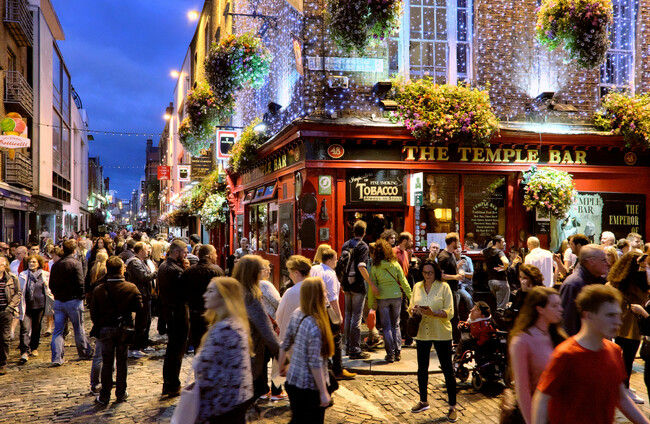
The four Councils hope to operate as a collective to push government Alamy Stock Photo

Dublin's four councils convene to push for local tourist tax

Labour Councillor Dermot Lacey has called the pushback from hoteliers “laughable”

DUBLIN’S FOUR LOCAL authorities will meet this month to commence their drive for national legislation to enable councils to implement a tourist tax.

Representatives are coming together to lobby the government to give councils the power to introduce a “transient visitor levy” on overnight stays in hotels, short-term rentals on platforms like Airbnbs, and other accommodation.

The proposed tax led by the Transient Visitor Levy Working Group would be applied at a local level, meaning individual councils would have the power to impose the tax as they see fit, or choose not to impose it at all. 

Councils cannot implement such a tax without enabling legislation from national government.

Fingal County Council wrote to the Minister for Finance late last year to request this but the government has not announced any plans for its introduction so far. 

The tax is modelled after other European countries who have introduced these taxes in high tourist areas.

For example, in Vienna, visitors must pay 3.2% tourist tax on their accommodation bill, while Lisbon doubled its tourist tax from €2 to €4 per guest per night last September.

Representatives from the councils’ group say that the revenue from the tax could be used for structural and cultural projects that would benefit both tourists and locals. 

However, the proposed implementation of a tourist tax has already been criticised by hoteliers, who have said that it would be a deterrent for tourists and that extra charges would harm the hospitality industry.

One of the Dublin City Council representatives for the group, Labour’s Dermot Lacey, believes the issue is that “nobody in Ireland understands local government finance” and this is leading to some of the pushback.

“When people don’t understand it, they’re naturally resistant,” Lacey said.

He called the pushback from hoteliers “laughable”, claiming that the tax would not be a deterrence for tourists “in the slightest”.

“You really think that someone with a €700 bill will care if one euro per day is added on? It does not make sense.”

He envisions the revenue from this tax to be used for “mutually beneficial projects” that he says would benefit tourists and residents alike.  

Green councillor Michael Pidgeon, who is also a representative on the working group said there was support for the proposal “across party lines” when it was first raised earlier this year.

He also said the group has looked at other European countries’ models for such taxes and that such taxes should be “left to the councils and the cities to decide”.

Pidgeon says the group hopes to approach the proposal as “a collective” but wouldn’t look to impose the tax universally across Dublin.

He also said he expected strong pushback from hoteliers on the proposal, because he believed that hoteliers would take issue with the tiered system this tax would create.

The tax would mean that some hotels would be subject to payment across different parts of the country as applied by their councils. 

However, Pidgeon believes this system is necessary: “This tiered system is appropriate, different places need different structures, we don’t do that enough in Ireland.”

He believes that “cities suffer from these [national] structures” and is in favour of the model adopted in other European countries, where there are high tax rates in some cities.

Back in March, Fingal County Council wrote to all councils nationwide calling for the introduction of this tax. 

When the new Dublin City Council ruling coalition  was formed in June 2024, they called for an introduction of a hotel tourist tax.

The previous Dublin City Council also called for a 1% hotel tax. 

Hoteliers pushed back on the proposal, with the Irish Hotels Federation saying there was “no grounds for introducing an additional tourist tax on consumers and overseas visitors”. 

In a statement at the time, they said hikes in taxes make Ireland less attractive as a destination – “at a time when consumers are under financial strain”.  

Readers like you are keeping these stories free for everyone...
A mix of advertising and supporting contributions helps keep paywalls away from valuable information like this article. Over 5,000 readers like you have already stepped up and support us with a monthly payment or a once-off donation.

View 55 comments
Close
55 Comments
This is YOUR comments community. Stay civil, stay constructive, stay on topic. Please familiarise yourself with our comments policy here before taking part.
Leave a Comment
    Submit a report
    Please help us understand how this comment violates our community guidelines.
    Thank you for the feedback
    Your feedback has been sent to our team for review.

    Leave a commentcancel

     
    JournalTv
    News in 60 seconds