We need your help now

Support from readers like you keeps The Journal open.

You are visiting us because we have something you value. Independent, unbiased news that tells the truth. Advertising revenue goes some way to support our mission, but this year it has not been enough.

If you've seen value in our reporting, please contribute what you can, so we can continue to produce accurate and meaningful journalism. For everyone who needs it.

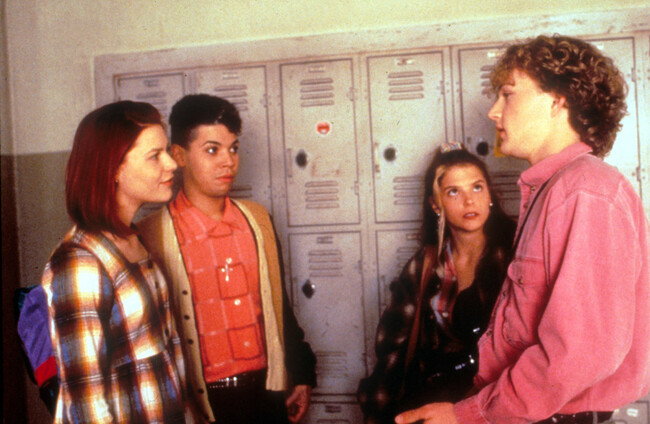
Claire Danes (left) and the cast of My So-Called Life Alamy Stock Photo

I know now how parents felt when we all started saying 'like' in the 1990s

A series where Emer McLysaght saves us from chasing every trend and instead points us to things worthy of our time (and money).

In Nobody Needs This, a new series for The Journal, Emer McLysaght focuses her eagle eye on the trends, products and notions we can do without. It’s not all giving out, however. She’ll also be keeping up with what’s catching her attention, keeping people interested and, quite frankly, driving her mad.

I THINK I can pinpoint the exact moment the word ‘like’ entered the Irish vocabulary as a sentence filler.

It was 1995 and the US TV show My So-Called Life was on Network 2 once a week. Fifteen-year-old Angela Chase, playing by a teenaged Claire Danes, was full of angst, hormones, hatred for her parents and lust for her schoolmate Jordan Catalano, portrayed by a young Jared Leto complete with the perfect curtain hair and baggy jean combo. My friends and I were obsessed with My So-Called Life. We dyed our hair copper like Angela and tied black shoelaces around our necks as chokers like Jordan.

One of Angela’s iconic lines from the show arose from her observations of Jordan lounging by his locker in the school hallway.

“I love the way he, like, leans”, her voiceover told the audience, and teenaged girls all over Ireland decided that they loved the way he, like, leaned too.

Thirty years on, I can relate to the annoyance that the parents and older people of nineties Ireland must have felt when My So-Called Life and the 1995 film Clueless breached our shores with the ‘like’ phenomenon. Except this time, it’s ‘bro’.

‘Bro’ has been with us for a while now. It has its roots, as so much slang does, in African American Vernacular English. It travelled into very mainstream usage in the US along with concepts like ‘bromance’ and ‘bro code’. More recently the popularity of YouTube and streaming platforms like Twitch means it has become engrained in the vocabularies of Gen Alpha iPad kids and younger Gen Z populations in Ireland. We even have our own ‘yup bro’ subculture, a combination of working-class Dublin slang and aesthetics and the appropriation of the same from UK and US culture.

In the same way that me and my teenaged peers’ enthusiastic use of ‘like’ must have singed the eardrums of those around us, the bro phenomenon almost has me praying for the sweet relief of nails of a chalkboard. However, I am even more concerned about the onward march of bro’s insidious cousin, ‘let’s go’.

I’ve been noticing and despising the use of ‘let’s go’ online and in American media for a while now. It’s typically used as punctuation at the end of a sentence or in response to a desirable outcome. If a sports team scores or good news is received it will elicit a fist pump and a ‘let’s gooooo’, or the even more annoying ‘let’s f***ing go!’, sometimes abbreviated to ‘LFG’. In 2023 Slate.com carried out a deep dive into ‘let’s go’ and noted that while its history may be traced back to World War II recruitment posters, it really has its modern roots in “dude-coded hobbies, especially gaming”. ‘Let’s go’, according to Slate, is uber-masculine, a stereotypical bro term and maybe even a little toxic.

If I drill down into my most hated use of ‘let’s go’, it’s when it’s delivered in monotone. I was watching one of those extreme trivia nerds on Instagram the other day, an otherwise incredibly impressive guy who can identify an obscure South American river just by looking at a greyscale satellite image, and each time he delivered a correct answer he responded with a muted ‘let’s goooooo’. I can’t blame the poor man. It’s just a reflex, the same way I might exclaim ‘yes!’ in a similar scenario (although, to be clear, I couldn’t name any of the rivers). It’s just that the way the phrase has quickly trickled down from an exuberant frat boy yell to a subdued, ubiquitous sentence-ender has me worried that it’s only a matter of time before I’m hearing it from the mouths of Irish babes.

Anecdotal evidence suggests that ‘let’s go’ is already with us in Ireland and I’m not sure if my misophonia is ready for it. I can accept that there’s nothing more elderly than policing the vocabulary of others, but haven’t we already endured enough with the nationwide adoption of ‘bro’? We don’t need to add ‘let’s go’ into the mix. Next things we’ll be calling Lego ‘Legos’ and that’s when the sky will start, like, falling down.

Intrigued by the mention of the extreme trivia man?

Well, he’s @solunaaaa16 and you can follow him here. He can name the country from its zoomed in flag, name the country from its rotated outline and name the football team from their logo.

While we’re here, why not see if you can name the album cover from just a snippet of the image, or try out @mahanlankarani’s countless trivia quizzes.

I’m currently reading

What to watch

justice-smith-and-brigette-lundy-paine-in-i-saw-the-tv-glow-2024-directed-by-jane-schoenbrun-credit-a24-fruit-tree-smudge-films-album Justice Smith and Jack Haven in I Saw the TV Glow Alamy Stock Photo Alamy Stock Photo

  • I Saw the TV Glow, a stunning elevated psychological horror film about identity which is now on Netflix
  • The fifth season of Trying, a comedy about a couple who decide to adopt, is coming to Apple TV on 8 July so with some extreme binging you can catch up in time
  • The world premiere of Frank Berry’s The Lost Children of Tuam is in Galway’s Town Hall Theatre on 11 July. You can try for tickets here.

Emer will be back next Friday morning with more recommendations.

Readers like you are keeping these stories free for everyone...
A mix of advertising and supporting contributions helps keep paywalls away from valuable information like this article. Over 5,000 readers like you have already stepped up and support us with a monthly payment or a once-off donation.

Close
Comments
This is YOUR comments community. Stay civil, stay constructive, stay on topic. Please familiarise yourself with our comments policy here before taking part.
Leave a Comment
    Submit a report
    Please help us understand how this comment violates our community guidelines.
    Thank you for the feedback
    Your feedback has been sent to our team for review.

    Leave a commentcancel

     
    JournalTv
    News in 60 seconds