We need your help now

Support from readers like you keeps The Journal open.

You are visiting us because we have something you value. Independent, unbiased news that tells the truth. Advertising revenue goes some way to support our mission, but this year it has not been enough.

If you've seen value in our reporting, please contribute what you can, so we can continue to produce accurate and meaningful journalism. For everyone who needs it.

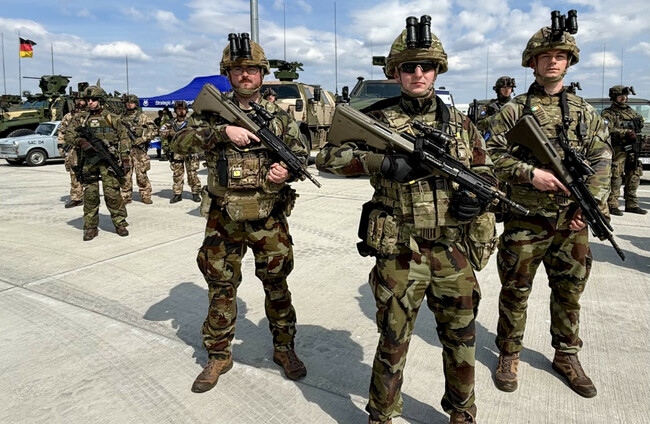
Irish soldiers in hungary with German colleagues during a recent EU Battlegroup exercise. Niall O'Connor/The Journal

Government warned state could contribute billions indirectly to EU defence with little benefit

The warning comes as work continues in negotiating the EU’s next budget – the Multiannual Financial Framework – which will cover the years 2028 to 2034.

THE GOVERNMENT HAS been warned that Ireland could end up contributing over €7 billion indirectly to massive defence spends in Europe through its EU contributions but will benefit little in return.

The Journal has learned that a presentation was made to a number of government bodies, including the Department of Defence, warning how Ireland faces losing out in the coming years as Europe prioritises boosting defence spending.

The warning comes as work continues in negotiating the EU’s next budget – the Multiannual Financial Framework (MFF) – which will cover the years 2028 to 2034.

Behind the scenes across Government, and contained in a briefing document seen by The Journal, there are gathering concerns that the EU budget will force Ireland to indirectly fund EU defence all the while losing out in money in real terms because of a change in agriculture funding. 

It is understood that the study states that a combination of reduced agricultural subsidies, which Ireland traditionally would benefit from, and increased contributions going towards defence would see the country losing out.

“Basically the message was laid out in really stark terms that defence is eating everything from an EU budget perspective and Ireland will suffer because it hasn’t been at the races in terms of how it engages with defence,” a source familiar with the briefings said. 

The internal presentation, given by expert economic advisors, warns that this will see the State contribute €7.3bn to defence but with little in return because Ireland does not participate in projects that benefit from central EU defence funding. 

This would be a proportion of the overall amount the State contributes to the EU budget over the six-year period. The final amounts are yet to be worked out – but Ireland contributed €3.69 billion to the bloc in 2023. 

Defence sources said that while the warnings have been made by briefers to the Department there is much work to be done on the EU MFF and nothing is decided as yet. It could take as long as 18 months to get to an agreement, they said.

Subsidising defence entities 

One source familiar with the report said the message contained in the briefing was concerning, and that government officials were warned Ireland will subsidise highly profitable “defence champions” in other European countries in the coming years. 

The EU aims to create an €800 billion fund for defence in order to plug the gap left by the US, under Donald Trump, walking away from its traditional role as Europe’s de facto security backstop.

Brussels, in its recent White Paper on Defence, has set out a plan to supercharge the European defence industry as countries across the bloc rearm. Part of that plan is to ensure that countries like Ireland focus on purchasing from the arms industry of fellow member states.

Ireland has been slow to engage with various initiatives contained in the plan citing its neutral status, but the State has begun to engage with some elements of EU defence funding.

The internal document states that there is “official caution” and that Ireland is “uncompetitive” across EU defence initiatives. 

One key issue identified by the internal document is the French policy of European autonomy. This is being driven by Paris and sets out the urgent need for EU member States to break away from a dependence from states such as the US and China.

In other words Europe must be able to manufacture its own military equipment. 

In a recent interview with The Journal Taoiseach Micheál Martin said that Irish companies should bid for defence contracts. This is a shift in Government policy.

With explicit language the report is understood to have said that the European Commission will reduce agricultural subsidies and increase defence funding. The report suggests that Ireland “risks losing on one hand and losing on the other”.

The report has warned that Ireland will essentially, because of its refusal to engage, “subsidise” highly profitable defence entities of other European countries. 

The briefing finally calls for Ireland to “up its game” in defence and security and identify programmes for “more effective national coordination”.  

The Department of Defence referred a request for a response to this story to the Department of Finance. 

Readers like you are keeping these stories free for everyone...
A mix of advertising and supporting contributions helps keep paywalls away from valuable information like this article. Over 5,000 readers like you have already stepped up and support us with a monthly payment or a once-off donation.

Close
JournalTv
News in 60 seconds