We need your help now

Support from readers like you keeps The Journal open.

You are visiting us because we have something you value. Independent, unbiased news that tells the truth. Advertising revenue goes some way to support our mission, but this year it has not been enough.

If you've seen value in our reporting, please contribute what you can, so we can continue to produce accurate and meaningful journalism. For everyone who needs it.

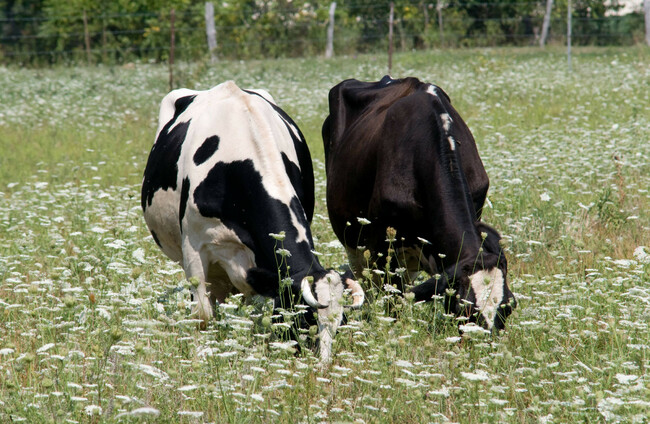
Cows in a field PA

First suspected bluetongue outbreak in Northern Ireland under investigation

The disease does not affect humans or food safety and is primarily transmitted through midges.

LAST UPDATE | 30 Nov 2025

THE FIRST SUSPECTED bluetongue virus outbreak in Northern Ireland is under investigation.

The disease is believed to be affecting two cows near Bangor, Co Down.

Yesterday, the Department of Agriculture, Environment and Rural Affairs (Daera) introduced a 20km temporary control zone (TCZ) and moving susceptible species in or out of it is now prohibited.

A general licence is available that allows animals to cross the boundary if they are going directly to slaughter.

Bluetongue is an animal disease that affects livestock including cattle and sheep, as well as goats, deer and llamas.

Symptoms include a blue and swollen tongue, fever, reduced milk yield and, in the most severe cases, death.

It does not affect humans or food safety and is primarily transmitted through midges.

NI Agriculture Minister Andrew Muir said all producers affected by the new control measures need to help limit the virus.

“While there was always a potential for bluetongue to arrive here, given its prevalence in GB and the EU, we must now do all we can to protect our livestock and limit the spread of the disease,” he said.

“That is why, as a result of the disease control framework for the virus we launched in June, Daera has moved rapidly to ensure disease control measures are put in place.”

He added: “Members of the public should be reassured the virus does not have any impact on people or food safety.

“In the face of these suspected cases, my officials are taking all the necessary steps to protect the agri-food industry.

“I urge everyone in the industry to play their part as well and especially appeal to those in the temporary control zone to follow the restrictions.”

President of the Irish Farmers’ Association Francie Gorman said the confirmation of a case of Bluetongue in Co Down is “very disappointing”, and that it is a scenario everyone in farming had worked hard to avoid over the last 18 months, since the virus was first detected in England.

“Farmers are actively playing their part in monitoring livestock for any signs of the disease and reporting any suspicions to their vets and the Department,” he said.

Gorman said the Department of Agriculture must work closely with DAERA in the north to contain this outbreak.

The IFA said it had called on the Department throughout the year to have vaccines available for emergency use and have them in stock should farmers need to use them, and said the Department of Agriculture must immediately move to have BTV 3 vaccines licensed and available for use.

Minister for Agriculture Martin Heydon said: “The news of a suspect bluetongue outbreak in Northern Ireland is unwelcome.

“My thoughts are first and foremost with the affected farm family, and those farmers in the locality who will be worried about their own herds now.

“This development has potentially serious implications. If the disease becomes established in one part of the island, it will be that much easier for it to spread, with consequences for animal health and welfare, and financial and emotional stress for farmers. ”

The suspected cases were detected by Daera’s active surveillance for the disease.

The first case of bluetongue serotype 3 (BTV-3) in England since early March 2024 was confirmed in one sheep in Norfolk on August 26 that year, Daera said.

There are now more than 260 premises affected in England, it added.

The direct movement of all ruminants and camelids from Britain to Northern Ireland is suspended as a result.

It can resume once the UK recovers its EU-recognised disease-free status for bluetongue.

Daera’s chief veterinary officer, Brian Dooher, said the virus “is unpredictable and can spread rapidly through and between flocks and herds”.

“Colleagues have been preparing for a possible incursion of this disease and have been working closely with our colleagues in the Republic of Ireland to ensure a co-ordinated response in tackling any incursion,” he added.

“I would urge all farmers to ensure they source their animals responsibly.

“The spread of bluetongue could have a significant impact on livestock and the rural economy. Furthermore, all livestock owners should remain vigilant for signs of the disease.”

Symptoms must be reported immediately to a vet, local divisional veterinary office or the Daera helpline on 0300 200 7840.

Close
24 Comments
This is YOUR comments community. Stay civil, stay constructive, stay on topic. Please familiarise yourself with our comments policy here before taking part.
Leave a Comment
    Submit a report
    Please help us understand how this comment violates our community guidelines.
    Thank you for the feedback
    Your feedback has been sent to our team for review.

    Leave a commentcancel

     
    JournalTv
    News in 60 seconds