We need your help now

Support from readers like you keeps The Journal open.

You are visiting us because we have something you value. Independent, unbiased news that tells the truth. Advertising revenue goes some way to support our mission, but this year it has not been enough.

If you've seen value in our reporting, please contribute what you can, so we can continue to produce accurate and meaningful journalism. For everyone who needs it.

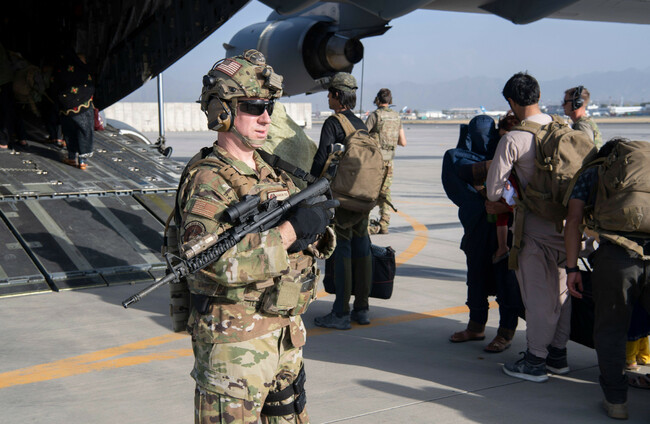
Former Staff Sergeant Séamus Ó Fianghusa described the abrupt withdrawal of US Forces from Afghanistan in August 2021 as a disaster. Alamy Stock Photo

Ex-US soldier Séamus is fighting a new battle, this time for the Irish language

Former US soldier Séamus Ó Fianghusa has swapped the front line in Afghanistan for a new mission, promoting the Irish language and identity.

(This article is produced by our Gaeltacht team. You can read an English version of this piece here)

AN AMERICAN EX-SOLDIER from Brooklyn, Séamus Ó Fianghusa, who learned Irish because of his love for the culture of his ancestors and his fight for the United States in Afghanistan, is a well-known figure in the Irish language community.

In fact, he is so passionate about Irish culture that he has participated in a sean nós singing competition at the Oireachtas and was recently at the festival in Belfast.

His commitment to Irish is such that his nickname, given to him in the Donegal Gaeltacht, is Seamus na Gaeilge and advancing the cause of language is his greatest motivation, something which is evident in the effort he has put into learning the language.

He enlisted in the Army twice, first in 1995 serving until 2003 and, again, in 2007 serving until 2018.  He spent a further seven years in Camp Smith in New York before retiring in August of last year.   During his second stint he served in Afghanistan in 2010 where he was badly injured.  His service there and his appreciation of the sacrifice of the Afghanis who helped American troops with translation and intelligence prompted him to describe the Biden administration’s decision to withdraw in late 2011 as an embarrasment and he set out his views with typical forthrightness in his book, ‘The Pullout Sellout’. 

This book was widely praised by his former comrades, including one Pete Hegseth, with whom Seamus had served, who is now the Secretary of War/Defence in the Trump administration. 

1935155f-c7f1-44f1-b631-df5420a7eb37 Seamus Ó Fianghusa being interviewed by his former US Army comrade, Pete Hegseth, who was then woriking for Fox News but is now the US Secretary of Defence/War. Seamus Ó Fianghusa Seamus Ó Fianghusa

“I may not have had any control over the situation, but I could say something nice publicly. That’s why I wrote the book The Pullout Sellout: The Betrayal of Afghanistan and America’s 9/11 Legacy, the first book in the world to come out about that tragedy.”

As much as Irish culture and the Irish language were in his blood, soldiering was a part of his heritage. His own father was in the US Army and as he learned about his Irish heritage and the Irish language, he discovered that the Irish word for warrior, fian(n), was actually part of his own name, Fianghusa/Fennessy.

He first joined the army in 1995 and remained enlisted until 2003. He then re-enlisted in 2007 during President Bush’s second term and remained with the 69th until 2018. He then transferred to Camp Smith in New York and retired from the Army last August.

Even though he has retired from full-time service, he remains committed to his regiment, the 69th, known as ‘the Fighting Irish’, and is the regiment’s historian.

He is very proud of the regiment and its history. “We were founded in 1849 by Irish Republicans from the Éire Óg/Young Ireland movement, who were expelled from Ireland after the 1848 Rebellion.

“We have fought in almost every war that America has been involved in since – the Civil War, the Spanish Civil War, the First and Second World Wars, Iraq and Afghanistan. The Irish heritage is still strong with us, and Irish can be seen on the walls in the regimental arsenal.

“The Regiment is at the forefront of the New York St. Patrick’s Parade every year. “Gentle under praise, fierce under insult” -  is the motto of the 69th.  And the regimental banner carries the Irish version of words uttered by the Fenian warrior, Oísín, to St Patrick, we never cowered from the strife of the blade.

In fact, he is still on duty every St. Patrick’s Day or he reads in Irish at Mass at St. Patrick’s Cathedral on New York’s Fifth Avenue on the great feast day for Irish people, especially those who live far away.

Growing up, his father used to tell him that he was ‘Irish’ – he started reading books about his heritage and he started to understand that he was a ‘Gael’ also.

I was raised with little bits of Irish, “cúpla focail’ as they say. And the first words I had, they were incredibly important.

“You could say they laid the foundation, they planted the seed in my soul. I learned the Sign of the Cross in Irish before I learned it in English when I was four years old.”

 ”I did a lot of study in my own time on the history of the Gaels, not only in Ireland but also in Scotland, I studied the history of all the Celts.

“And I was very proud of this heritage. But I knew at the same time that all of that was in mortal danger, and that’s why I had such an interest in Irish.

Through his research, he discovered that his family had Donegal heritage. He then met a woman from the county who lives in the US who spoke to him in Irish and encouraged him to redouble his efforts to learn the language and, in addition, she encouraged him to focus on the Donegal dialect, the dialect undoubtedly spoken by previous generations of his own clan.

That was the kick in the backside I needed to make a serious effort to learn Irish.

“And by the time I first came to Ireland in 2008, I was fluent in it.

“It wasn’t long after that that I was nicknamed “Séamus na Gaeilge /Séamus of the Irish language” in Donegal. I didn’t give it to myself, it was the people of the Gaeltacht.”

Séamus took that nickname as evidence that he was succeeding in bringing the Irish language with him.

In 2007, during President George W. Bush’s second term, he re-enlisted in the Army.

I was not at all satisfied that young men my age were going over there and dying while I was at home, perfectly comfortable.

He said that this decision did not depend on who was in charge of the government.

“I didn’t care whether Bush or Obama was president, I knew I had a moral obligation to do it, and that’s what I did.”

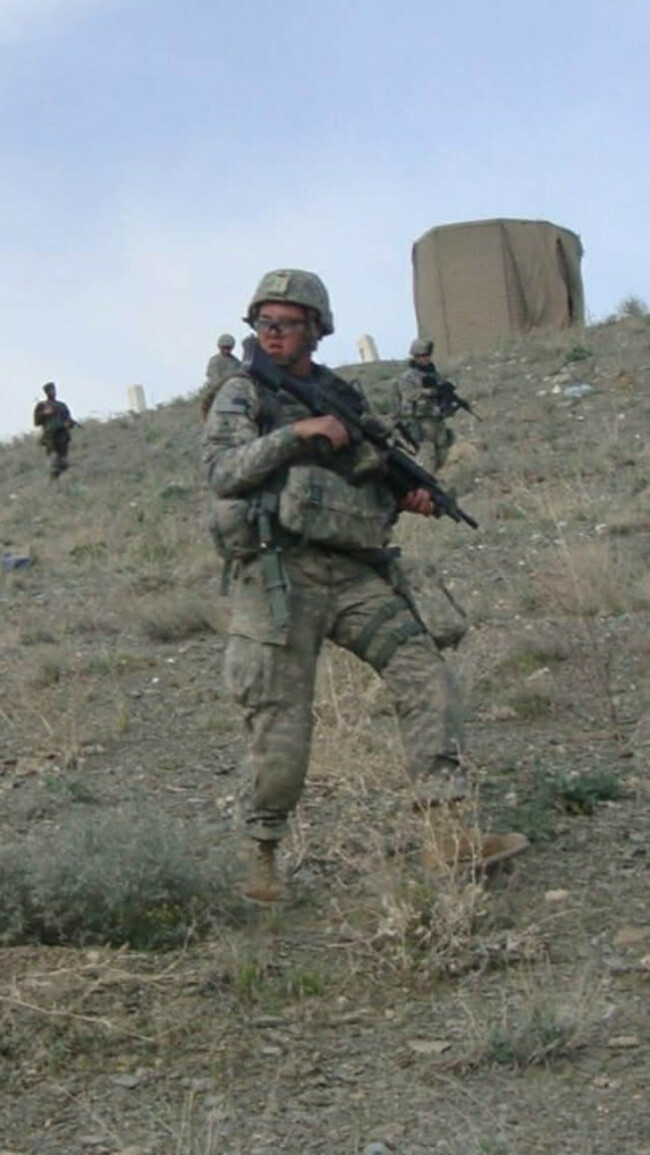
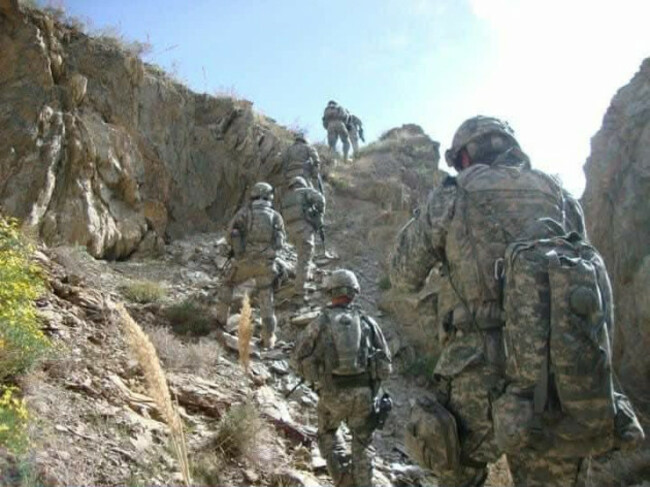
During 2010, the most intense year of the conflict in Afghanistan, he was on the front lines.

90cecc13-5952-4f68-8770-db9a57c79f69 Seamus Ó Fianghusa in action in Afghanistan in 2010 Seamus Ó Fianghusa Seamus Ó Fianghusa

“It would be foolish to have no fear when you’re in danger of dying fighting in a war zone,” he said.

“So, of course I was afraid, but I was perfectly able to control it and keep a clear head. That’s the point. “Calmness,” that’s the concept.”

He said he kept a ‘bit of holy clay’ of Colmcille in his belt at all times while in Afghanistan.Colmcille is the patron saint of the Fennessy clan; I knew he would be watching over me and that I would come home in one piece.

However, he did not escape his time in Afghanistan unscathed.

“I broke a bone in my right leg when we landed from a height on a very dangerous mission and I fell into a hole I didn’t see.

“And I had to walk a couple of miles to the next COP (Combat Outpost) because we had no other way to travel! But I carried my equipment along the way, I wasn’t going to let anyone else carry my load.”

da958f76-04ad-48be-bdfa-5f6a251709f5 Staff Sergeant Seamus Fennessy was on the front line in Afghanistan in 2010. Séamus Ó Fianghusa Séamus Ó Fianghusa

He achieved a measure of fame while in Afghanistan in 2016 when he sang a Wolfe Tones song in the presence of British soldiers. The song was ‘Go On Home British Soldiers’, a rebel song written by Tommy Skelly and recorded by the Wolfe Tones and Eire Óg, and it was broadcast on a US Military TV channel.

Looking back, however, Séamus maintains he wouldn’t change a thing.

“If I had the chance to go back in time, I would do it again in a heartbeat. My honor and the defence of good people are more important than my own personal safety.”

Seamus is now working on establishing a charity to support those left behind by US forces as they withdraw from Afghanistan.

“The Freedom Support Institute will help rescue those left behind in Afghanistan, and will provide expert military advice to the War Department and Congress.”

Ultimately, though, Séamus is a true Gael. He sees the Irish language as an energy source that gives meaning and energy to everything else he does in his life.

“I feel a great sense of duty to do my best to preserve, strengthen, and pass on our precious heritage to future generations. And everything I do in my life is working toward that goal.”

The Journal’s Gaeltacht initiative is supported by the Local Democracy Reporting Scheme

Readers like you are keeping these stories free for everyone...
A mix of advertising and supporting contributions helps keep paywalls away from valuable information like this article. Over 5,000 readers like you have already stepped up and support us with a monthly payment or a once-off donation.

Close
Comments
This is YOUR comments community. Stay civil, stay constructive, stay on topic. Please familiarise yourself with our comments policy here before taking part.
Leave a Comment
    Submit a report
    Please help us understand how this comment violates our community guidelines.
    Thank you for the feedback
    Your feedback has been sent to our team for review.

    Leave a commentcancel

     
    JournalTv
    News in 60 seconds