We need your help now

Support from readers like you keeps The Journal open.

You are visiting us because we have something you value. Independent, unbiased news that tells the truth. Advertising revenue goes some way to support our mission, but this year it has not been enough.

If you've seen value in our reporting, please contribute what you can, so we can continue to produce accurate and meaningful journalism. For everyone who needs it.

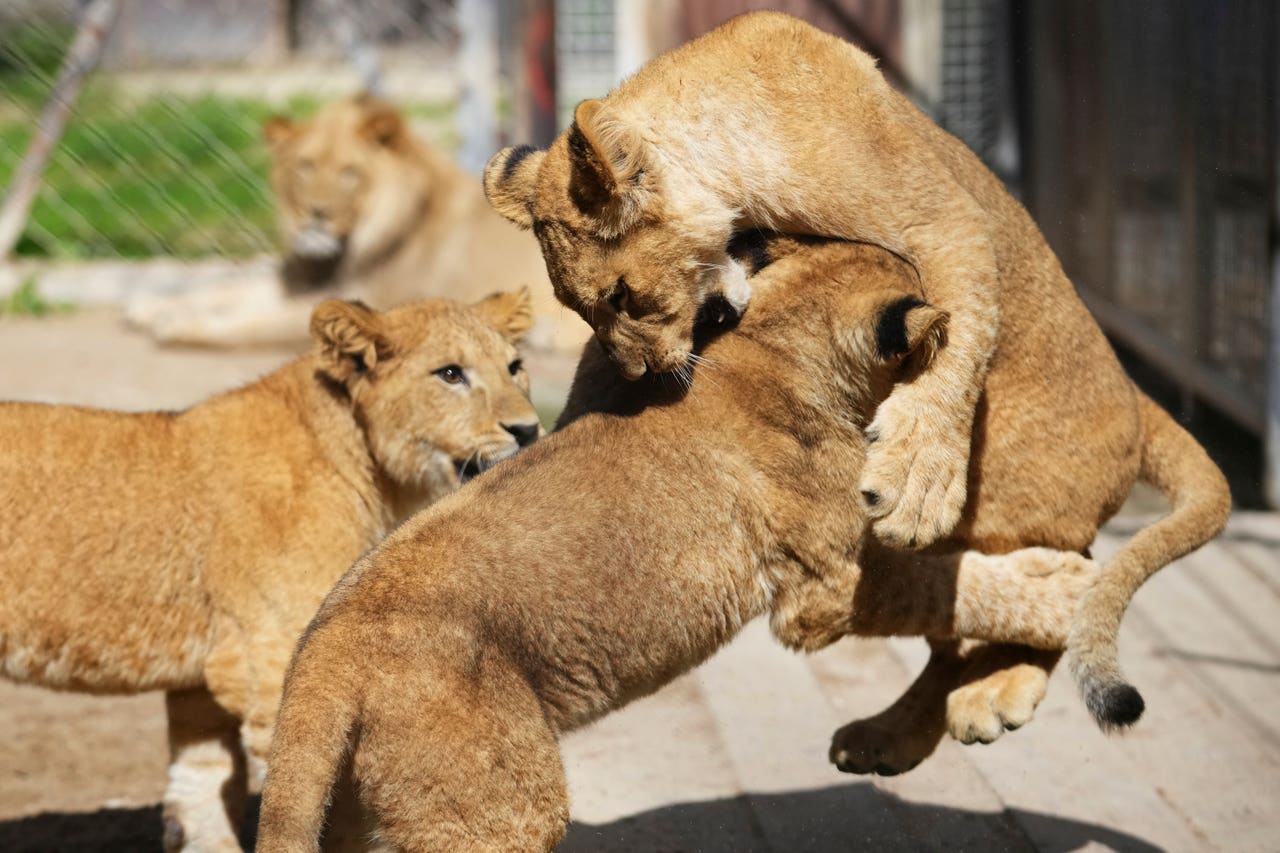
Three of the cubs playing at the zoo PA

Four new cubs of a rare lion species have been born in a European zoo

Fewer than 200 Barbary lions are estimated to live in captivity, and they’re extinct in the wild.

FOUR BARBARY LION cubs have been born in a Czech zoo, adding to a small surviving population of the rare lion which is extinct in the wild.

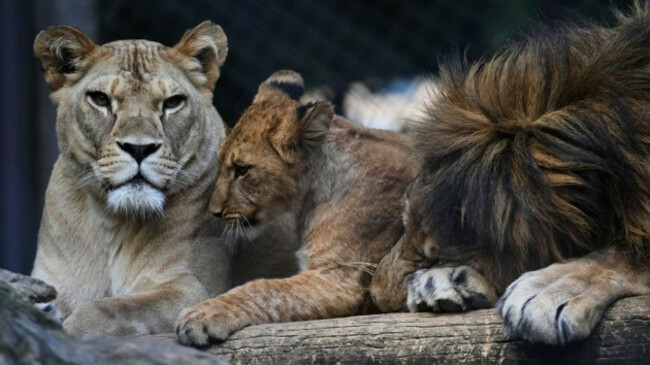
The three females and one male are currently living in the Dvur Kralove Safari Park, located about 140km north-east of Prague, under the watchful eyes of their parents, Khalila and Bart.

As they grow bigger, the cubs will be sent to other participating parks as part of an international endangered species programme which coordinates efforts for their survival in captivity.

Dvur Kralove Safari Park deputy director Jaroslav Hyjanek said that while preliminary steps have been taken for a possible reintroduction of the Barbary lion into its natural habitat, it is still a “far distant future”.

A member of the northern lion subspecies, the Barbary lion once roamed freely its native northern Africa, including the Atlas Mountains.

They were almost completely wiped out because of human activity. Many were killed by gladiators in Roman times, while overhunting and a loss of habitat contributed to their extinction in the wild later.

The last known photo of a wild lion was taken in 1925, and the last individual was killed in 1942.

It is believed the last small populations became extinct in the wild in the middle of the 1960s.

Fewer than 200 Barbary lions are estimated to live in captivity.

3f111b578afb49389fd4bdfcb5906b2b One of the cubs lying with its parents PA PA

Hyjanek said that after initial talks with Moroccan authorities, who have not rejected the idea of their reintroduction, a conference of experts has been planned to take place in Morocco to decide whether it would make sense to go ahead with such a plan in one of the national parks in the Atlas Mountains.

Any reintroduction would face numerous bureaucratic and other obstacles.

Since the lion has not been present in the environment for such a long time, the plans would have to ensure their protection, a sufficient prey population and co-operation and approval from local communities.

Hyjanek said such a move is still worth trying if it turns out to be sustainable.

“It’s important to have such a vision for any animal,” he said. “Without it, the existence of zoos wouldn’t make sense.”

Close
22 Comments
This is YOUR comments community. Stay civil, stay constructive, stay on topic. Please familiarise yourself with our comments policy here before taking part.
Leave a Comment
    Submit a report
    Please help us understand how this comment violates our community guidelines.
    Thank you for the feedback
    Your feedback has been sent to our team for review.

    Leave a commentcancel

     
    JournalTv
    News in 60 seconds