We need your help now

Support from readers like you keeps The Journal open.

You are visiting us because we have something you value. Independent, unbiased news that tells the truth. Advertising revenue goes some way to support our mission, but this year it has not been enough.

If you've seen value in our reporting, please contribute what you can, so we can continue to produce accurate and meaningful journalism. For everyone who needs it.

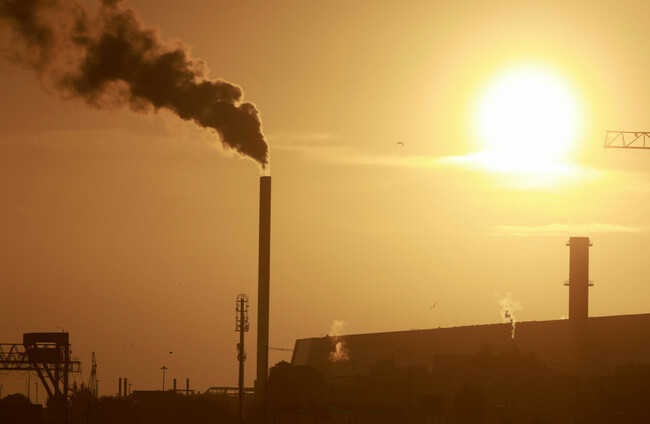
UN Sectretary-General Antonio Guterres said that "every key climate indicator is flashing red." Rolling News

UN warns planet is ‘in a state of emergency’ as global heat levels hit record high

A UN report found that the last 11 years were the hottest on record, with impacts set to last for centuries.

THE AMOUNT OF heat trapped by the Earth reached record levels in 2025, with the consequences of such warming feared to last for thousands of years, the UN has warned.

The 11 hottest years ever recorded were all between 2015 and 2025, the United Nations’ World Meteorological Organization (WMO) confirmed in its flagship State of the Global Climate annual report.

Last year was the second or third hottest year on record, at about 1.43 degrees above the 1850-1900 average, the WMO said.

UN Secretary-General Antonio Guterres said of the report that the global climate “is in a state of emergency”.

“Planet Earth is being pushed beyond its limits. Every key climate indicator is flashing red,” Guterres said.

“Humanity has just endured the 11 hottest years on record. When history repeats itself 11 times, it is no longer a coincidence. It is a call to act.”

For the first time, the WMO climate report includes the planet’s energy imbalance, the rate at which energy enters and leaves the Earth system.

Under a stable climate, incoming energy from the Sun is about the same as the amount of outgoing energy, the Geneva-based agency said.

However the increase in concentrations of heat-trapping greenhouse gases (carbon dioxide, methane and nitrous oxide) “to their highest level in at least 800,000 years” has “upset this equilibrium”, the WMO said.

“The Earth’s energy imbalance has increased since its observational record began in 1960, particularly in the past 20 years. It reached a new high in 2025.”

Ocean heat record

WMO chief Celeste Saulo said scientific advances had improved understanding of the energy imbalance and its implications for the climate.

“Human activities are increasingly disrupting the natural equilibrium and we will live with these consequences for hundreds and thousands of years,” Saulo said.

More than 91% of the excess heat is stored in the ocean.

“Ocean heat content reached a new record high in 2025 and its rate of warming more than doubled from 1960-2005 to 2005-2025,” the WMO said.

Ocean warming has far-reaching consequences, such as degradation of marine ecosystems, biodiversity loss and reduction of the ocean carbon sink, the agency said.

“It fuels tropical and subtropical storms and exacerbates ongoing sea-ice loss in the polar regions.”

The Antarctic and Greenland ice sheets have both lost considerable mass, and the annual average extent of Arctic sea ice in 2025 was the lowest or second-lowest ever recorded in the satellite era.

Last year, the global mean sea level was around 11 centimetres higher than when satellite altimetry records began in 1993.

Ocean warming and sea level rise are projected to continue for centuries.

‘Dire picture’

WMO scientific officer John Kennedy said global weather is still under the influence of La Nina, a naturally occurring climate phenomenon that cools surface temperatures in the central and eastern equatorial Pacific Ocean. It brings changes in winds, pressure and rainfall patterns.

Conditions oscillate between La Nina and its warming opposite El Nino, with neutral conditions in between.

The warmest year on record, 2024, was around 1.55C above the 1850-1900 average, and started in a strong El Nino.

Forecasts indicate neutral conditions by the middle of 2026 with a possible El Nino developing before the end of the year, said Kennedy.

If so, “then we’re likely to see maybe elevated temperatures again in 2027″, he told a press conference.

The WMO’s deputy chief, Ko Barrett, said the outlook was a “dire picture”.

She said the WMO provided the evidence it sees, hoping that the information “will encourage people to take action”.

But there was “no denying” that “these indicators are not moving in a direction that provides for a lot of hope”, she said.

With war gripping the Middle East and fuel prices soaring, Guterres said the world should heed the alarm call.

“In this age of war, climate stress is also exposing another truth: our addiction to fossil fuels is destabilising both the climate and global security,” Guterres said.

“Today’s report should come with a warning label: climate chaos is accelerating and delay is deadly.”

Unsure of what exactly is happening with the earth’s climate? Check out our FactCheck Knowledge Bank for essential reads and guides to finding good information online.

Author
View 73 comments
Close
73 Comments
This is YOUR comments community. Stay civil, stay constructive, stay on topic. Please familiarise yourself with our comments policy here before taking part.
Leave a Comment
    Submit a report
    Please help us understand how this comment violates our community guidelines.
    Thank you for the feedback
    Your feedback has been sent to our team for review.

    Leave a commentcancel

     
    JournalTv
    News in 60 seconds