We need your help now

Support from readers like you keeps The Journal open.

You are visiting us because we have something you value. Independent, unbiased news that tells the truth. Advertising revenue goes some way to support our mission, but this year it has not been enough.

If you've seen value in our reporting, please contribute what you can, so we can continue to produce accurate and meaningful journalism. For everyone who needs it.

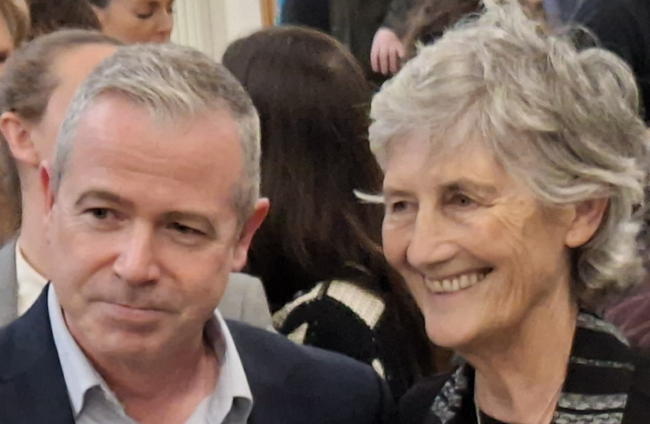
Pól Deeds, Northern Ireland's first Irish language commissioner, pictured here with then President-elect Catherine Connolly at the recent Oireachtas na Gaeilge festival in Belfast. Concubhar Ó Liatháin

Northern Ireland finally got an Irish Language Commissioner today - and he's going to be busy

A row over dual language signage at Grand Central Station and the non delivery of the NI Executive’s Irish language strategy are in his in-tray.

(Foireann Gaeltachta The Journal a chuir an scéal seo ar fáil. Tá leagan as Gaeilge anseo.) 

NORTHERN IRELAND’S FIRST ever Irish Language Commissioner has been urged not to be hamstrung by politicians as he takes up his job after a lengthy recruitment process and protracted negotiations.

Pól Deeds, the former Deputy Chief Executive of Foras na Gaeilge, began his five year term as the Irish Language Commissioner on an annual salary of £88,268 (€100,000) today, after the Northern Ireland Executive took over two months to approve his appointment following his name coming into the public domain.

And he hit the ground running by expressing his opinion on one of the most contentious Irish language issues of the moment.  In an interview with RTÉ, the new Irish Language Commissioner said: 

There should be bilingual signage in Grand Central Station. That is just adhering to the best international advice which says that minority languages need to be visible in order to ensure their survival and that they thrive.

The position of Irish Language Commissione had been provided for in the New Decade, New Approach agreement reached between the British and Irish Governments and the Northern parties in January 2020, a deal which allowed for the restoration of the powersharing executive after three years of suspension.

One of the reasons the power-sharing institutions collapsed in 2017 was a row over the withdrawal of funding amounting to £50,000 (€56,819) by the then Communities Minister, Paul Givan of the DUP, for a scheme which supported schoolchildren from Northern Ireland travelling to the Donegal Gaeltacht for summer courses learning Irish.

The protracted negotiations which led to the re-establishment of the North’s power-sharing Executive were centred on achieving an agreement on the demand for an Irish Language Act from nationalists and the resistance to such a demand from unionists.

New journey for Irish in the North

In advance of the commissioner’s first day, Conradh na Gaeilge issued a statement in which the organisation’s president, Ciarán Mac Giolla Bhéin,  heralded the start of a ‘new journey’ for the Irish language community in the North.

Mac Giolla Bhéin also called on the Commissioner to exercise functions independently of the Office of the First Minister and Deputy First Minister (OFMDFM) which the Irish language organisation believes could have a “transformative effect” on the community in Northern Ireland. 

Conradh na Gaeilge said that the office of the Irish Language Commissioner “was a fundamental element of the Identity and Language Act passed in Westminster in December 2022″.

“The legislation sets out that the Irish Language Commissioner has the functions of ‘giving advice, support and guidance to public authorities in relation to the use of the Irish language’

“According to the legislation, it will be up to the Commissioner alone to carry out that function, but that function does not require ‘the consent of the First and Deputy First Ministers’, as is the case for the agreement of language standards.

“In addition to all of this, the Irish Language Commissioner will have duties to investigate any complaints from the public regarding the failure of any of the public authorities to implement those language standards.”

In the statement, Mac Giolla Bhéin referred to the campaigning and struggle that the Irish language community in the North has endured to this day and said that the legislation wasn’t the final destination for the campaign.

We are finally at a point where we have Irish language legislation that, despite its faults, gives the language a legal foothold here in the north for the very first time.

“Whilst this legislation is not our final destination, and falls short of what was set out in the St Andrew’s Agreement, it is a hugely significant milestone,” he said.

“Today we begin a new chapter in our long-running campaign for language rights and equality, as the very first Irish Language Commissioner in the history of the state takes up office. 

“We look forward to immediately engaging with the new Commissioner and her functions in the legislation and we have high expectations as a community that through this Office the equality that has been promised to us over the years will be achieved.”

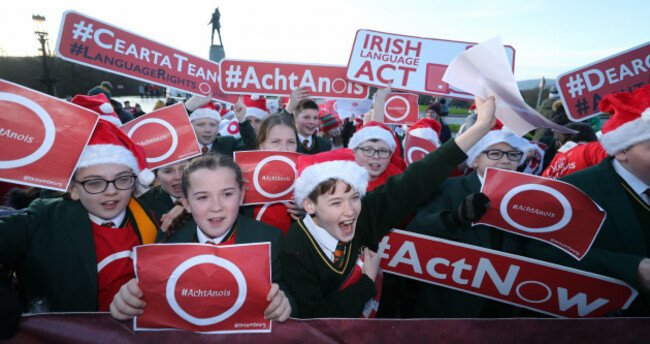
campaigners-for-an-irish-language-act-protest-outside-parliament-buildings-as-talks-to-restore-the-northern-ireland-powersharing-executive-begin-at-stormont-in-belfast Irish language activists and speakers have been campaigning for decades for fair treatment in Northern Ireland. Alamy Stock Photo Alamy Stock Photo

Mac Giolla Bhéin said that there had been “a lot of talk” about the power of the Office of the First Minister and the Deputy First Minister to stop policies if they did not agree with them.

Irish Times columnist Newton Emerson and an editorial on the Irish language website, Tuairisc, have suggested that the terms of the appointment meant that the DUP could veto proposals from the Irish language commissioner and that it would be a constant battle to get proposed measures implemented. 

The Conradh na Gaeilge president addressed this concern in his statement.

We have heard much talk, and condemnation, of an Executive Office ‘veto’ pertaining to the approval of the Commissioner’s ‘best practice standards’, and we anticipate those political decisions will be a litmus test of the fundamental implementation of the Act at that juncture.

“That big test will come soon when the Commissioner’s recommendations on standards are prepared.”

Busy agenda

The in-tray of the Irish Language Commissioner will be overflowing with issues relating to signage and a proposed strategy for the Irish language which the Executive is supposed to produce.

During a recent court case being taken by loyalist activist Jamie Bryson against an order by Sinn Féin’s Infrastructure Minister Liz Kimmins that there should be bilingual signage in Irish and English at the new train and public transport station in central Belfast, Grand Central. it was suggested that the matter be added to the in-tray of the Irish Language Commissioner who was yet to be appointed at that stage.

Conradh na Gaeilge has obtained a third judicial review because the Executive has consistently failed to agree a strategy for the advancement of the Irish language due to the DUP’s refusal to accept it.

Mac Giolla Bhéin said it was important that the Commissioner carried out the functions that did not require the approval of the Office of the First Minister and Deputy First Minister.

“These functions would make a transformative difference to the passive, often oppressive, approach to Irish language provision by the state.”

Former senior DUP councillor Lee Reynolds has been appointed Commissioner for Britonism and Ulster-Scots. He took up his role a week ago. The Irish Language Commissioner was due to start on the same day but due to a pre-arranged holiday, his first day was postponed for a week..

It remains to be seen how the Irish Language Commissioner will meet the demands that will be coming his way from all sides as he begins his term.

The Journal’s Gaeltacht initiative is supported by the Local Democracy Reporting Scheme

Readers like you are keeping these stories free for everyone...
A mix of advertising and supporting contributions helps keep paywalls away from valuable information like this article. Over 5,000 readers like you have already stepped up and support us with a monthly payment or a once-off donation.

Close
Comments
This is YOUR comments community. Stay civil, stay constructive, stay on topic. Please familiarise yourself with our comments policy here before taking part.
Leave a Comment
    Submit a report
    Please help us understand how this comment violates our community guidelines.
    Thank you for the feedback
    Your feedback has been sent to our team for review.

    Leave a commentcancel

     
    JournalTv
    News in 60 seconds